Exam-Style Problems
⬅ Back to SubchapterNov 2022 p13 q5
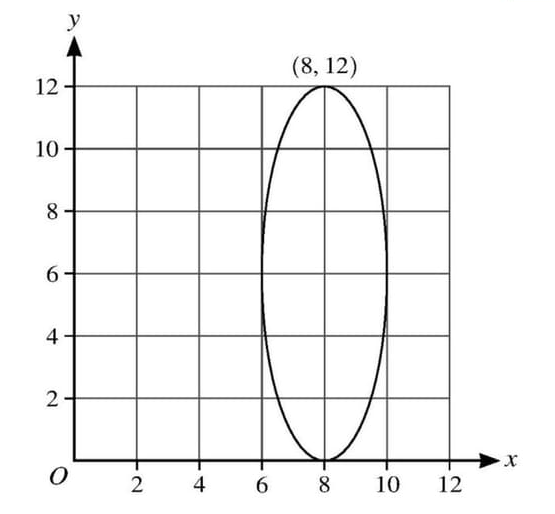
The diagram shows a curve which has a maximum point at (8, 12) and a minimum point at (8, 0). The curve is the result of applying a combination of two transformations to a circle. The first transformation applied is a translation of \(\begin{pmatrix} 7 \\ -3 \end{pmatrix}\). The second transformation applied is a stretch in the y-direction.
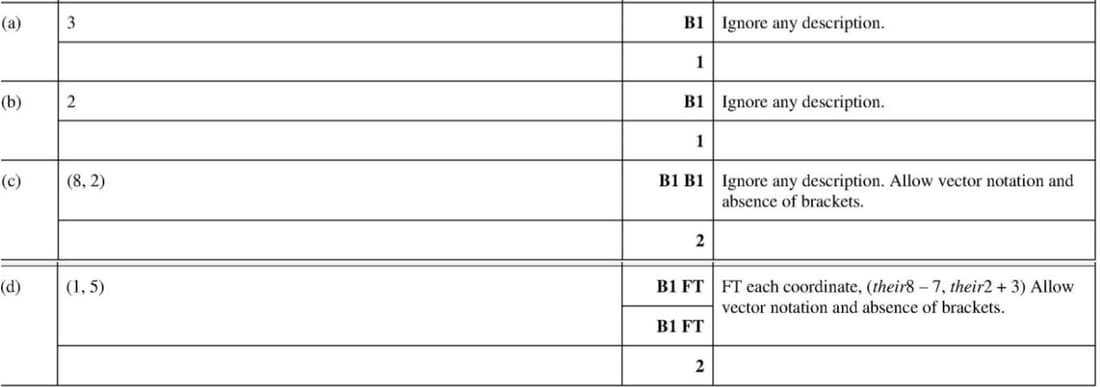
(a) State the scale factor of the stretch.
(b) State the radius of the original circle.
(c) State the coordinates of the centre of the circle after the translation has been completed but before the stretch is applied.
(d) State the coordinates of the centre of the original circle.
Nov 2022 p12 q5
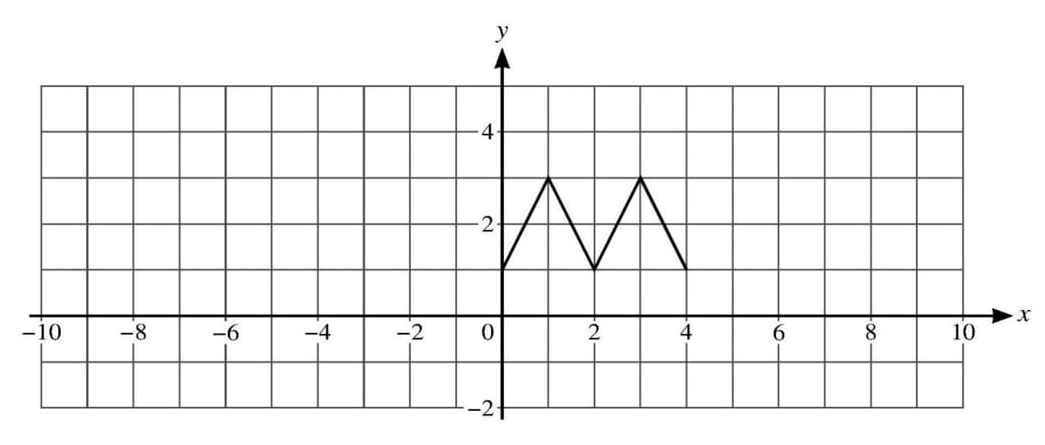
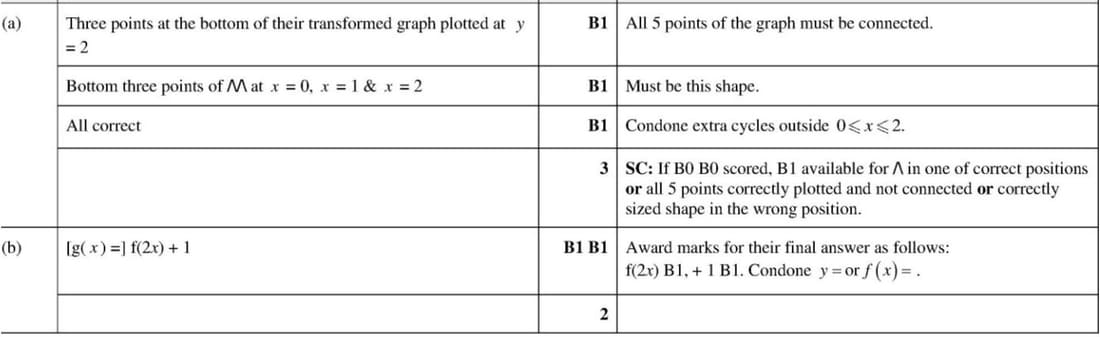
The graph with equation \(y = f(x)\) is transformed to the graph with equation \(y = g(x)\) by a stretch in the \(x\)-direction with factor 0.5, followed by a translation of \(\begin{pmatrix} 0 \\ 1 \end{pmatrix}\).
(a) The diagram below shows the graph of \(y = f(x)\). On the diagram sketch the graph of \(y = g(x)\).
(b) Find an expression for \(g(x)\) in terms of \(f(x)\).
Nov 2022 p11 q9
Functions f and g are both defined for \(x \in \mathbb{R}\) and are given by
\(f(x) = x^2 - 4x + 9,\)
\(g(x) = 2x^2 + 4x + 12.\)
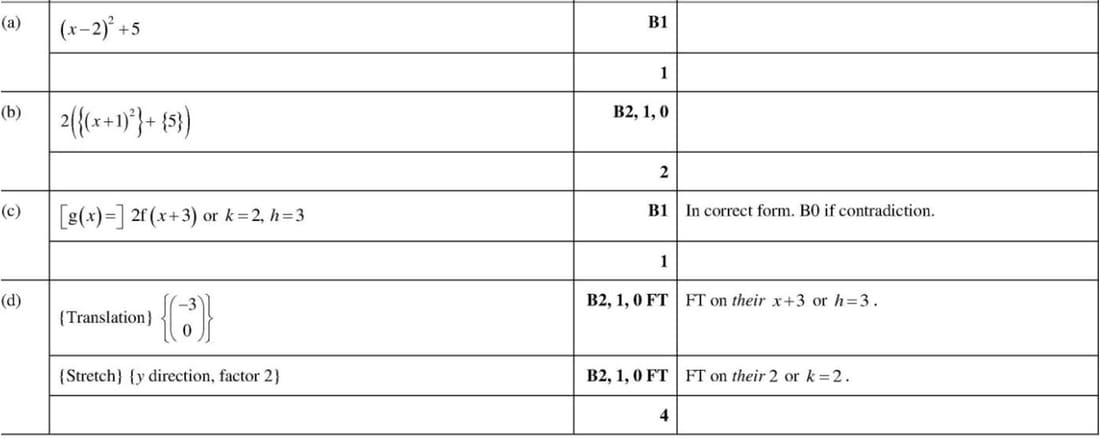
(a) Express \(f(x)\) in the form \((x-a)^2 + b.\) [1]
(b) Express \(g(x)\) in the form \(2[(x+c)^2 + d].\) [2]
(c) Express \(g(x)\) in the form \(kf(x+h),\) where \(k\) and \(h\) are integers. [1]
(d) Describe fully the two transformations that have been combined to transform the graph of \(y = f(x)\) to the graph of \(y = g(x).\) [4]
June 2022 p13 q4
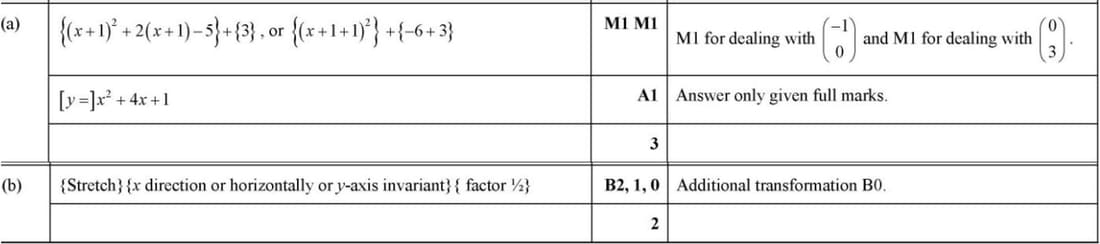
(a) The curve with equation \(y = x^2 + 2x - 5\) is translated by \(\begin{pmatrix} -1 \\ 3 \end{pmatrix}\). Find the equation of the translated curve, giving your answer in the form \(y = ax^2 + bx + c\).
(b) The curve with equation \(y = x^2 + 2x - 5\) is transformed to a curve with equation \(y = 4x^2 + 4x - 5\). Describe fully the single transformation that has been applied.