Exam-Style Problems
⬅ Back to SubchapterNov 2015 p13 q8
The function f is defined by \(f(x) = 3x + 1\) for \(x \leq a\), where \(a\) is a constant. The function g is defined by \(g(x) = -1 - x^2\) for \(x \leq -1\).
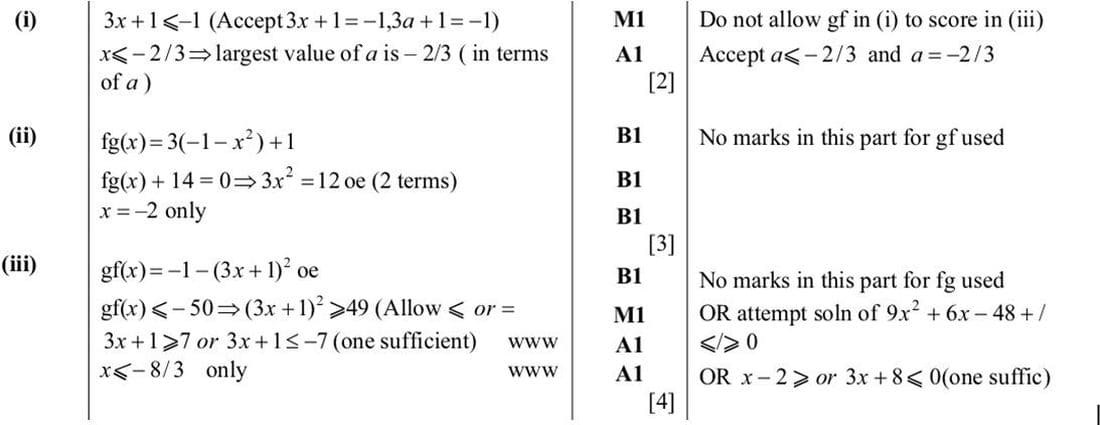
(i) Find the largest value of \(a\) for which the composite function \(gf\) can be formed.
For the case where \(a = -1\),
(ii) solve the equation \(fg(x) + 14 = 0\),
(iii) find the set of values of \(x\) which satisfy the inequality \(gf(x) \leq -50\).
Nov 2015 p12 q8
The function \(f\) is defined, for \(x \in \mathbb{R}\), by \(f : x \mapsto x^2 + ax + b\), where \(a\) and \(b\) are constants.
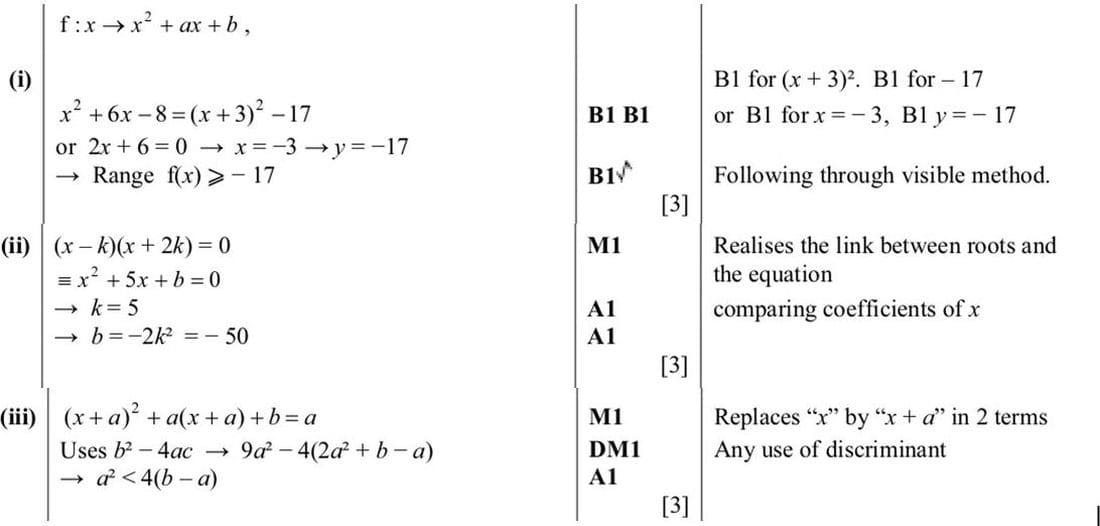
(i) In the case where \(a = 6\) and \(b = -8\), find the range of \(f\).
(ii) In the case where \(a = 5\), the roots of the equation \(f(x) = 0\) are \(k\) and \(-2k\), where \(k\) is a constant. Find the values of \(b\) and \(k\).
(iii) Show that if the equation \(f(x+a) = a\) has no real roots, then \(a^2 < 4(b-a)\).
June 2015 p13 q6
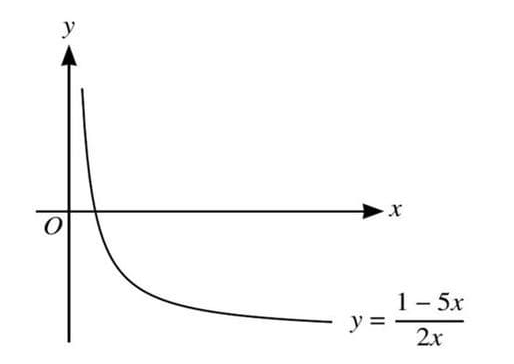
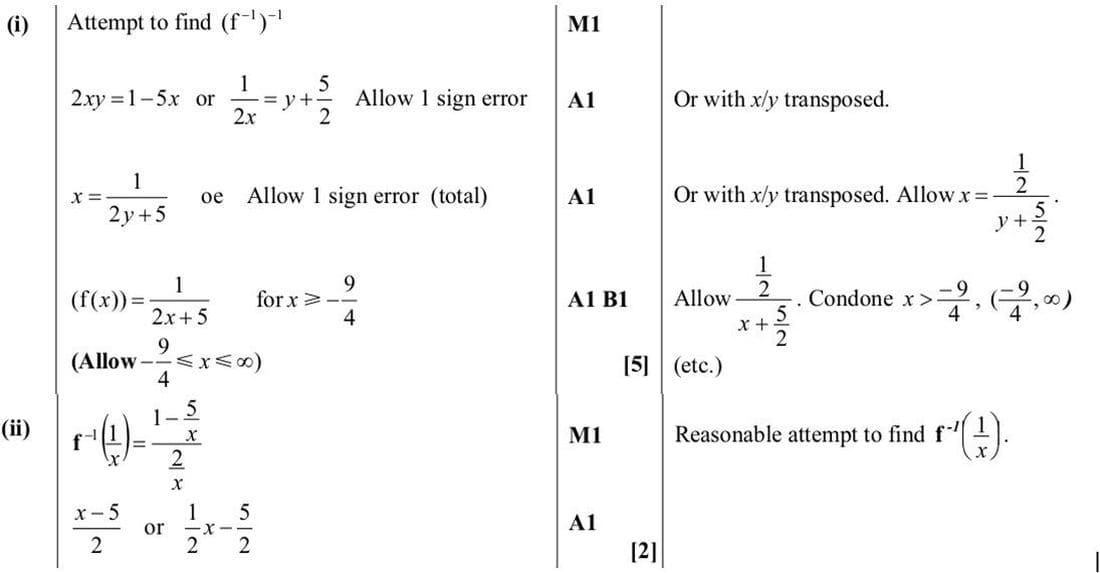
The diagram shows the graph of \(y = f^{-1}(x)\), where \(f^{-1}\) is defined by \(f^{-1}(x) = \frac{1 - 5x}{2x}\) for \(0 < x \leq 2\).
(i) Find an expression for \(f(x)\) and state the domain of \(f\).
(ii) The function \(g\) is defined by \(g(x) = \frac{1}{x}\) for \(x \geq 1\). Find an expression for \(f^{-1}g(x)\), giving your answer in the form \(ax + b\), where \(a\) and \(b\) are constants to be found.
Nov 2014 p13 q10
The functions f and g are defined for \(x \geq 0\) by
\(f : x \mapsto (ax + b)^{\frac{1}{3}}\), where \(a\) and \(b\) are positive constants,
\(g : x \mapsto x^2\).
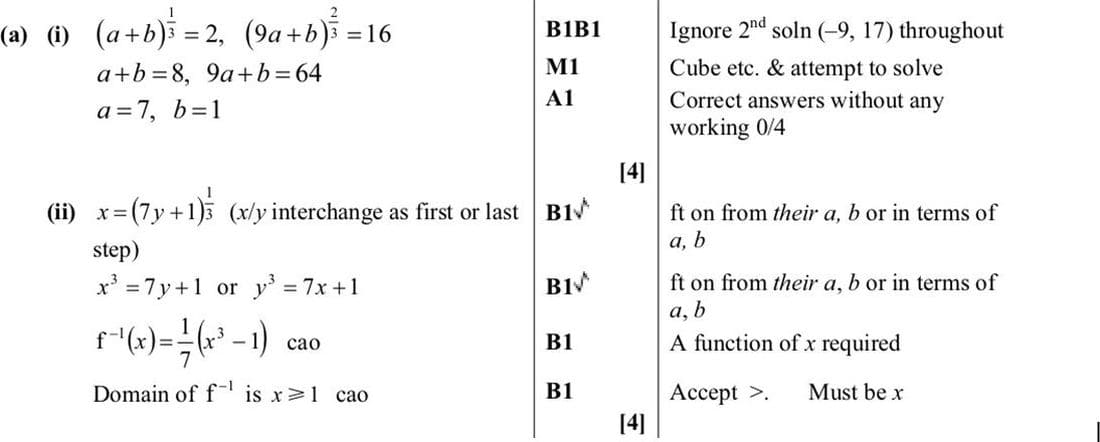
Given that \(fg(1) = 2\) and \(gf(9) = 16\),
- calculate the values of \(a\) and \(b\),
- obtain an expression for \(f^{-1}(x)\) and state the domain of \(f^{-1}\).
Nov 2014 p11 q10
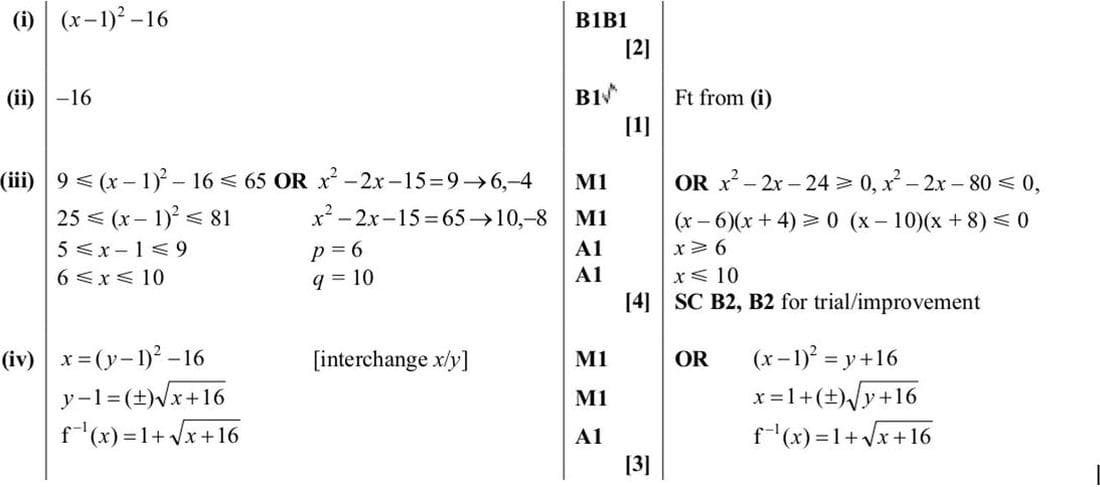
(i) Express \(x^2 - 2x - 15\) in the form \((x + a)^2 + b\).
The function \(f\) is defined for \(p \leq x \leq q\), where \(p\) and \(q\) are positive constants, by \(f : x \mapsto x^2 - 2x - 15\).
The range of \(f\) is given by \(c \leq f(x) \leq d\), where \(c\) and \(d\) are constants.
(ii) State the smallest possible value of \(c\).
For the case where \(c = 9\) and \(d = 65\),
(iii) find \(p\) and \(q\),
(iv) find an expression for \(f^{-1}(x)\).