Exam-Style Problems
⬅ Back to SubchapterNov 2019 p11 q7
Functions f and g are defined by
\(f : x \mapsto \frac{3}{2x+1}\) for \(x > 0\),
\(g : x \mapsto \frac{1}{x} + 2\) for \(x > 0\).
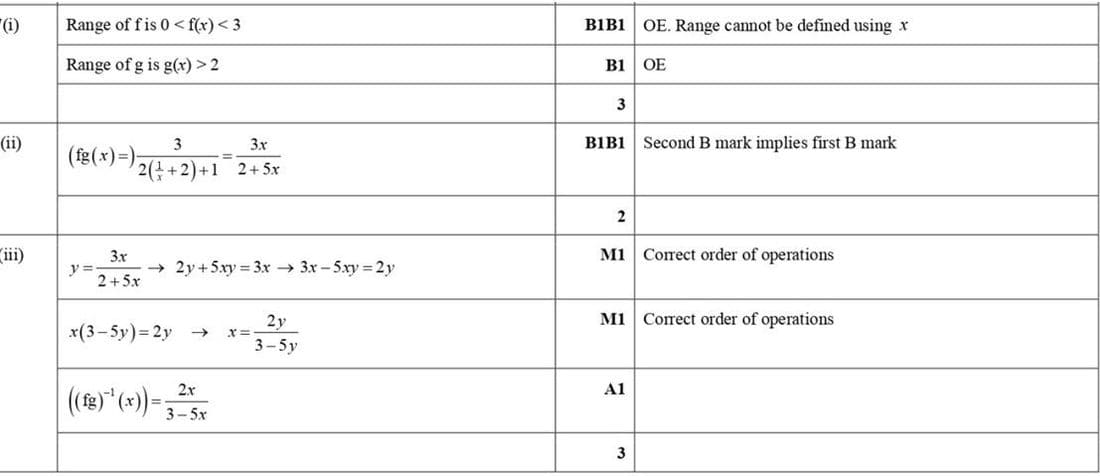
(i) Find the range of \(f\) and the range of \(g\).
(ii) Find an expression for \(fg(x)\), giving your answer in the form \(\frac{ax}{bx+c}\), where \(a, b\) and \(c\) are integers.
(iii) Find an expression for \((fg)^{-1}(x)\), giving your answer in the same form as for part (ii).
June 2019 p12 q7
Functions f and g are defined by
\(f : x \mapsto 3x - 2, \; x \in \mathbb{R},\)
\(g : x \mapsto \frac{2x + 3}{x - 1}, \; x \in \mathbb{R}, \; x \neq 1.\)
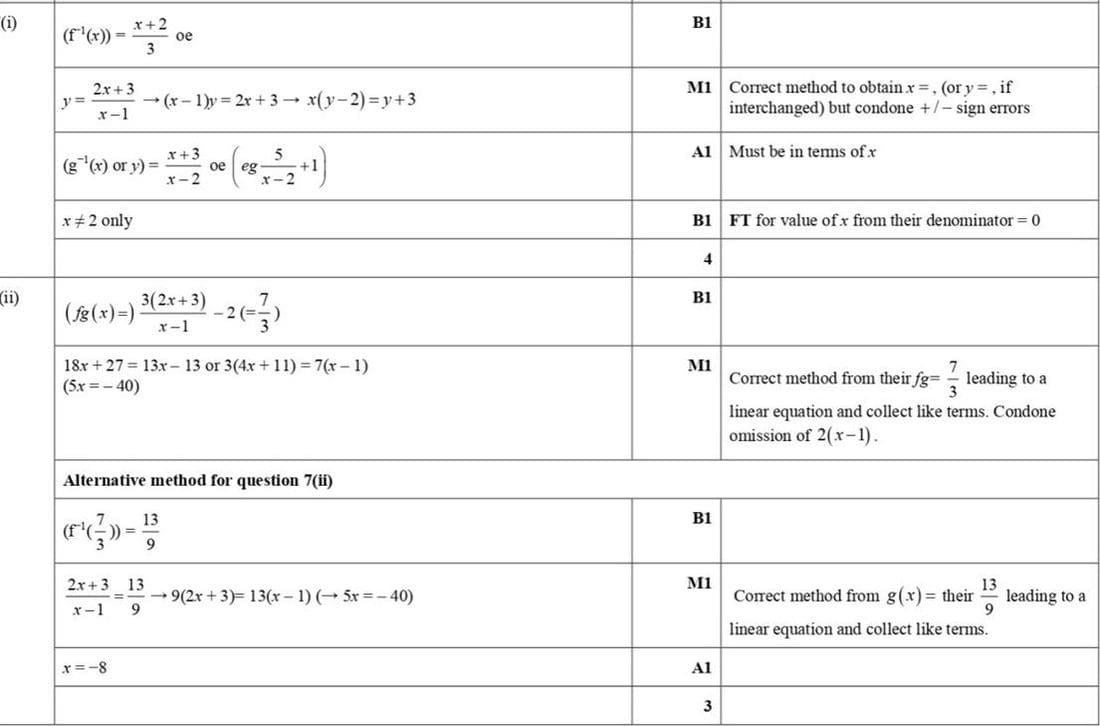
(i) Obtain expressions for \(f^{-1}(x)\) and \(g^{-1}(x)\), stating the value of \(x\) for which \(g^{-1}(x)\) is not defined.
(ii) Solve the equation \(fg(x) = \frac{7}{3}.\)
June 2019 p11 q5
The function \(f\) is defined by \(f(x) = -2x^2 + 12x - 3\) for \(x \in \mathbb{R}\).
(i) Express \(-2x^2 + 12x - 3\) in the form \(-2(x+a)^2 + b\), where \(a\) and \(b\) are constants.
(ii) State the greatest value of \(f(x)\).
The function \(g\) is defined by \(g(x) = 2x + 5\) for \(x \in \mathbb{R}\).
(iii) Find the values of \(x\) for which \(gf(x) + 1 = 0\).

Feb/Mar 2019 p12 q8
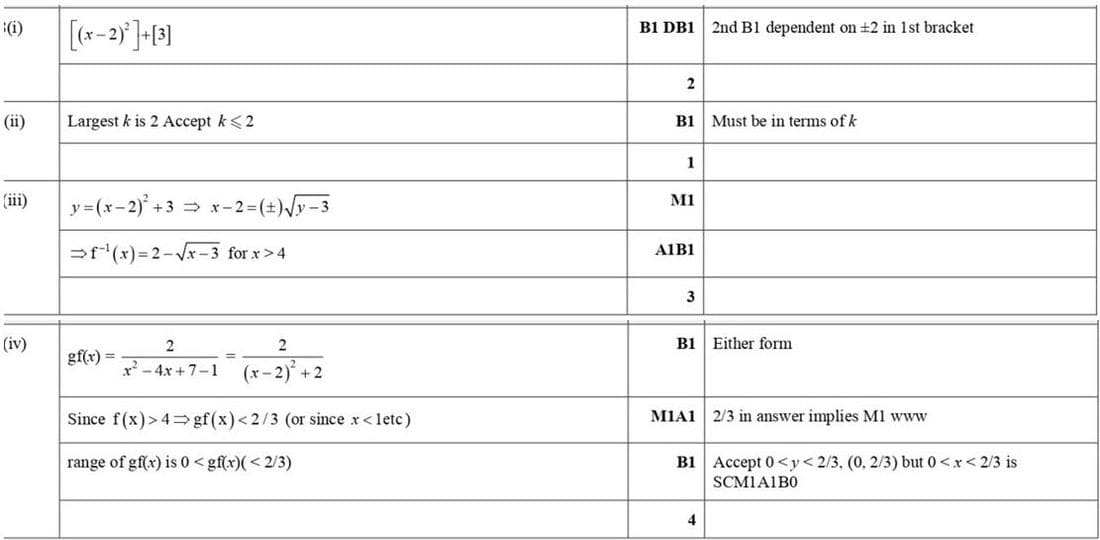
(i) Express \(x^2 - 4x + 7\) in the form \((x + a)^2 + b\).
The function \(f\) is defined by \(f(x) = x^2 - 4x + 7\) for \(x < k\), where \(k\) is a constant.
(ii) State the largest value of \(k\) for which \(f\) is a decreasing function.
The value of \(k\) is now given to be 1.
(iii) Find an expression for \(f^{-1}(x)\) and state the domain of \(f^{-1}\).
(iv) The function \(g\) is defined by \(g(x) = \frac{2}{x-1}\) for \(x > 1\). Find an expression for \(gf(x)\) and state the range of \(gf\).
Nov 2017 p13 q6
The functions f and g are defined by
\(f(x) = \frac{2}{x^2 - 1}\) for \(x < -1\),
\(g(x) = x^2 + 1\) for \(x > 0\).
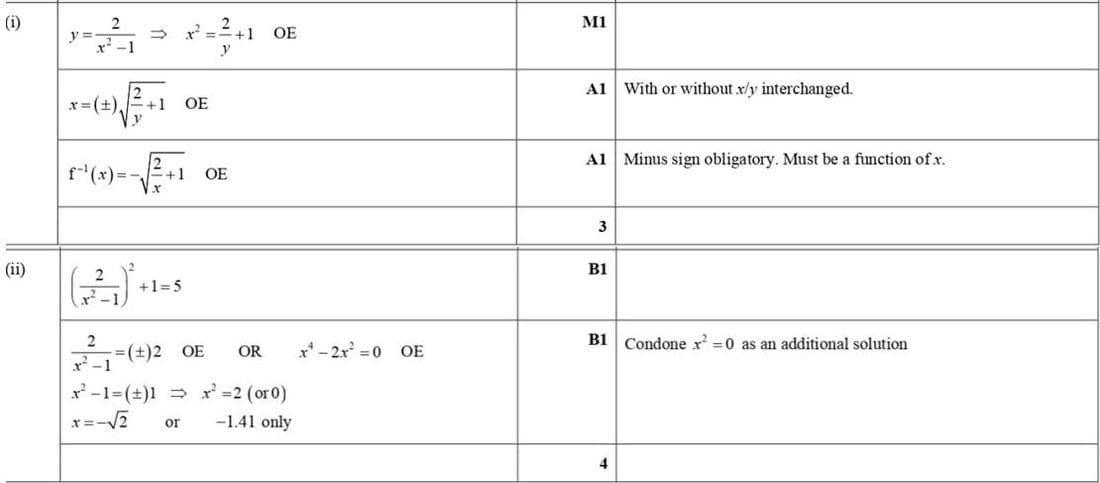
(i) Find an expression for \(f^{-1}(x)\).
(ii) Solve the equation \(gf(x) = 5\).