Exam-Style Problems
⬅ Back to SubchapterFM November 2022 p11 q02
4247
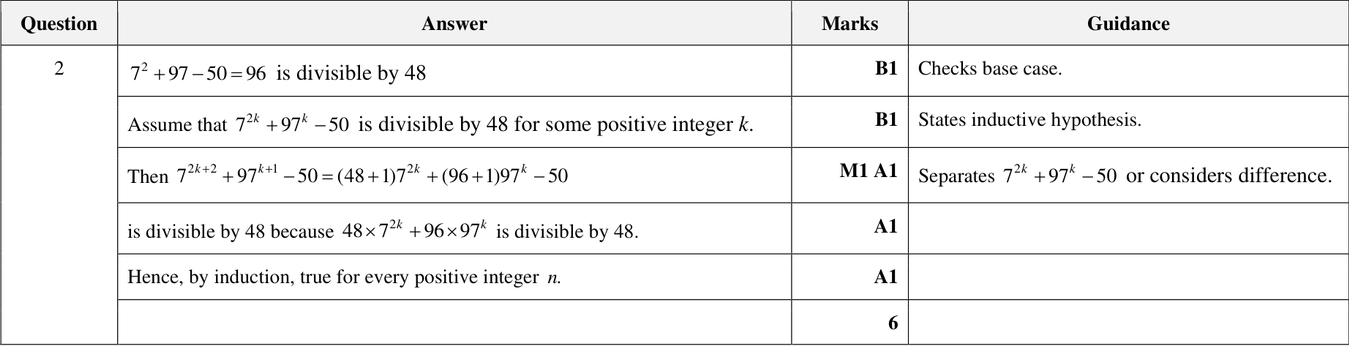
Prove by mathematical induction that, for all positive integers n, \(7^{2n} + 97^n - 50\) is divisible by 48. [6]
FM November 2022 p11 q03
4248
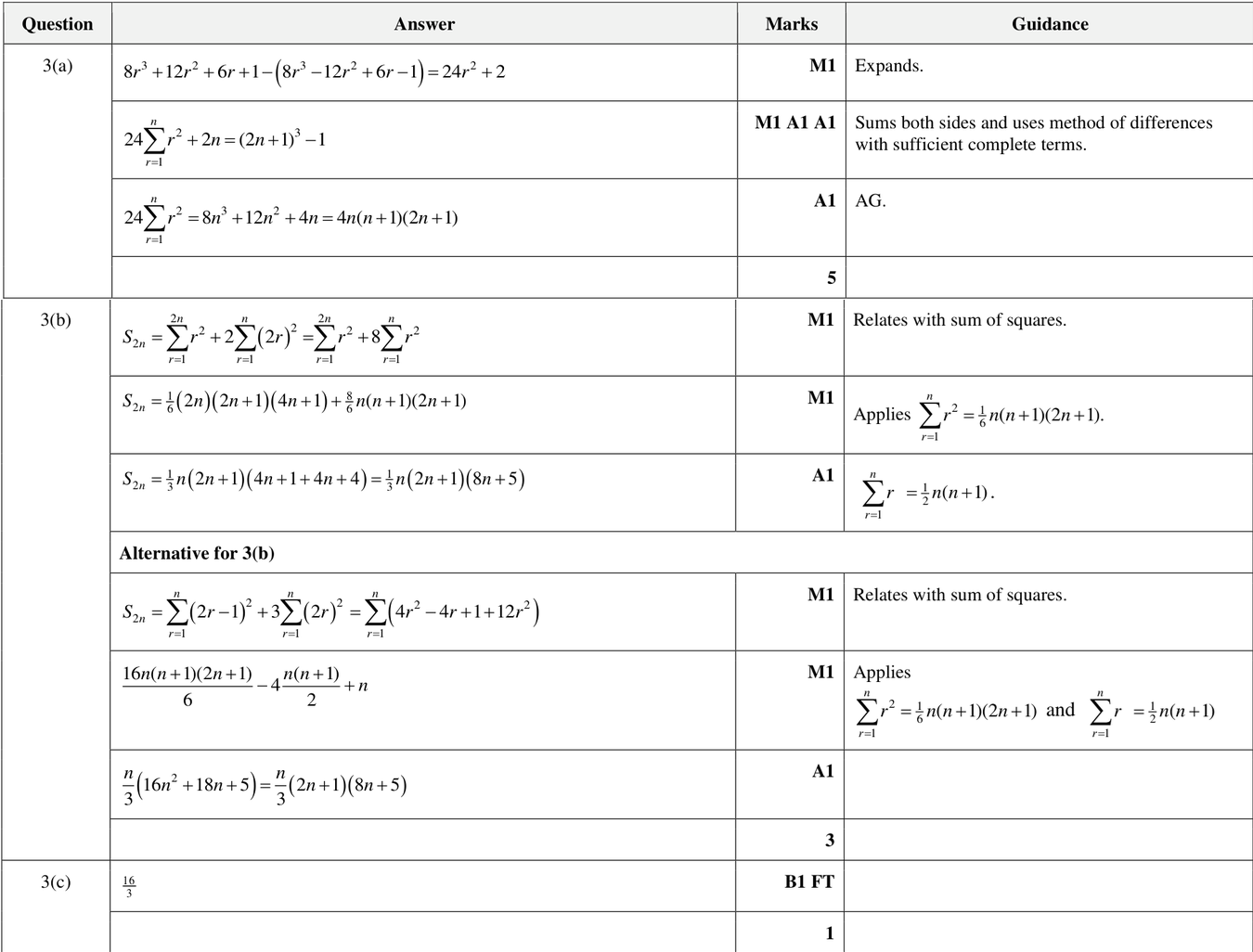
(a) By considering \((2r+1)^3 - (2r-1)^3\), use the method of differences to prove that \(\sum_{r=1}^{n} r^2 = \frac{1}{6}n(n+1)(2n+1)\).
Let \(S_n = 1^2 + 3 \times 2^2 + 3^2 + 3 \times 4^2 + 5^2 + 3 \times 6^2 + \ldots + \left(2 + (-1)^n\right)n^2\).
(b) Show that \(S_{2n} = \frac{1}{3}n(2n+1)(an+b)\), where \(a\) and \(b\) are integers to be determined.
(c) State the value of \(\lim_{n \to \infty} \frac{S_{2n}}{n^3}\).
FM November 2022 p11 q04
4249
The plane \(\Pi\) contains the lines \(\mathbf{r} = 3\mathbf{i} - 2\mathbf{j} + \mathbf{k} + \lambda(-\mathbf{i} + 2\mathbf{j} + \mathbf{k})\) and \(\mathbf{r} = 4\mathbf{i} + 4\mathbf{j} + 2\mathbf{k} + \mu(3\mathbf{i} + 2\mathbf{j} - \mathbf{k})\).
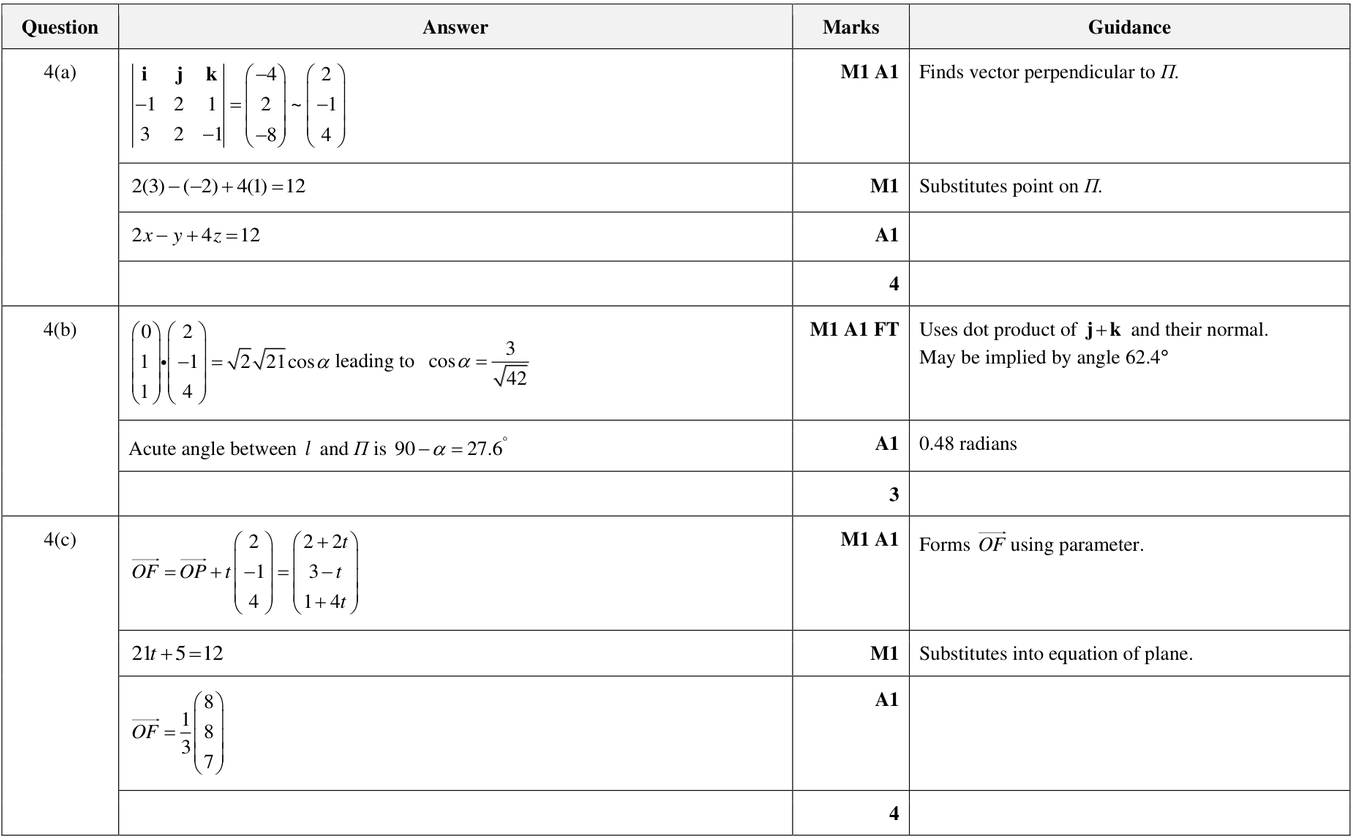
(a) Find a Cartesian equation of \(\Pi\), giving your answer in the form \(ax + by + cz = d\). [4]
The line \(l\) passes through the point \(P\) with position vector \(2\mathbf{i} + 3\mathbf{j} + \mathbf{k}\) and is parallel to the vector \(\mathbf{j} + \mathbf{k}\).
(b) Find the acute angle between \(l\) and \(\Pi\). [3]
(c) Find the position vector of the foot of the perpendicular from \(P\) to \(\Pi\). [4]
FM November 2022 p11 q05
4250
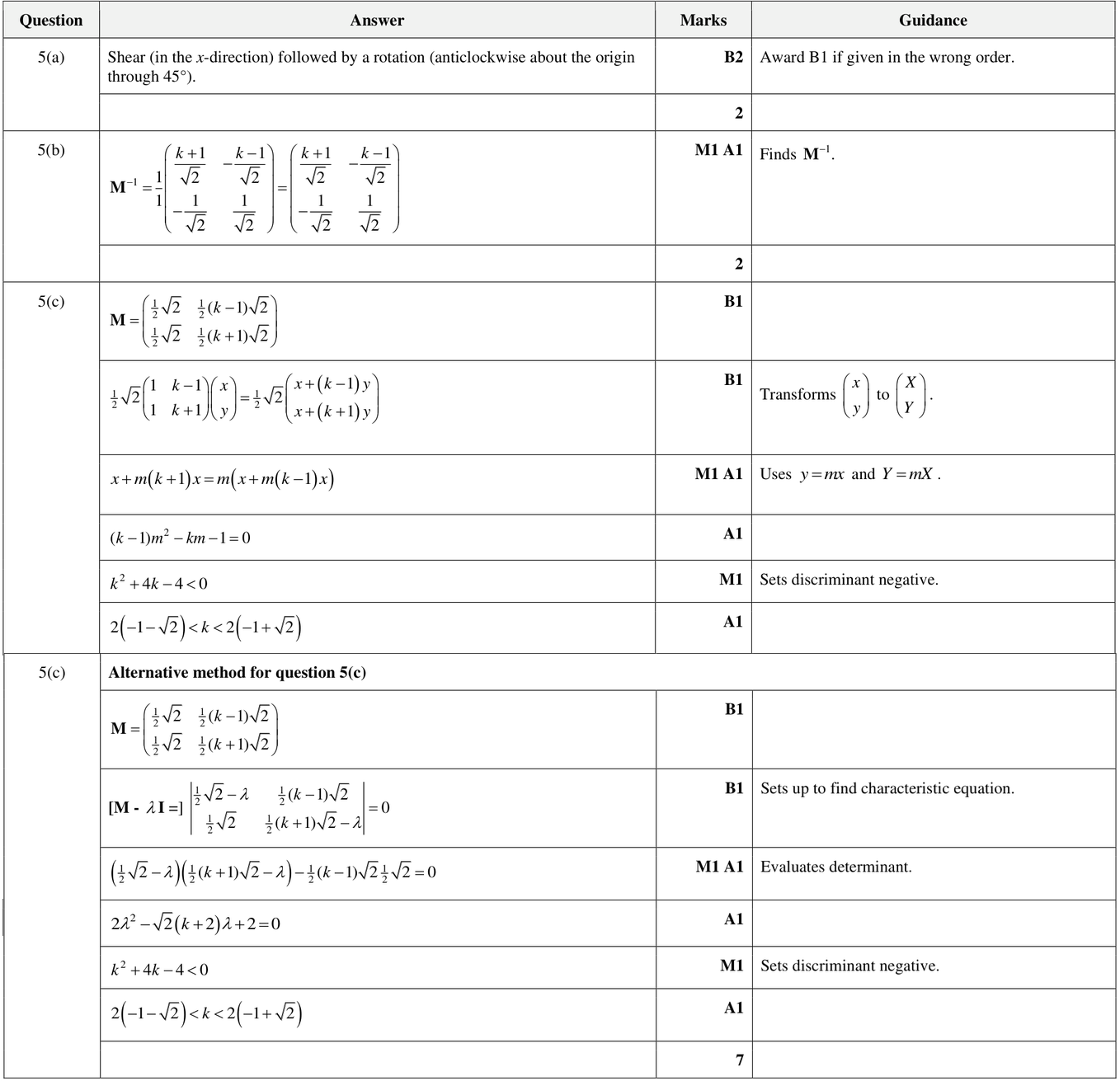
The matrix M is given by \(M = \begin{pmatrix} \frac{1}{2}\sqrt{2} & -\frac{1}{2}\sqrt{2} \\ \frac{1}{2} & \frac{1}{2}\sqrt{2} \end{pmatrix} \begin{pmatrix} 1 & k \\ 0 & 1 \end{pmatrix}\), where \(k\) is a constant.
(a) The matrix M represents a sequence of two geometrical transformations. State the type of each transformation, and make clear the order in which they are applied.
(b) The triangle ABC in the \(x-y\) plane is transformed by M onto triangle DEF. Find, in terms of \(k\), the single matrix which transforms triangle DEF onto triangle ABC.
(c) Find the set of values of \(k\) for which the transformation represented by M has no invariant lines through the origin.
FM November 2022 p11 q06
4251
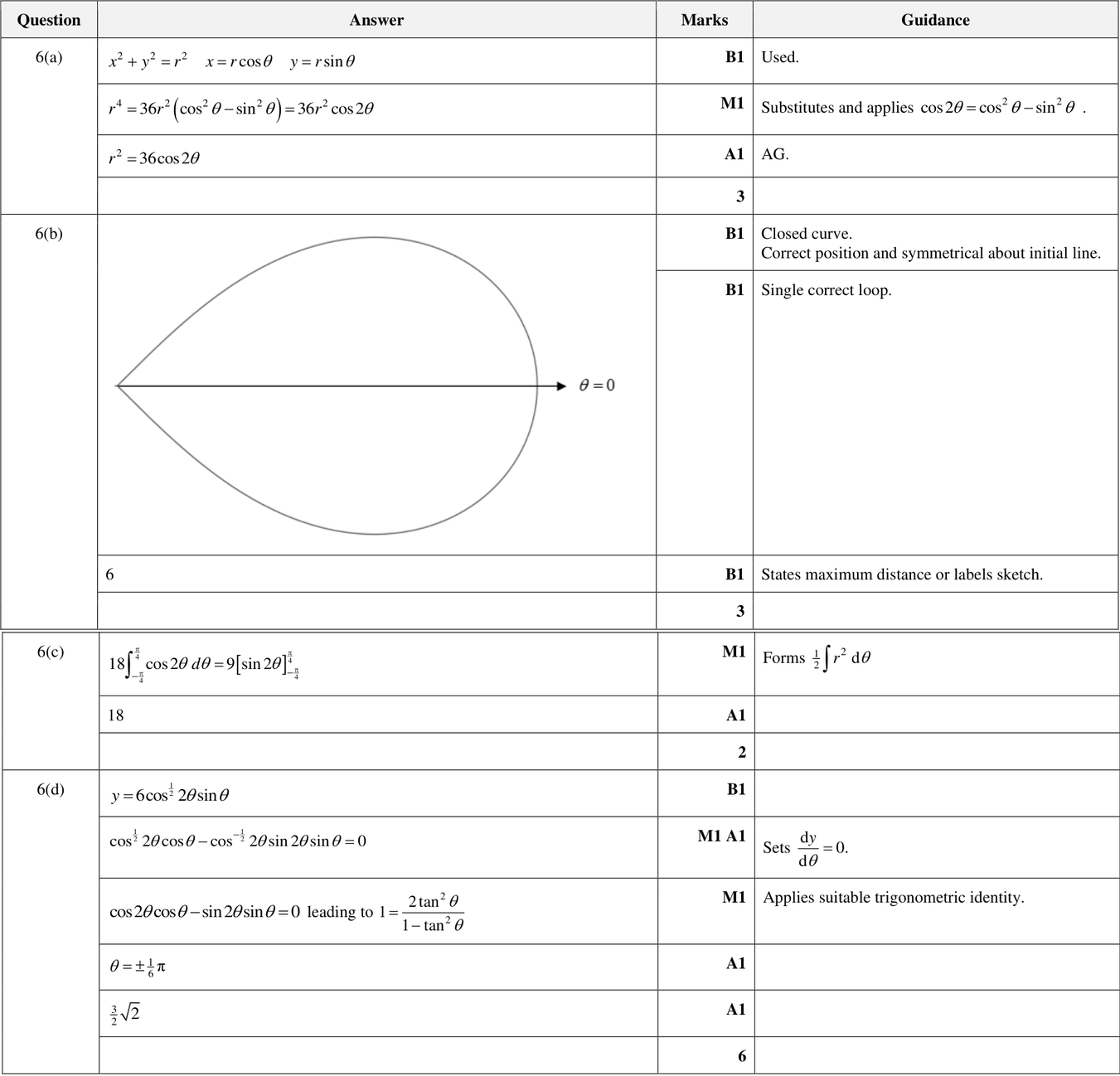
(a) Show that the curve with Cartesian equation \((x^2 + y^2)^2 = 36(x^2 - y^2)\) has polar equation \(r^2 = 36 \cos 2\theta\).
The curve \(C\) has polar equation \(r^2 = 36 \cos 2\theta\), for \(-\frac{1}{4}\pi \leq \theta \leq \frac{1}{4}\pi\).
(b) Sketch \(C\) and state the maximum distance of a point on \(C\) from the pole.
(c) Find the area of the region enclosed by \(C\).
(d) Find the maximum distance of a point on \(C\) from the initial line, giving the answer in exact form.