Exam-Style Problems
⬅ Back to SubchapterFM June 2025 p13 q02
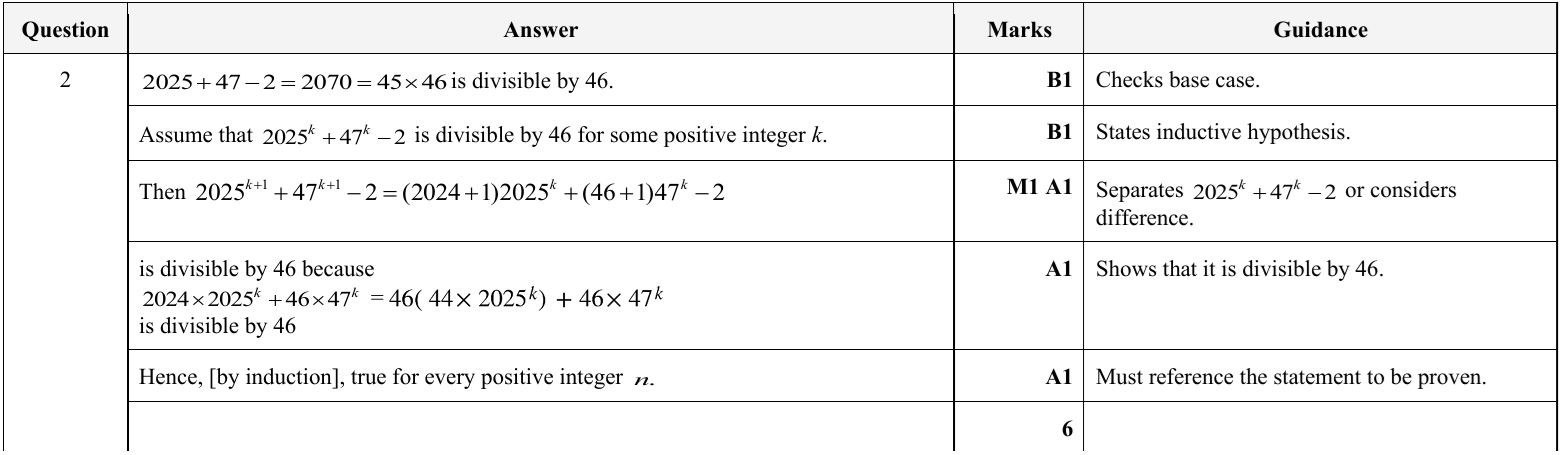
Prove by mathematical induction that \(2025^n + 47^n - 2\) is divisible by 46 for all positive integers \(n\).
FM June 2025 p13 q03
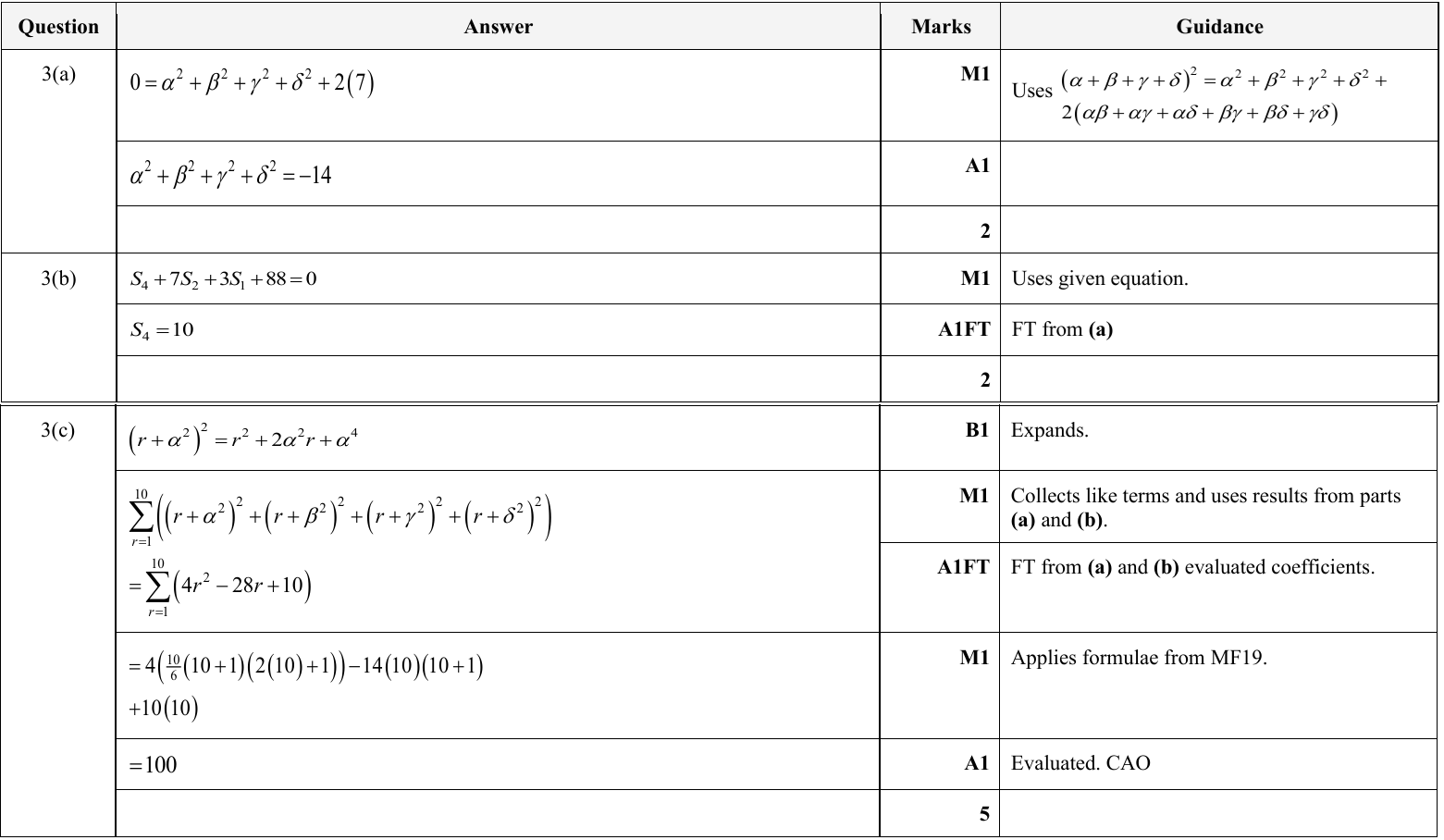
The quartic equation \(x^4 + 7x^2 + 3x + 22 = 0\) has roots \(\alpha, \beta, \gamma, \delta\).
(a) Find the value of \(\alpha^2 + \beta^2 + \gamma^2 + \delta^2\).
(b) Find the value of \(\alpha^4 + \beta^4 + \gamma^4 + \delta^4\).
(c) Use standard results from the list of formulae (MF19) to find the value of \(\sum_{r=1}^{10} ((\alpha^2 + r)^2 + (\beta^2 + r)^2 + (\gamma^2 + r)^2 + (\delta^2 + r)^2)\).
FM June 2025 p13 q04
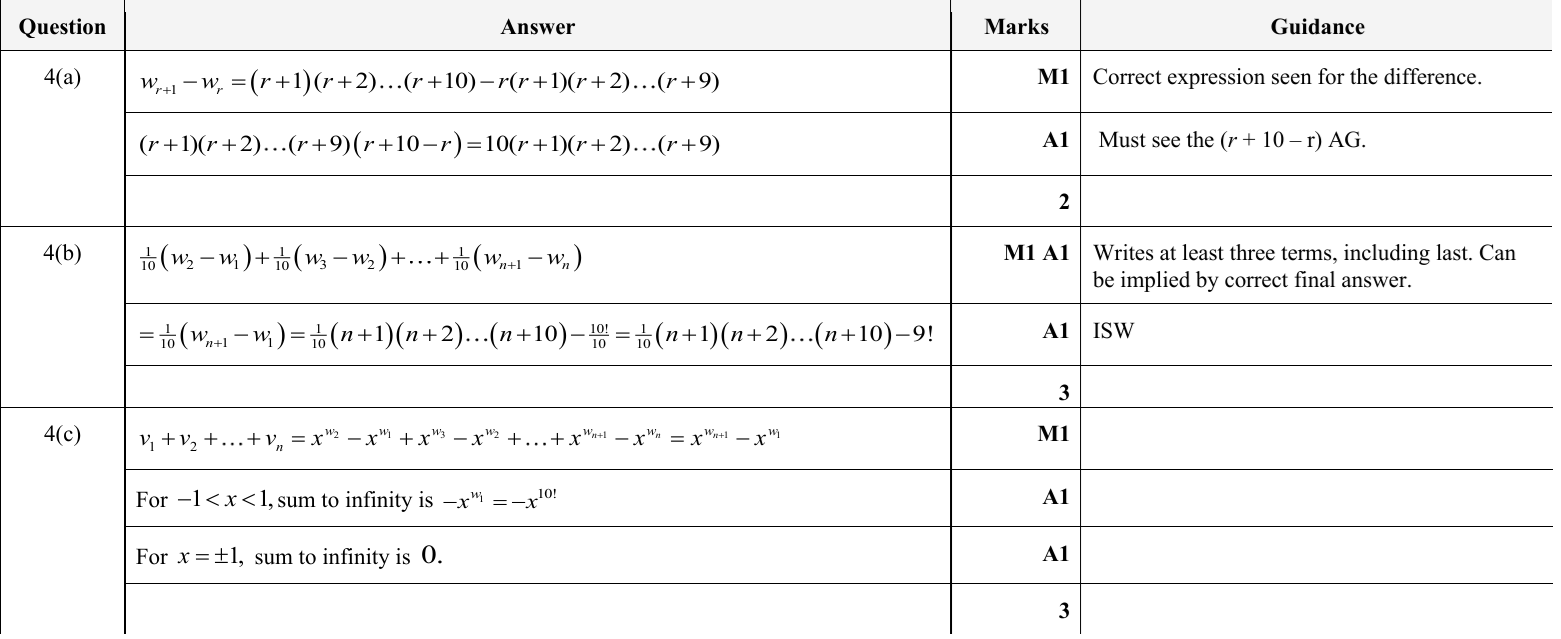
Let \(w_r = r(r+1)(r+2)\ldots(r+9)\).
(a) Show that \(w_{r+1} - w_r = 10(r+1)(r+2)\ldots(r+9)\).
(b) Given that \(u_r = (r+1)(r+2)\ldots(r+9)\), find \(\sum_{r=1}^{n} u_r\) in terms of \(n\).
(c) Given that \(v_r = x^{w_{r+1}} - x^{w_r}\), find the set of values of \(x\) for which the infinite series \(v_1 + v_2 + v_3 + \ldots\) is convergent and give the sum to infinity when this exists.
FM June 2025 p13 q05
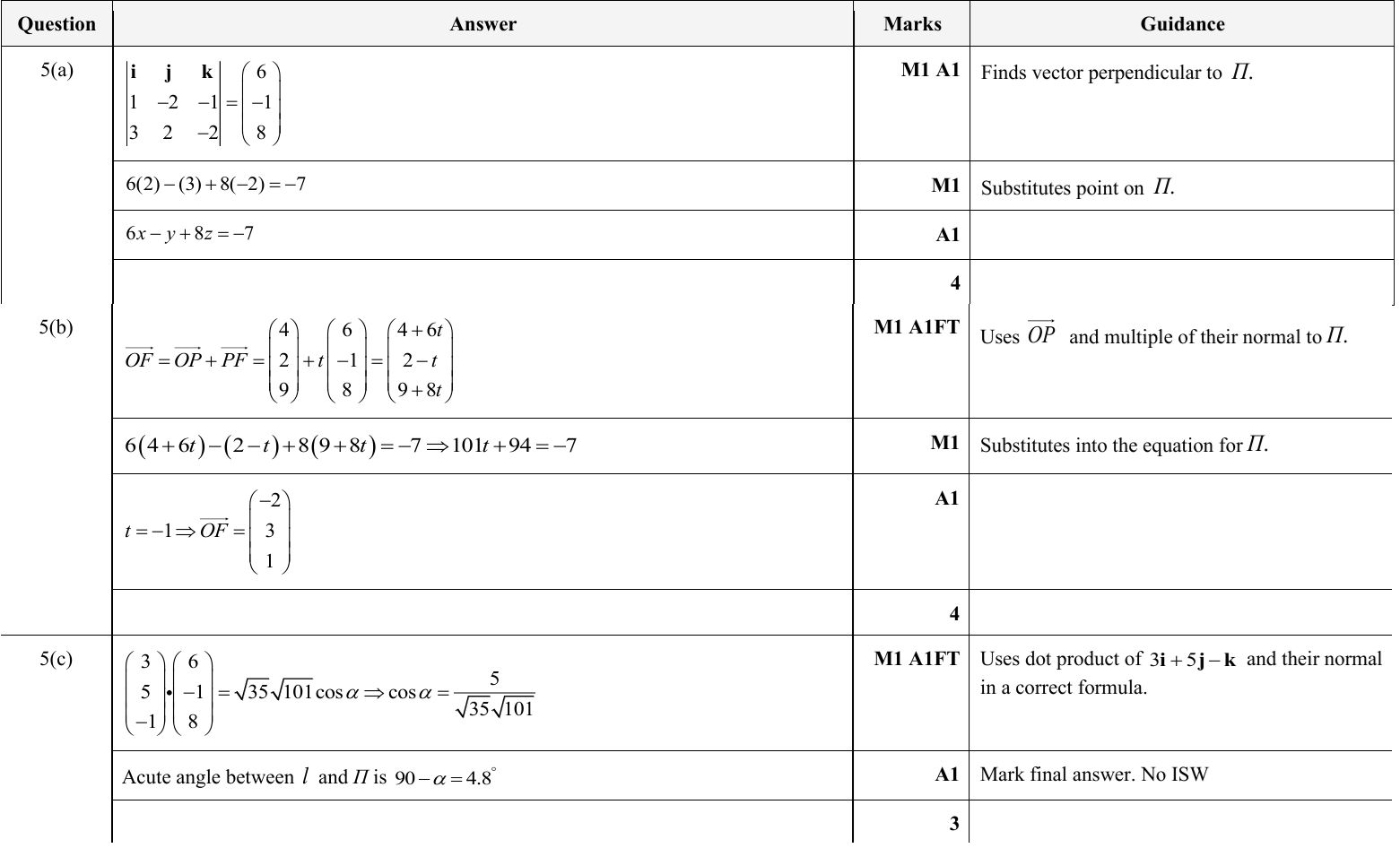
The plane \(\Pi\) has equation \(\mathbf{r} = 2\mathbf{i} + 3\mathbf{j} - 2\mathbf{k} + \lambda (\mathbf{i} - 2\mathbf{j} - \mathbf{k}) + \mu (3\mathbf{i} + 2\mathbf{j} - 2\mathbf{k})\).
(a) Find a Cartesian equation of \(\Pi\), giving your answer in the form \(ax + by + cz = d\).
The point \(P\) has position vector \(4\mathbf{i} + 2\mathbf{j} + 9\mathbf{k}\).
(b) Find the position vector of the foot of the perpendicular from \(P\) to \(\Pi\).
The line \(l\) is parallel to the vector \(3\mathbf{i} + 5\mathbf{j} - \mathbf{k}\).
(c) Find the acute angle between \(l\) and \(\Pi\).
FM June 2025 p13 q06
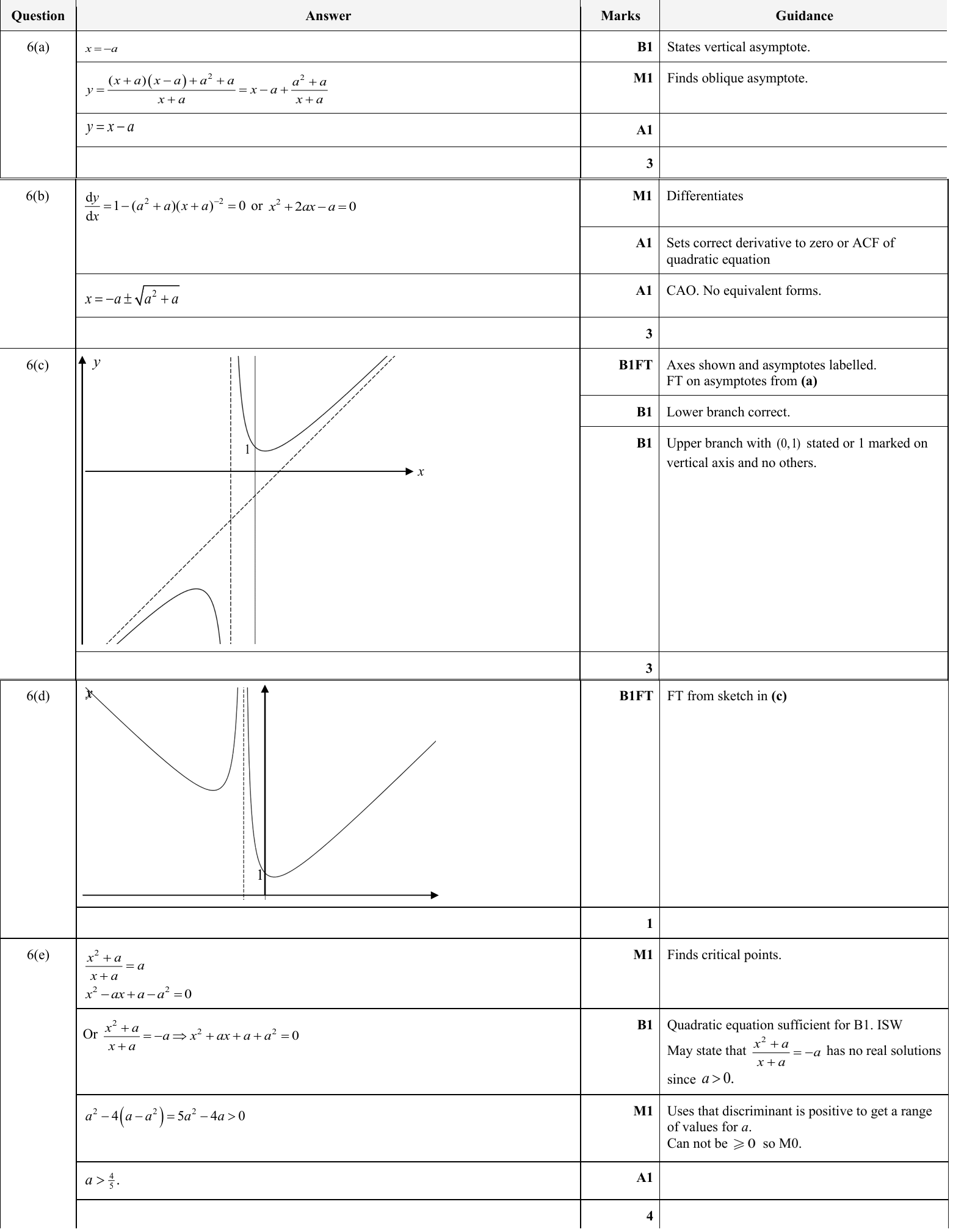
The curve C has equation \(y = \frac{x^2 + a}{x + a}\), where \(a\) is a positive constant.
- (a) Find the equations of the asymptotes of C.
- (b) Find, in terms of \(a\), the \(x\)-coordinates of the stationary points on C.
- (c) Sketch C, stating the coordinates of any intersections with the axes.
- (d) Sketch the curve with equation \(y = \left| \frac{x^2 + a}{x + a} \right|\).
- (e) Find the set of values of \(a\) for which \(\left| \frac{x^2 + a}{x + a} \right| = a\) has two real solutions.