Exam-Style Problems
⬅ Back to SubchapterJune 2023 p43 q6
4070
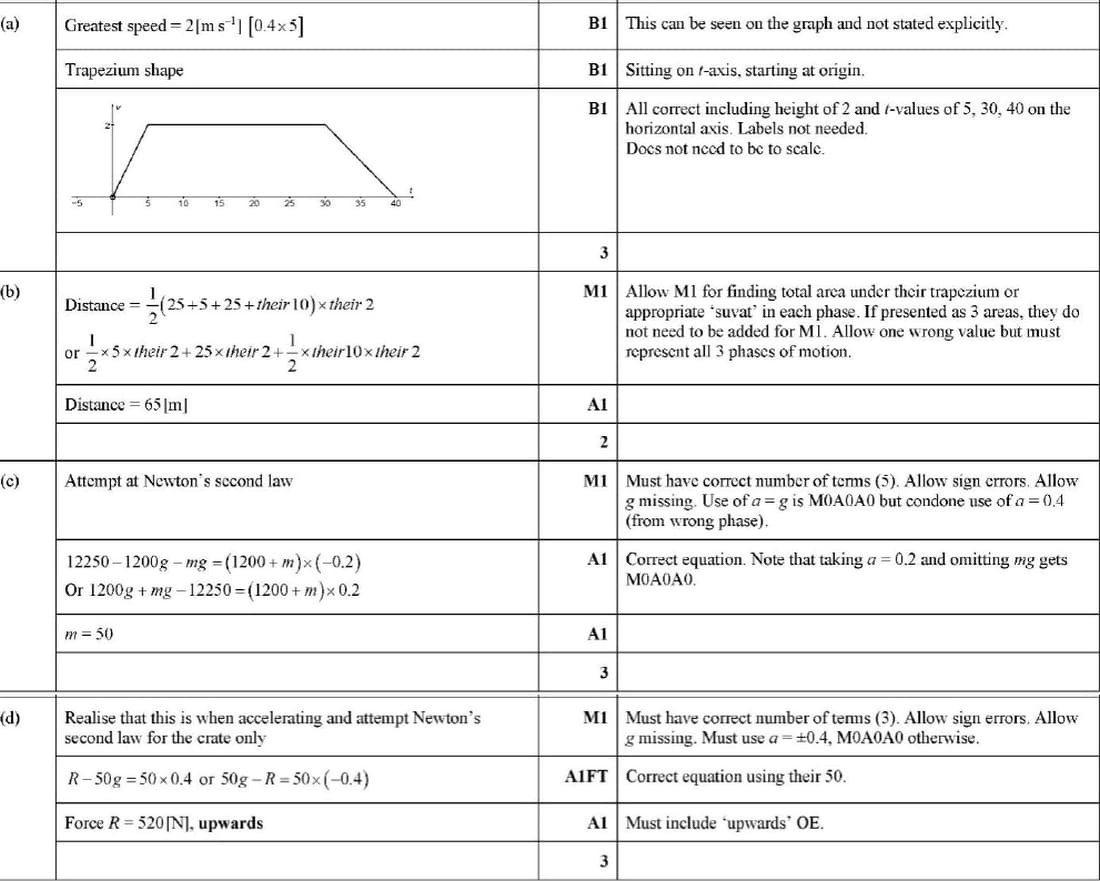
An elevator is pulled vertically upwards by a cable. The elevator accelerates at 0.4 m/s2 for 5 s, then travels at constant speed for 25 s. The elevator then decelerates at 0.2 m/s2 until it comes to rest.
(a) Find the greatest speed of the elevator and hence draw a velocity-time graph for the motion of the elevator.
(b) Find the total distance travelled by the elevator.
The mass of the elevator is 1200 kg and there is a crate of mass m kg resting on the floor of the elevator.
(c) Given that the tension in the cable when the elevator is decelerating is 12250 N, find the value of m.
(d) Find the greatest magnitude of the force exerted on the crate by the floor of the elevator, and state its direction.

Feb/Mar 2021 p42 q4
4071
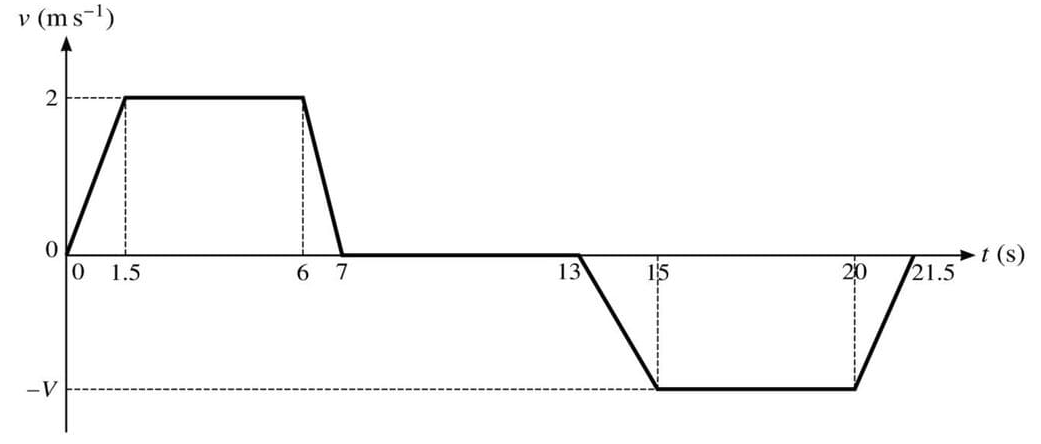
An elevator moves vertically, supported by a cable. The diagram shows a velocity-time graph which models the motion of the elevator. The graph consists of 7 straight line segments.
The elevator accelerates upwards from rest to a speed of 2 m/s-1 over a period of 1.5 s and then travels at this speed for 4.5 s, before decelerating to rest over a period of 1 s.
The elevator then remains at rest for 6 s, before accelerating to a speed of V m/s-1 downwards over a period of 2 s. The elevator travels at this speed for a period of 5 s, before decelerating to rest over a period of 1.5 s.
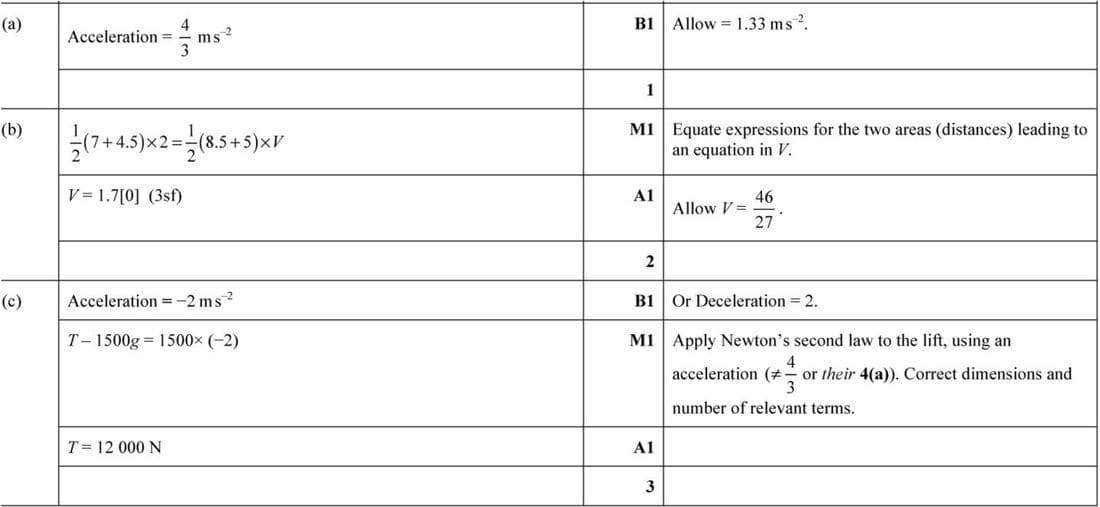
(a) Find the acceleration of the elevator during the first 1.5 s.
(b) Given that the elevator starts and finishes its journey on the ground floor, find V.
(c) The combined weight of the elevator and passengers on its upward journey is 1500 kg. Assuming that there is no resistance to motion, find the tension in the elevator cable on its upward journey when the elevator is decelerating.
Nov 2019 p41 q6
4072
A particle of mass 0.4 kg is released from rest at a height of 1.8 m above the surface of the water in a tank. There is no instantaneous change of speed when the particle enters the water. The water exerts an upward force of 5.6 N on the particle when it is in the water.
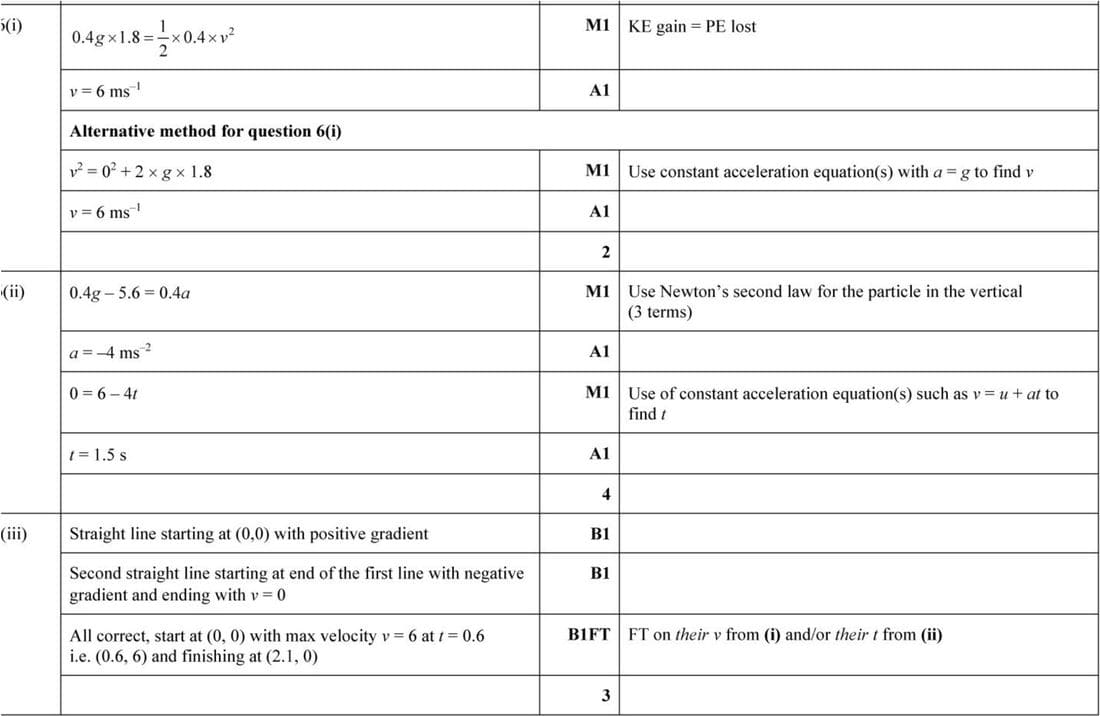
(i) Find the velocity of the particle at the instant when it reaches the surface of the water.
(ii) Find the time that it takes from the instant when the particle enters the water until it comes to instantaneous rest in the water. You may assume that the tank is deep enough so that the particle does not reach the bottom of the tank.
(iii) Sketch a velocity-time graph for the motion of the particle from the instant at which it is released until it comes to instantaneous rest in the water.
Nov 2014 p41 q6
4073
A particle of mass 3 kg falls from rest at a point 5 m above the surface of a liquid which is in a container. There is no instantaneous change in speed of the particle as it enters the liquid. The depth of the liquid in the container is 4 m. The downward acceleration of the particle while it is moving in the liquid is 5.5 m s-2.
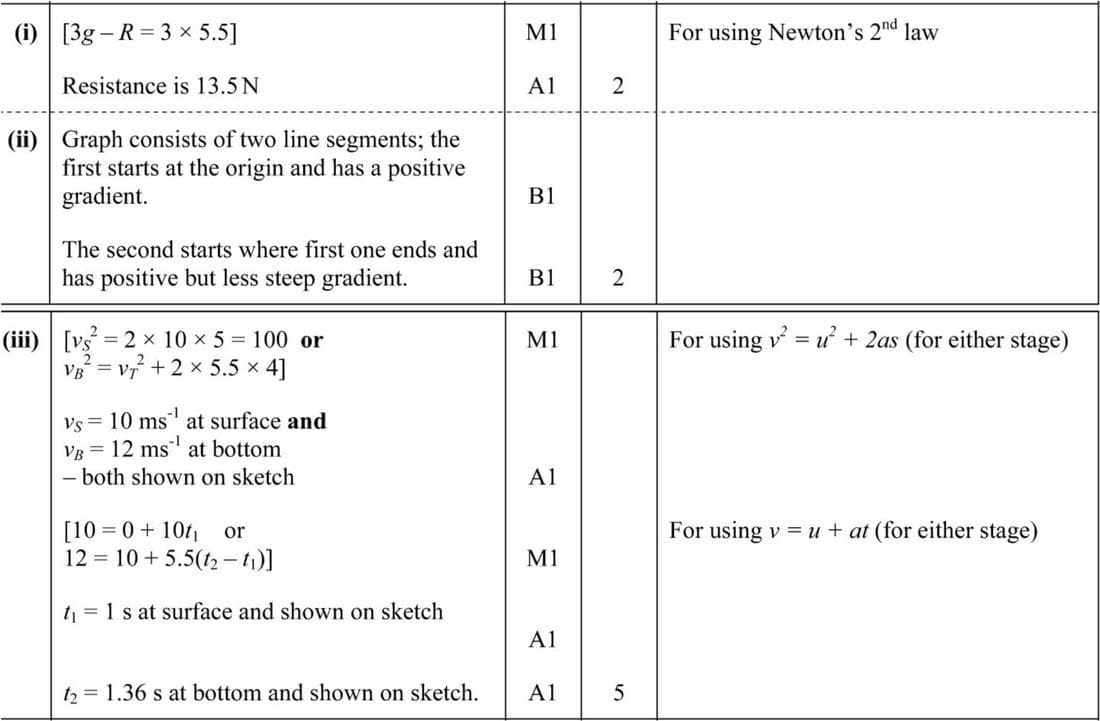
- Find the resistance to motion of the particle while it is moving in the liquid.
- Sketch the velocity-time graph for the motion of the particle, from the time it starts to move until the time it reaches the bottom of the container. Show on your sketch the velocity and the time when the particle enters the liquid, and when the particle reaches the bottom of the container.
Nov 2013 p42 q7
4074
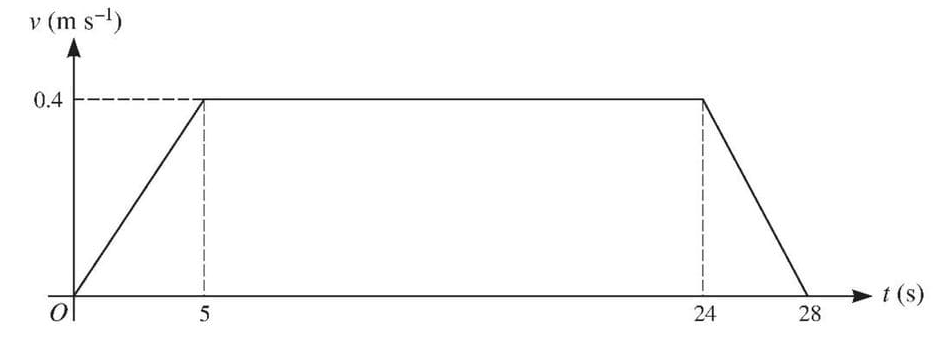
An elevator is pulled vertically upwards by a cable. The velocity-time graph for the motion is shown above. Find
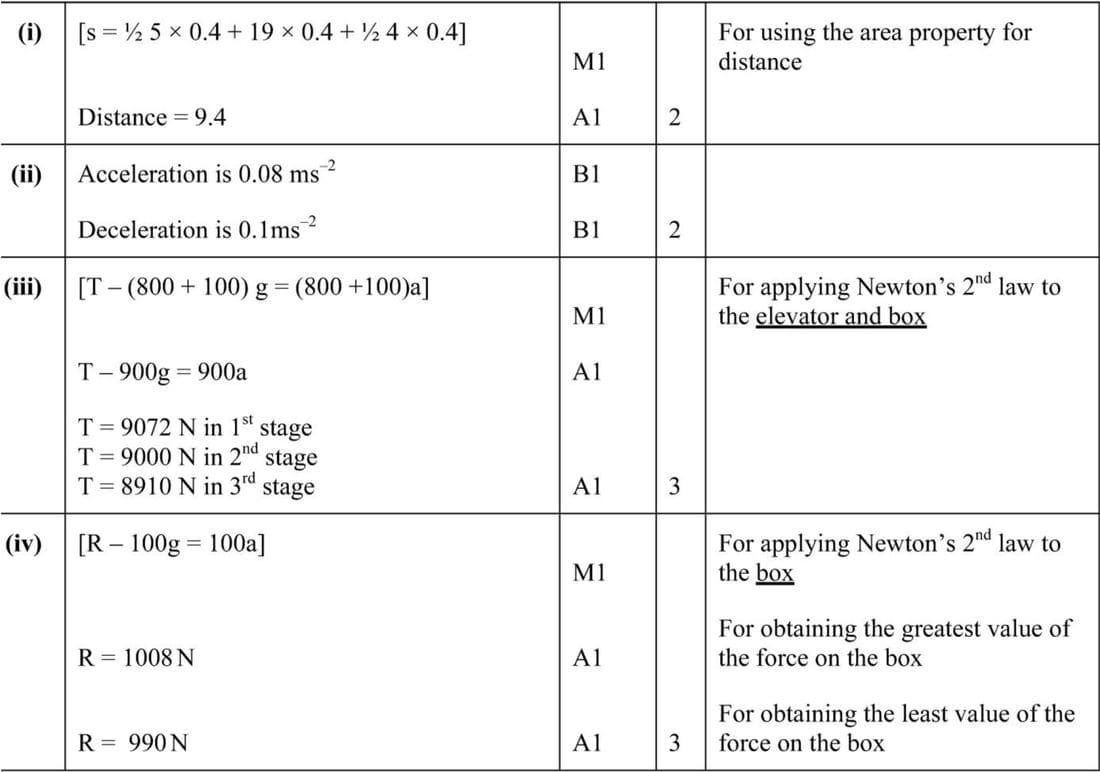
- the distance travelled by the elevator,
- the acceleration during the first stage and the deceleration during the third stage.
The mass of the elevator is 800 kg and there is a box of mass 100 kg on the floor of the elevator.
- Find the tension in the cable in each of the three stages of the motion.
- Find the greatest and least values of the magnitude of the force exerted on the box by the floor of the elevator.