Exam-Style Problems
⬅ Back to SubchapterJune 2019 p42 q6
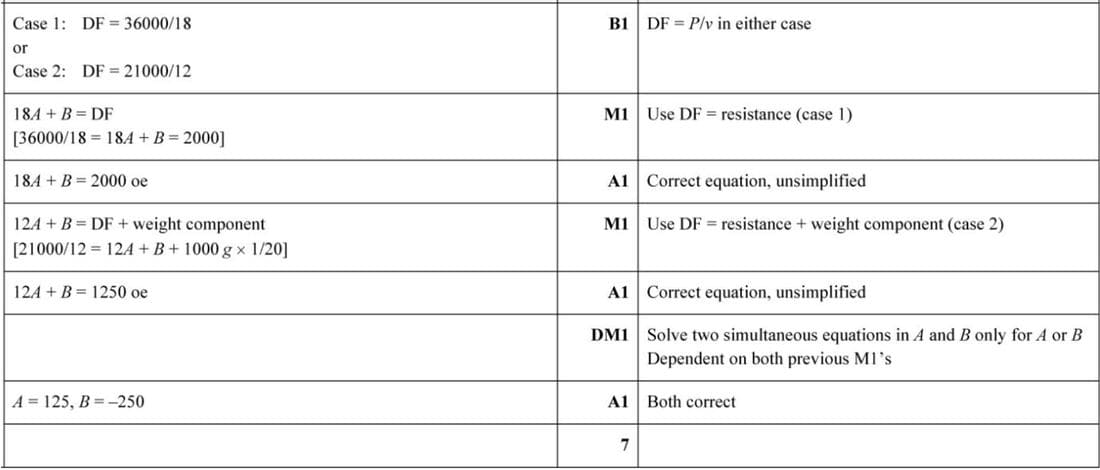
A car has mass 1000 kg. When the car is travelling at a steady speed of \(v \text{ m s}^{-1}\), where \(v > 2\), the resistance to motion of the car is \((Av + B) \text{ N}\), where \(A\) and \(B\) are constants. The car can travel along a horizontal road at a steady speed of \(18 \text{ m s}^{-1}\) when its engine is working at \(36 \text{ kW}\). The car can travel up a hill inclined at an angle of \(\theta\) to the horizontal, where \(\sin \theta = 0.05\), at a steady speed of \(12 \text{ m s}^{-1}\) when its engine is working at \(21 \text{ kW}\). Find \(A\) and \(B\).
June 2019 p41 q3
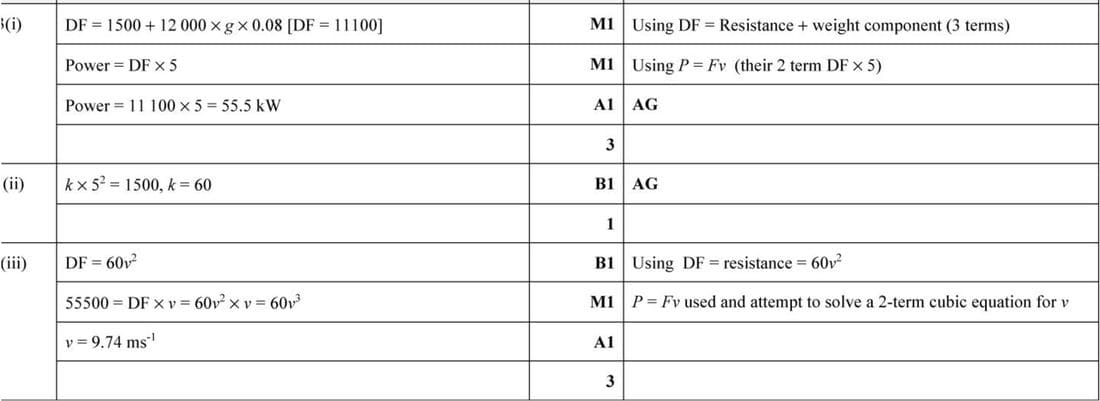
A lorry has mass 12,000 kg.
(i) The lorry moves at a constant speed of 5 m s-1 up a hill inclined at an angle of \(\theta\) to the horizontal, where \(\sin \theta = 0.08\). At this speed, the magnitude of the resistance to motion on the lorry is 1500 N. Show that the power of the lorry’s engine is 55.5 kW.
When the speed of the lorry is \(v\) m s-1 the magnitude of the resistance to motion is \(kv^2\) N, where \(k\) is a constant.
(ii) Show that \(k = 60\).
(iii) The lorry now moves at a constant speed on a straight level road. Given that its engine is still working at 55.5 kW, find the lorry’s speed.
Feb/Mar 2019 p42 q4
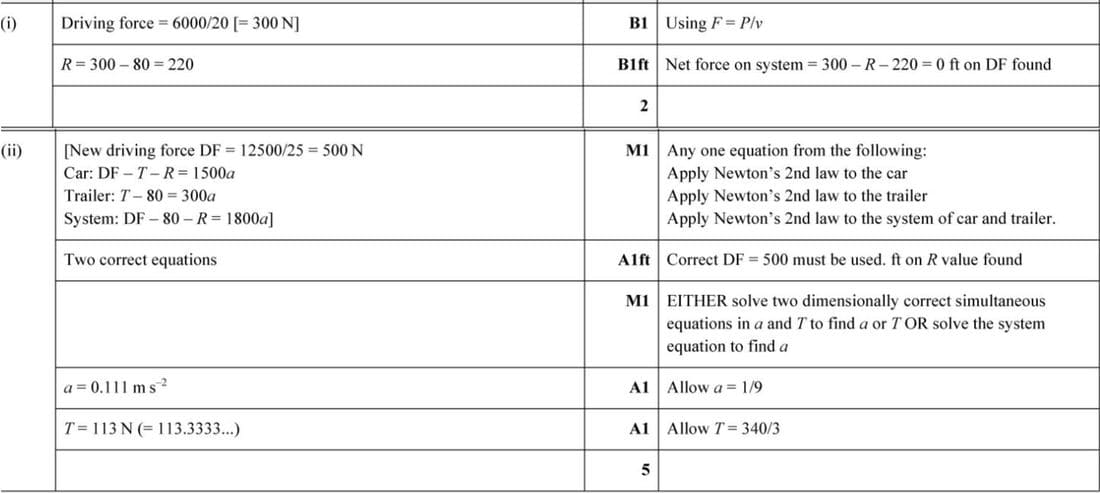
A car of mass 1500 kg is pulling a trailer of mass 300 kg along a straight horizontal road at a constant speed of 20 m s-1. The system of the car and trailer is modelled as two particles, connected by a light rigid horizontal rod. The power of the car’s engine is 6000 W. There are constant resistances to motion of R N on the car and 80 N on the trailer.
(i) Find the value of R.
The power of the car’s engine is increased to 12 500 W. The resistance forces do not change.
(ii) Find the acceleration of the car and trailer and the tension in the rod at an instant when the speed of the car is 25 m s-1.
Nov 2018 p43 q6
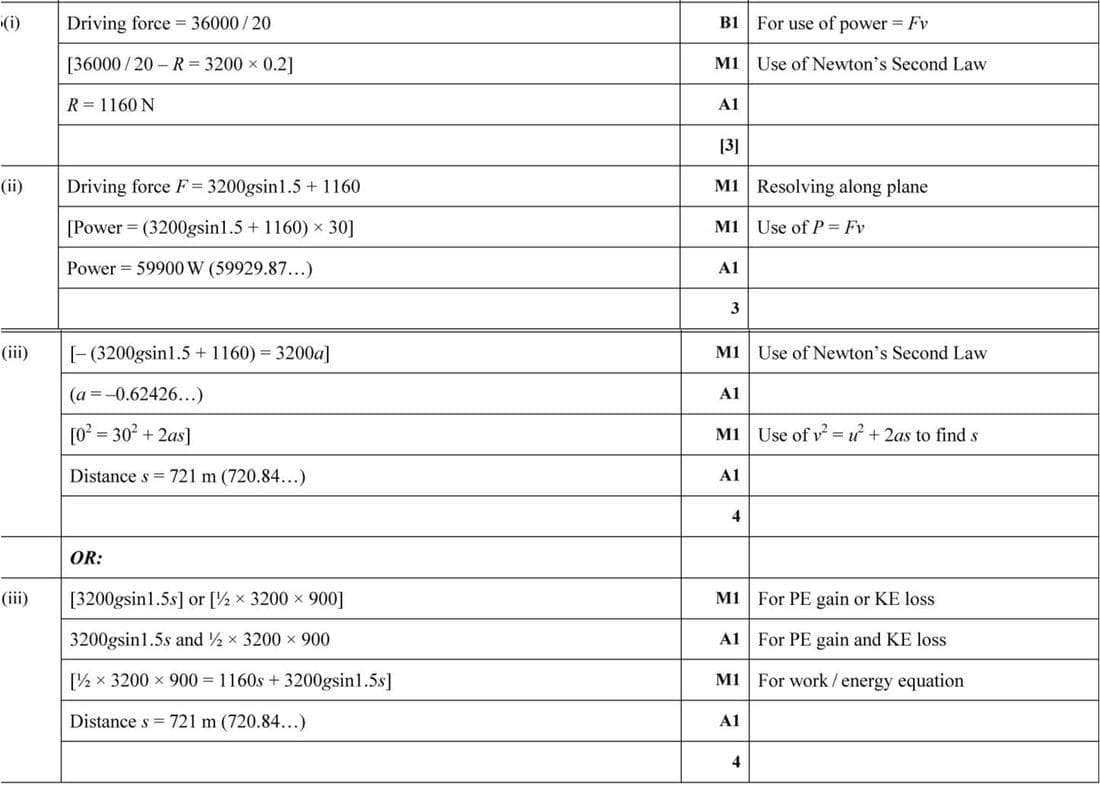
A van of mass 3200 kg travels along a horizontal road. The power of the van’s engine is constant and equal to 36 kW, and there is a constant resistance to motion acting on the van.
- When the speed of the van is 20 m s-1, its acceleration is 0.2 m s-2. Find the resistance force.
- When the van is travelling at 30 m s-1, it begins to ascend a hill inclined at 1.5° to the horizontal. The power is increased and the resistance force is still equal to the value found in part (i). Find the power required to maintain this speed of 30 m s-1.
- The engine is now stopped, with the van still travelling at 30 m s-1, and the van decelerates to rest. Find the distance the van moves up the hill from the point at which the engine is stopped until it comes to rest.
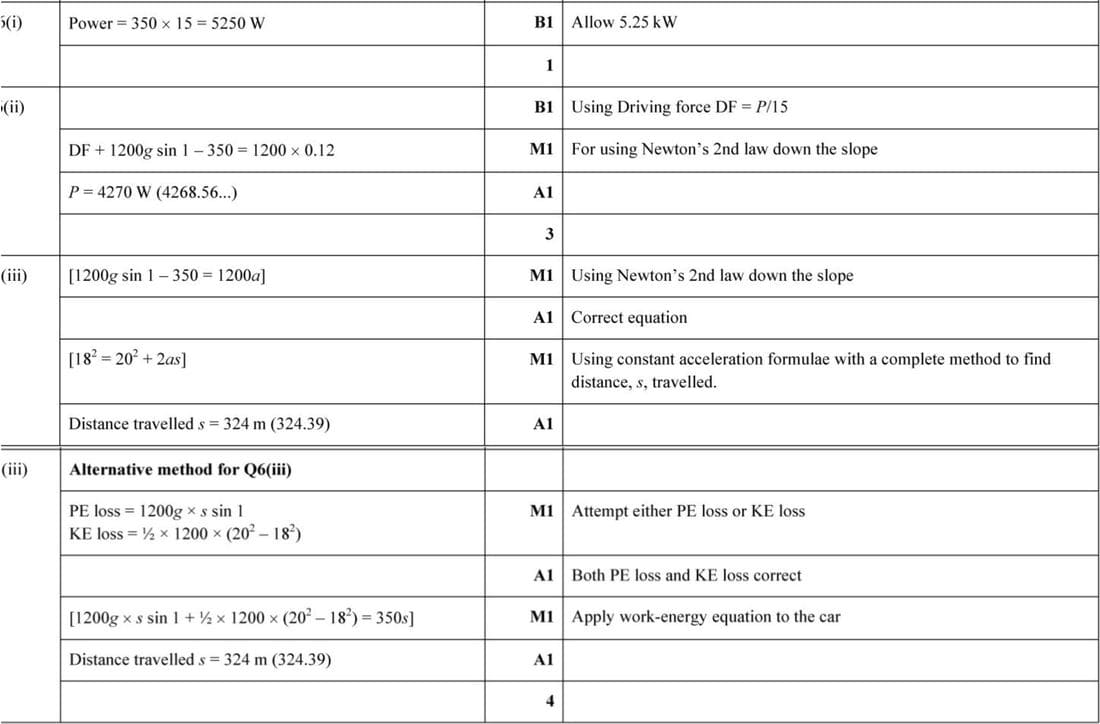
Nov 2018 p42 q6
A car of mass 1200 kg is driving along a straight horizontal road at a constant speed of 15 m s-1. There is a constant resistance to motion of 350 N.
- Find the power of the car’s engine.
The car comes to a hill inclined at 1° to the horizontal, still travelling at 15 m s-1.
- The car starts to descend the hill with reduced power and with an acceleration of 0.12 m s-2. Given that there is no change in the resistance force, find the new power of the car’s engine at the instant when it starts to descend the hill.
- When the car is travelling at 20 m s-1 down the hill, the power is cut off and the car gradually slows down. Assuming that the resistance force remains 350 N, find the distance travelled from the moment when the power is cut off until the speed of the car is reduced to 18 m s-1.