Exam-Style Problems
⬅ Back to SubchapterJune 2013 p42 q2
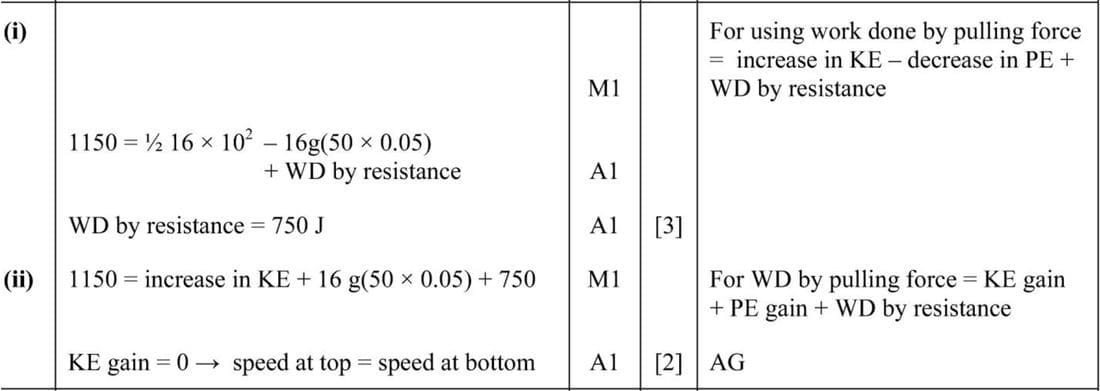
A and B are two points 50 metres apart on a straight path inclined at an angle \(\theta\) to the horizontal, where \(\sin \theta = 0.05\), with A above the level of B. A block of mass 16 kg is pulled down the path from A to B. The block starts from rest at A and reaches B with a speed of 10 m s-1. The work done by the pulling force acting on the block is 1150 J.
- Find the work done against the resistance to motion.
The block is now pulled up the path from B to A. The work done by the pulling force and the work done against the resistance to motion are the same as in the case of the downward motion.
- Show that the speed of the block when it reaches A is the same as its speed when it started at B.
June 2013 p41 q2
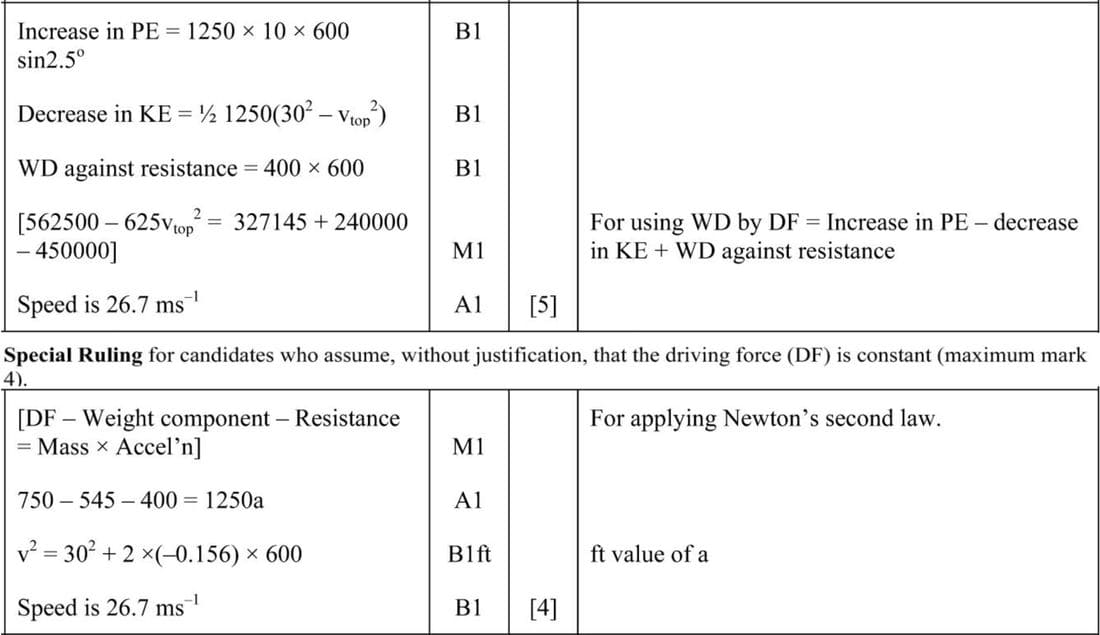
A car of mass 1250 kg travels from the bottom to the top of a straight hill of length 600 m, which is inclined at an angle of 2.5° to the horizontal. The resistance to motion of the car is constant and equal to 400 N. The work done by the driving force is 450 kJ. The speed of the car at the bottom of the hill is 30 m s-1. Find the speed of the car at the top of the hill.
Nov 2012 p42 q1
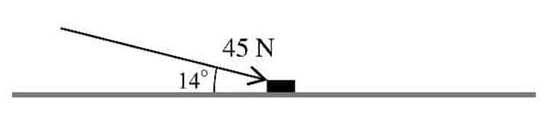
A block is pushed along a horizontal floor by a force of magnitude 45 N acting at an angle of 14° to the horizontal (see diagram). Find the work done by the force in moving the block a distance of 25 m.

June 2012 p43 q1
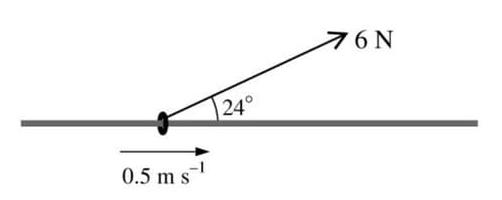
A ring is threaded on a fixed horizontal bar. The ring is attached to one end of a light inextensible string which is used to pull the ring along the bar at a constant speed of 0.5 m s-1. The string makes a constant angle of 24° with the bar and the tension in the string is 6 N (see diagram). Find the work done by the tension in a period of 8 s.

June 2012 p42 q1
A block is pulled in a straight line along horizontal ground by a force of constant magnitude acting at an angle of 60° above the horizontal. The work done by the force in moving the block a distance of 5 m is 75 J. Find the magnitude of the force.
