Exam-Style Problems
⬅ Back to SubchapterNov 2020 p43 q2
3508
A box of mass 5 kg is pulled at a constant speed a distance of 15 m up a rough plane inclined at an angle of 20° to the horizontal. The box moves along a line of greatest slope against a frictional force of 40 N. The force pulling the box is parallel to the line of greatest slope.
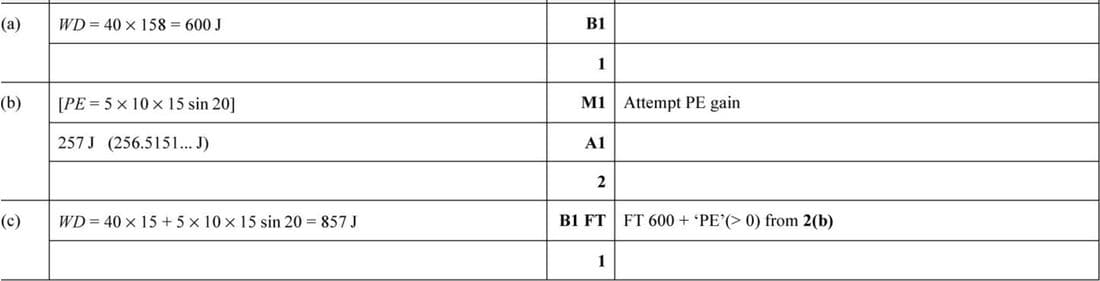
(a) Find the work done against friction.
(b) Find the change in gravitational potential energy of the box.
(c) Find the work done by the pulling force.
Nov 2020 p42 q8
3509
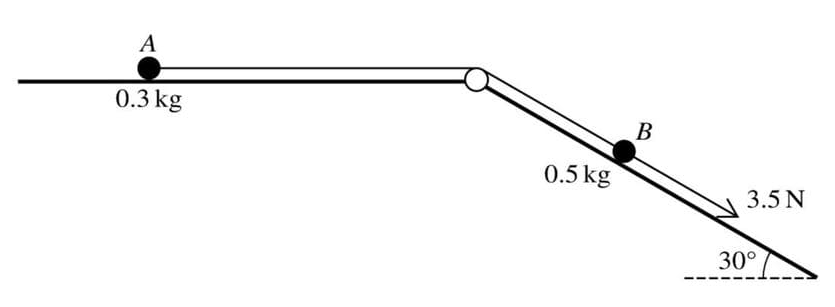
Two particles A and B, of masses 0.3 kg and 0.5 kg respectively, are attached to the ends of a light inextensible string. The string passes over a fixed smooth pulley which is attached to a horizontal plane and to the top of an inclined plane. The particles are initially at rest with A on the horizontal plane and B on the inclined plane, which makes an angle of 30° with the horizontal. The string is taut and B can move on a line of greatest slope of the inclined plane. A force of magnitude 3.5 N is applied to B acting down the plane (see diagram).
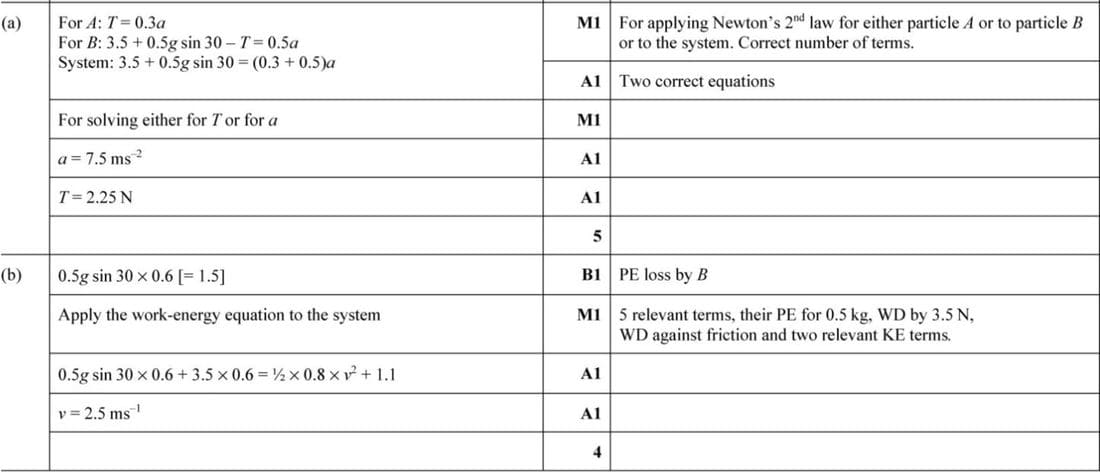
(a) Given that both planes are smooth, find the tension in the string and the acceleration of B. [5]
(b) It is given instead that the two planes are rough. When each particle has moved a distance of 0.6 m from rest, the total amount of work done against friction is 1.1 J.
Use an energy method to find the speed of B when it has moved this distance down the plane. [You should assume that the string is sufficiently long so that A does not hit the pulley when it moves 0.6 m.] [4]
Nov 2020 p41 q6
3510
A car of mass 1500 kg is pulling a trailer of mass 750 kg up a straight hill of length 800 m inclined at an angle of \(\sin^{-1} 0.08\) to the horizontal. The resistances to the motion of the car and trailer are 400 N and 200 N respectively. The car and trailer are connected by a light rigid tow-bar. The car and trailer have speed 30 m/s at the bottom of the hill and 20 m/s at the top of the hill.
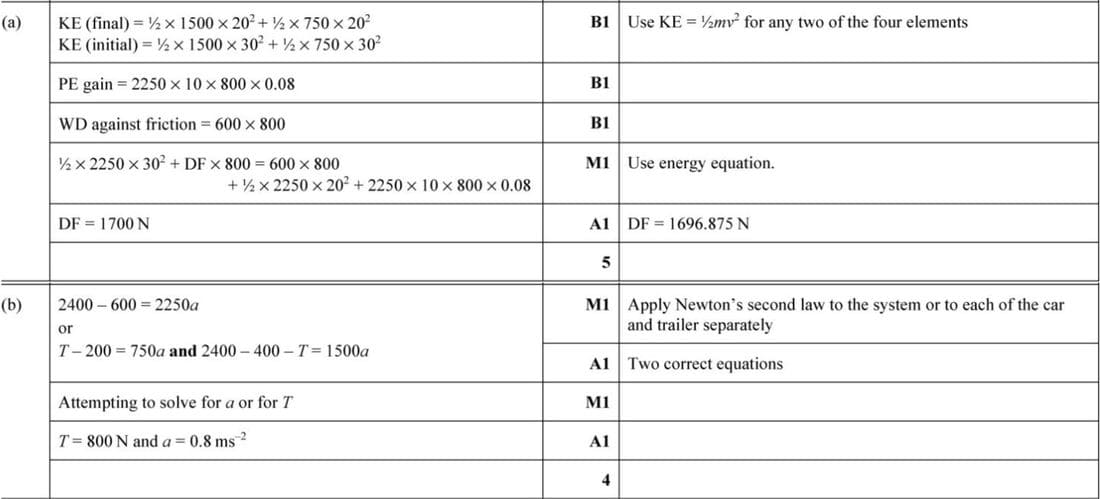
(a) Use an energy method to find the constant driving force as the car and trailer travel up the hill. [5]
After reaching the top of the hill the system consisting of the car and trailer travels along a straight level road. The driving force of the car’s engine is 2400 N and the resistances to motion are unchanged.
(b) Find the acceleration of the system and the tension in the tow-bar. [4]
June 2020 p43 q5
3511
A block B of mass 4 kg is pushed up a line of greatest slope of a smooth plane inclined at 30° to the horizontal by a force applied to B, acting in the direction of motion of B. The block passes through points P and Q with speeds 12 m s-1 and 8 m s-1 respectively. P and Q are 10 m apart with P below the level of Q.
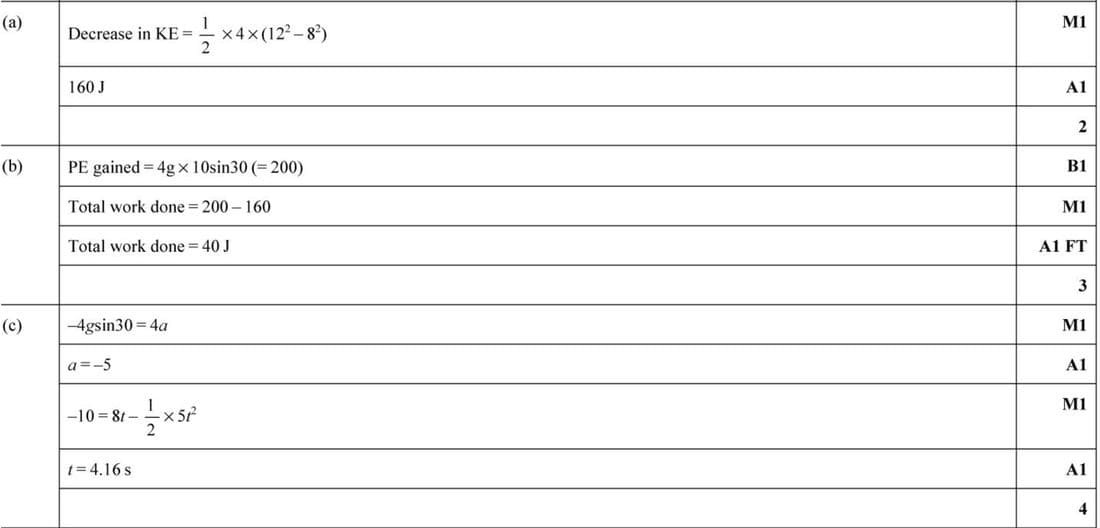
(a) Find the decrease in kinetic energy of the block as it moves from P to Q.
(b) Hence find the work done by the force pushing the block up the slope as the block moves from P to Q.
(c) At the instant the block reaches Q, the force pushing the block up the slope is removed.
Find the time taken, after this instant, for the block to return to P.
June 2020 p41 q5
3512
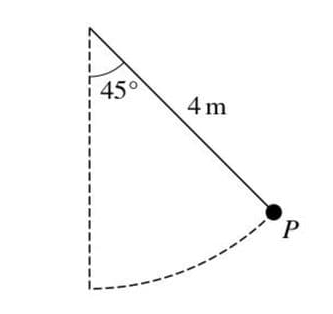
A child of mass 35 kg is swinging on a rope. The child is modelled as a particle P and the rope is modelled as a light inextensible string of length 4 m. Initially P is held at an angle of 45° to the vertical (see diagram).
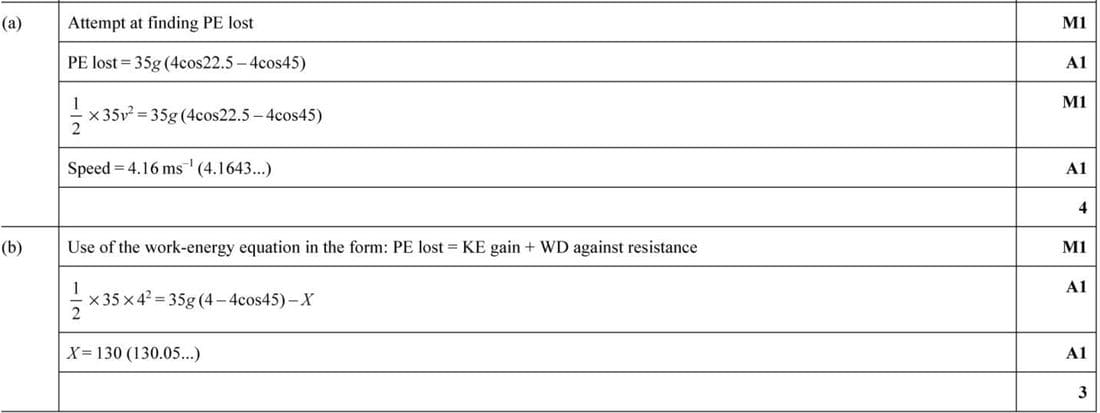
(a) Given that there is no resistance force, find the speed of P when it has travelled half way along the circular arc from its initial position to its lowest point.
(b) It is given instead that there is a resistance force. The work done against the resistance force as P travels from its initial position to its lowest point is X J. The speed of P at its lowest point is 4 m s-1.
Find X.