Exam-Style Problems
⬅ Back to SubchapterNov 2020 p41 q1
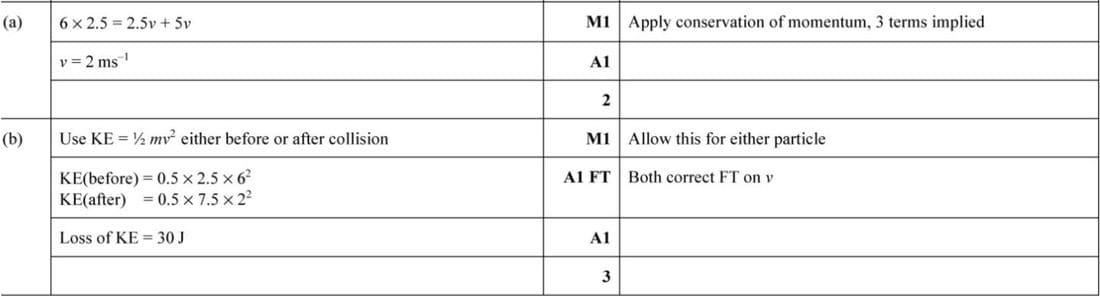
A particle B of mass 5 kg is at rest on a smooth horizontal table. A particle A of mass 2.5 kg moves on the table with a speed of 6 m s-1 and collides directly with B. In the collision, the two particles coalesce.
(a) Find the speed of the combined particle after the collision.
(b) Find the loss of kinetic energy of the system due to the collision.
June 2020 p43 q1
Particles P of mass m kg and Q of mass 0.2 kg are free to move on a smooth horizontal plane. P is projected at a speed of 2 m s-1 towards Q which is stationary. After the collision P and Q move in opposite directions with speeds of 0.5 m s-1 and 1 m s-1 respectively.
Find m.

June 2020 p42 q4
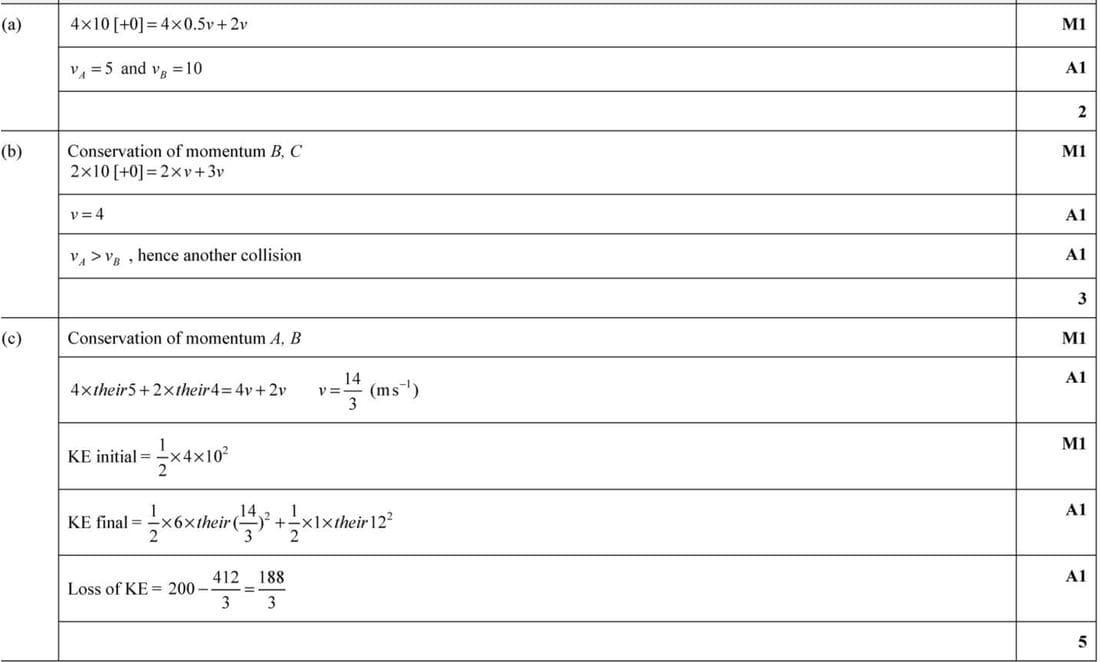
Small smooth spheres A and B, of equal radii and of masses 4 kg and 2 kg respectively, lie on a smooth horizontal plane. Initially B is at rest and A is moving towards B with speed 10 m/s. After the spheres collide A continues to move in the same direction but with half the speed of B.
(a) Find the speed of B after the collision. [2]
A third small smooth sphere C, of mass 1 kg and with the same radius as A and B, is at rest on the plane. B now collides directly with C. After this collision B continues to move in the same direction but with one third the speed of C.
(b) Show that there is another collision between A and B. [3]
(c) A and B coalesce during this collision. Find the total loss of kinetic energy in the system due to the three collisions. [5]
June 2020 p41 q7
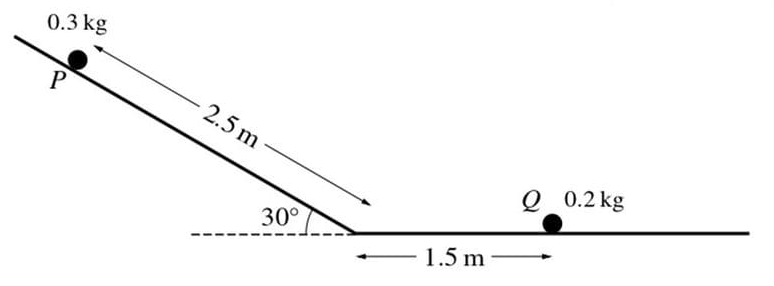
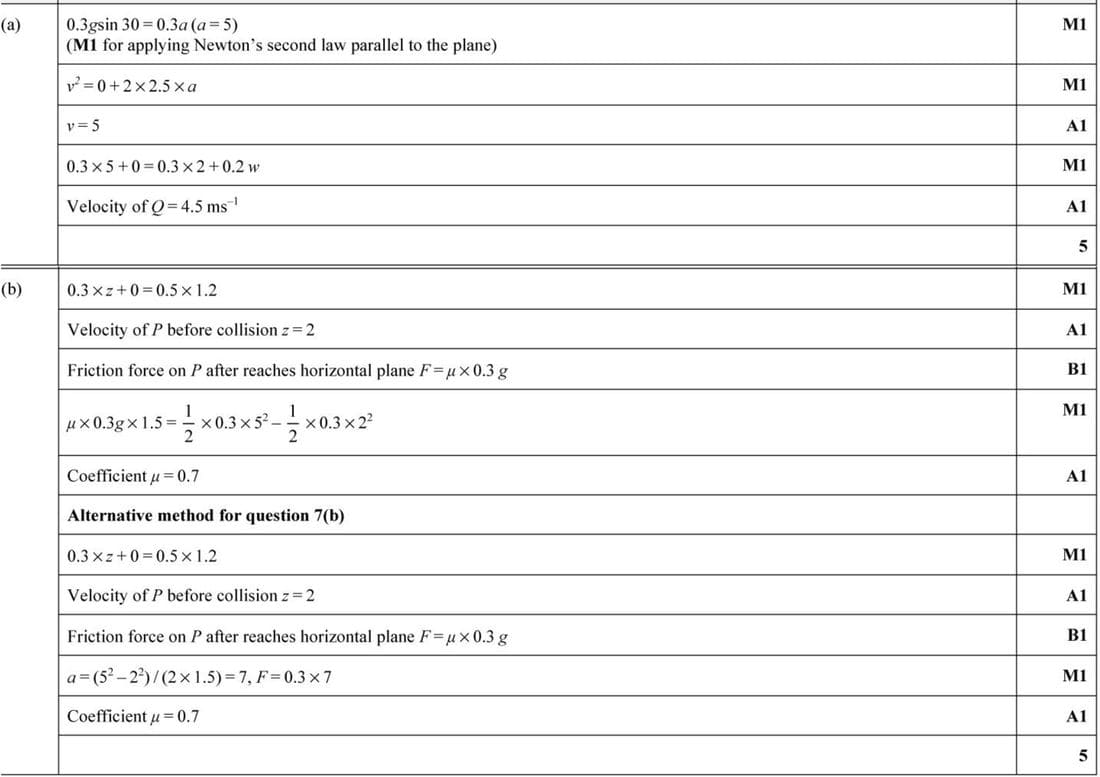
A particle P of mass 0.3 kg, lying on a smooth plane inclined at 30° to the horizontal, is released from rest. P slides down the plane for a distance of 2.5 m and then reaches a horizontal plane. There is no change in speed when P reaches the horizontal plane. A particle Q of mass 0.2 kg lies at rest on the horizontal plane 1.5 m from the end of the inclined plane (see diagram). P collides directly with Q.
(a) It is given that the horizontal plane is smooth and that, after the collision, P continues moving in the same direction, with speed 2 m s-1.
Find the speed of Q after the collision.
(b) It is given instead that the horizontal plane is rough and that when P and Q collide, they coalesce and move with speed 1.2 m s-1.
Find the coefficient of friction between P and the horizontal plane.
Feb/Mar 2020 p42 q6
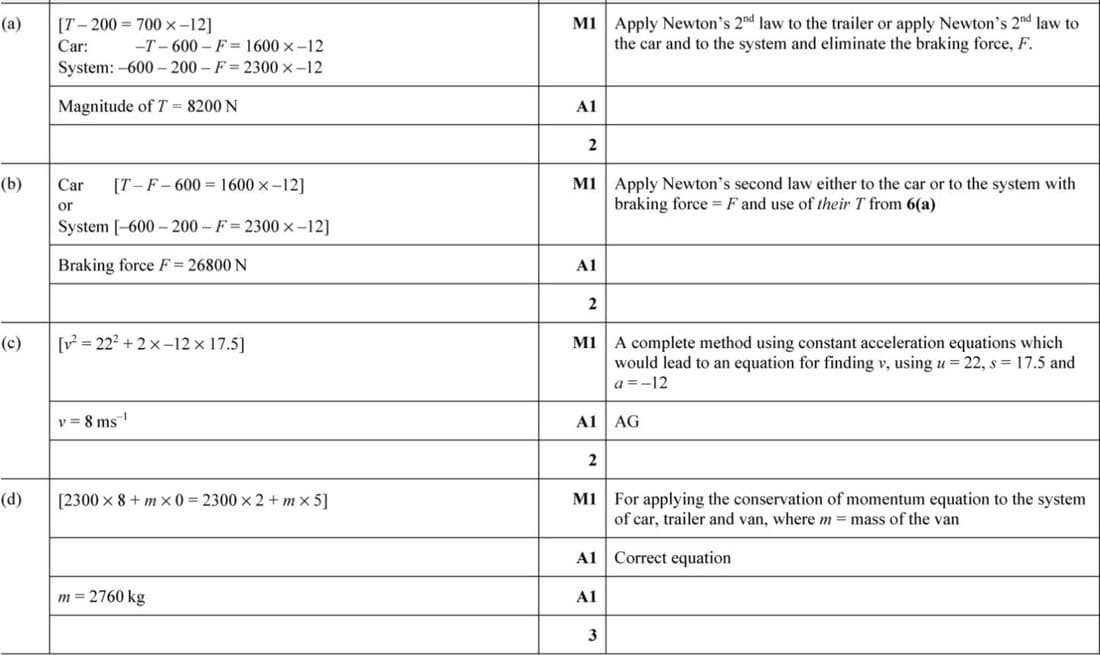
On a straight horizontal test track, driverless vehicles (with no passengers) are being tested. A car of mass 1600 kg is towing a trailer of mass 700 kg along the track. The brakes are applied, resulting in a deceleration of 12 m s-2. The braking force acts on the car only. In addition to the braking force there are constant resistance forces of 600 N on the car and of 200 N on the trailer.
(a) Find the magnitude of the force in the tow-bar. [2]
(b) Find the braking force. [2]
(c) At the instant when the brakes are applied, the car has speed 22 m s-1. At this instant the car is 17.5 m away from a stationary van, which is directly in front of the car. Show that the car hits the van at a speed of 8 m s-1. [2]
(d) After the collision, the van starts to move with speed 5 m s-1 and the car and trailer continue moving in the same direction with speed 2 m s-1. Find the mass of the van. [3]