Exam-Style Problems
⬅ Back to SubchapterJune 2017 p42 q3
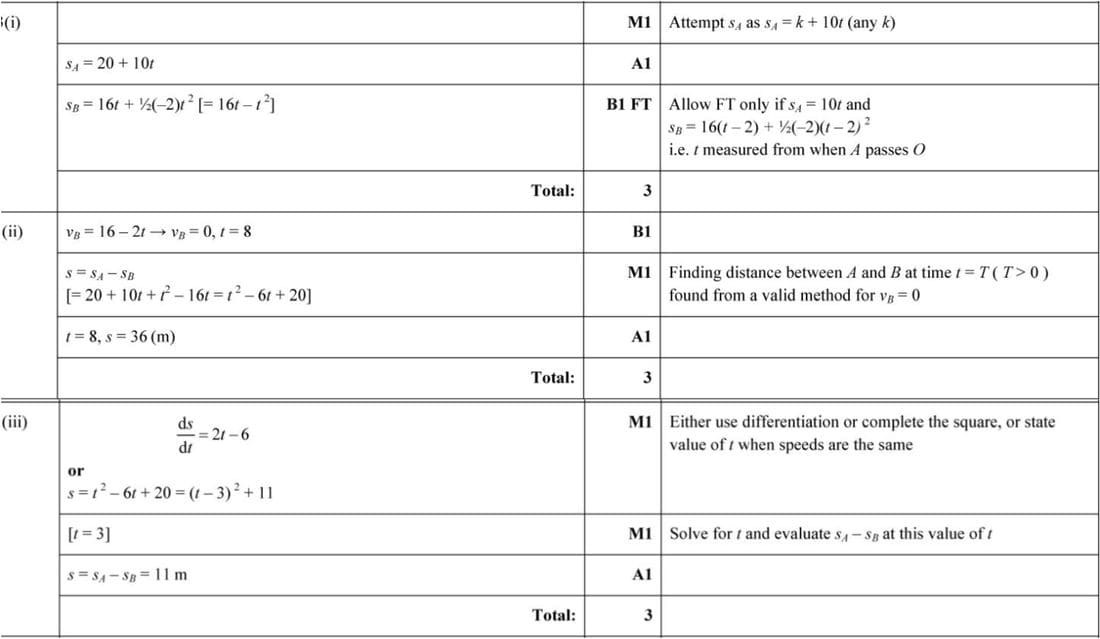
A particle A moves in a straight line with constant speed 10 m s-1. Two seconds after A passes a point O on the line, a particle B passes through O, moving along the line in the same direction as A. Particle B has speed 16 m s-1 at O and has a constant deceleration of 2 m s-2.
(i) Find expressions, in terms of t, for the displacement from O of each particle t s after B passes through O.
(ii) Find the distance between the particles when B comes to instantaneous rest.
(iii) Find the minimum distance between the particles.
Nov 2016 p43 q5
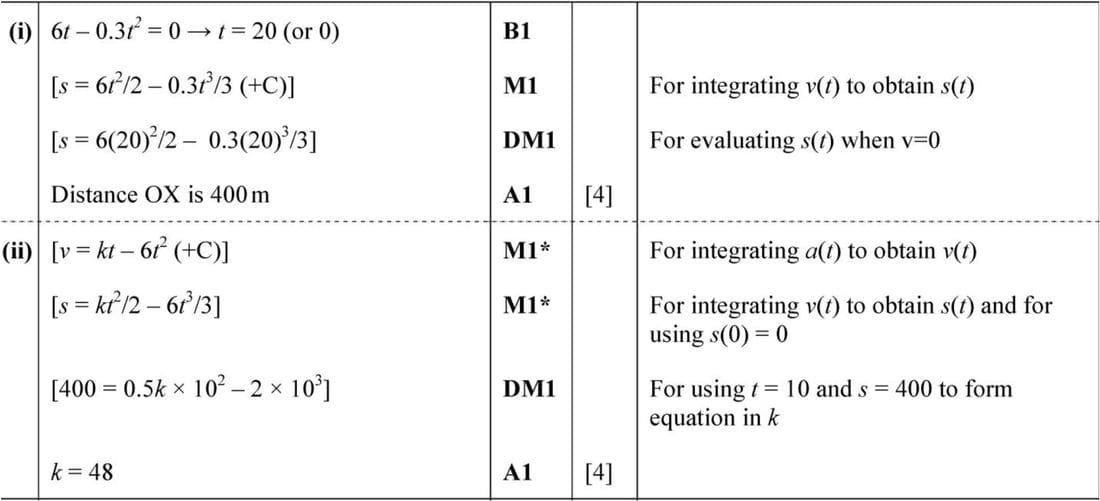
A particle P starts from a fixed point O and moves in a straight line. At time t s after leaving O, the velocity v m s-1 of P is given by v = 6t - 0.3t2. The particle comes to instantaneous rest at point X.
- Find the distance OX.
A second particle Q starts from rest from O, at the same instant as P, and also travels in a straight line. The acceleration a m s-2 of Q is given by a = k - 12t, where k is a constant. The displacement of Q from O is 400 m when t = 10.
- Find the value of k.
June 2016 p43 q2
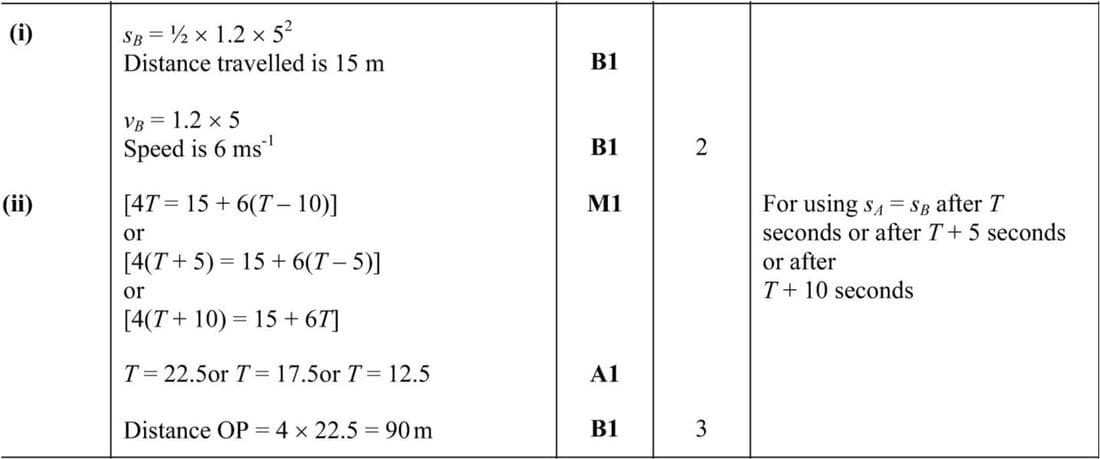
Alan starts walking from a point O, at a constant speed of 4 m s-1, along a horizontal path. Ben walks along the same path, also starting from O. Ben starts from rest 5 s after Alan and accelerates at 1.2 m s-2 for 5 s. Ben then continues to walk at a constant speed until he is at the same point, P, as Alan.
(i) Find how far Ben has travelled when he has been walking for 5 s and find his speed at this instant.
(ii) Find the distance OP.
Nov 2015 p41 q7
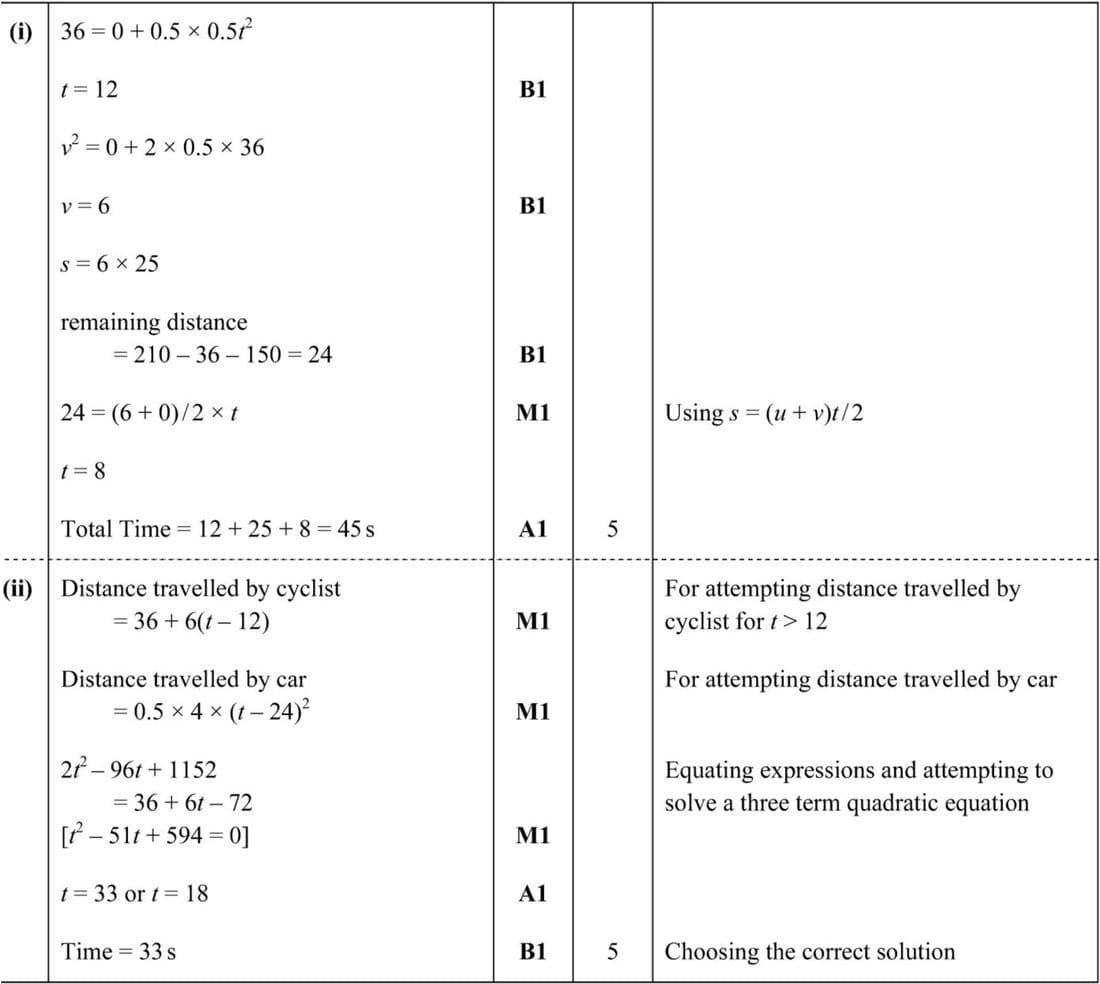
A cyclist starts from rest at point A and moves in a straight line with acceleration 0.5 m s-2 for a distance of 36 m. The cyclist then travels at constant speed for 25 s before slowing down, with constant deceleration, to come to rest at point B. The distance AB is 210 m.
(i) Find the total time that the cyclist takes to travel from A to B.
24 s after the cyclist leaves point A, a car starts from rest from point A, with constant acceleration 4 m s-2, towards B. It is given that the car overtakes the cyclist while the cyclist is moving with constant speed.
(ii) Find the time that it takes from when the cyclist starts until the car overtakes her.
June 2015 p42 q5
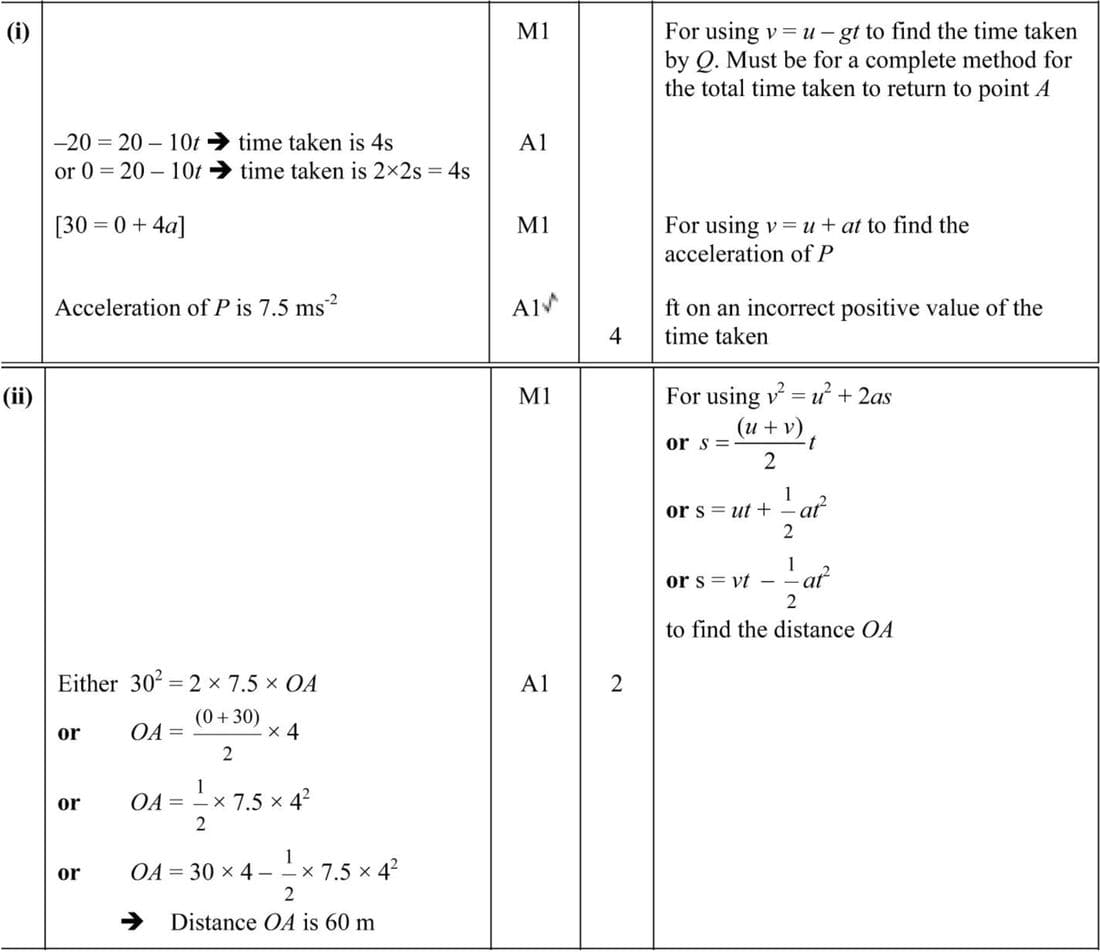
A particle P starts from rest at a point O on a horizontal straight line. P moves along the line with constant acceleration and reaches a point A on the line with a speed of 30 m s-1. At the instant that P leaves O, a particle Q is projected vertically upwards from the point A with a speed of 20 m s-1. Subsequently P and Q collide at A. Find
- the acceleration of P,
- the distance OA.