Exam-Style Problems
⬅ Back to SubchapterJune 2014 p42 q7
3899
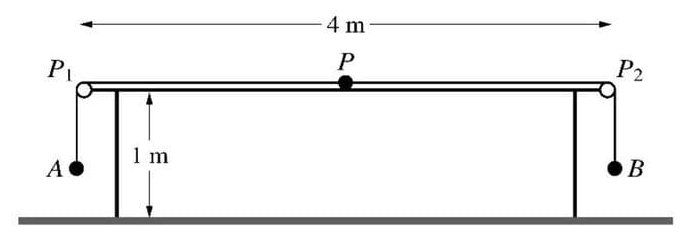
A light inextensible string of length 5.28 m has particles A and B, of masses 0.25 kg and 0.75 kg respectively, attached to its ends. Another particle P, of mass 0.5 kg, is attached to the mid-point of the string. Two small smooth pulleys P1 and P2 are fixed at opposite ends of a rough horizontal table of length 4 m and height 1 m. The string passes over P1 and P2 with particle A held at rest vertically below P1, the string taut and B hanging freely below P2. Particle P is in contact with the table halfway between P1 and P2 (see diagram). The coefficient of friction between P and the table is 0.4. Particle A is released and the system starts to move with constant acceleration of magnitude a m s-2. The tension in the part AP of the string is TA N and the tension in the part PB of the string is TB N.
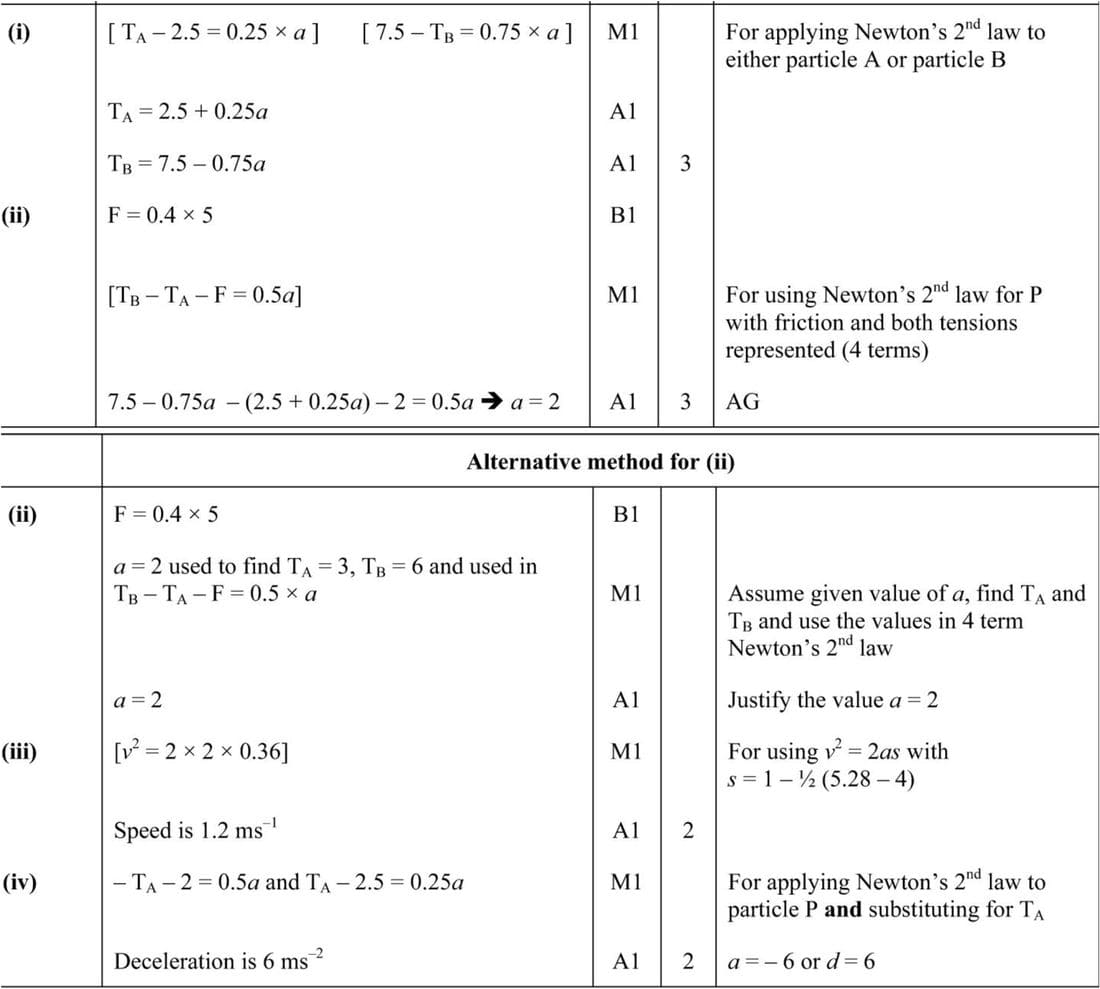
- Find TA and TB in terms of a.
- Show by considering the motion of P that a = 2.
- Find the speed of the particles immediately before B reaches the floor.
- Find the deceleration of P immediately after B reaches the floor.
June 2018 p42 q7
3900
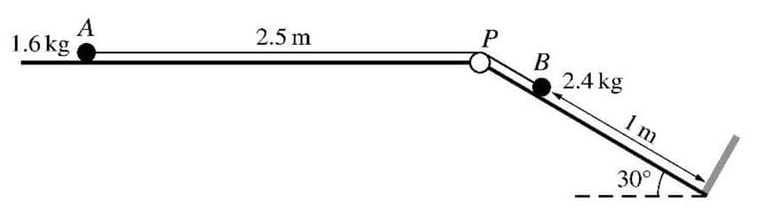
As shown in the diagram, a particle A of mass 1.6 kg lies on a horizontal plane and a particle B of mass 2.4 kg lies on a plane inclined at an angle of 30° to the horizontal. The particles are connected by a light inextensible string which passes over a small smooth pulley P fixed at the top of the inclined plane. The distance AP is 2.5 m and the distance of B from the bottom of the inclined plane is 1 m. There is a barrier at the bottom of the inclined plane preventing any further motion of B. The part BP of the string is parallel to a line of greatest slope of the inclined plane. The particles are released from rest with both parts of the string taut.
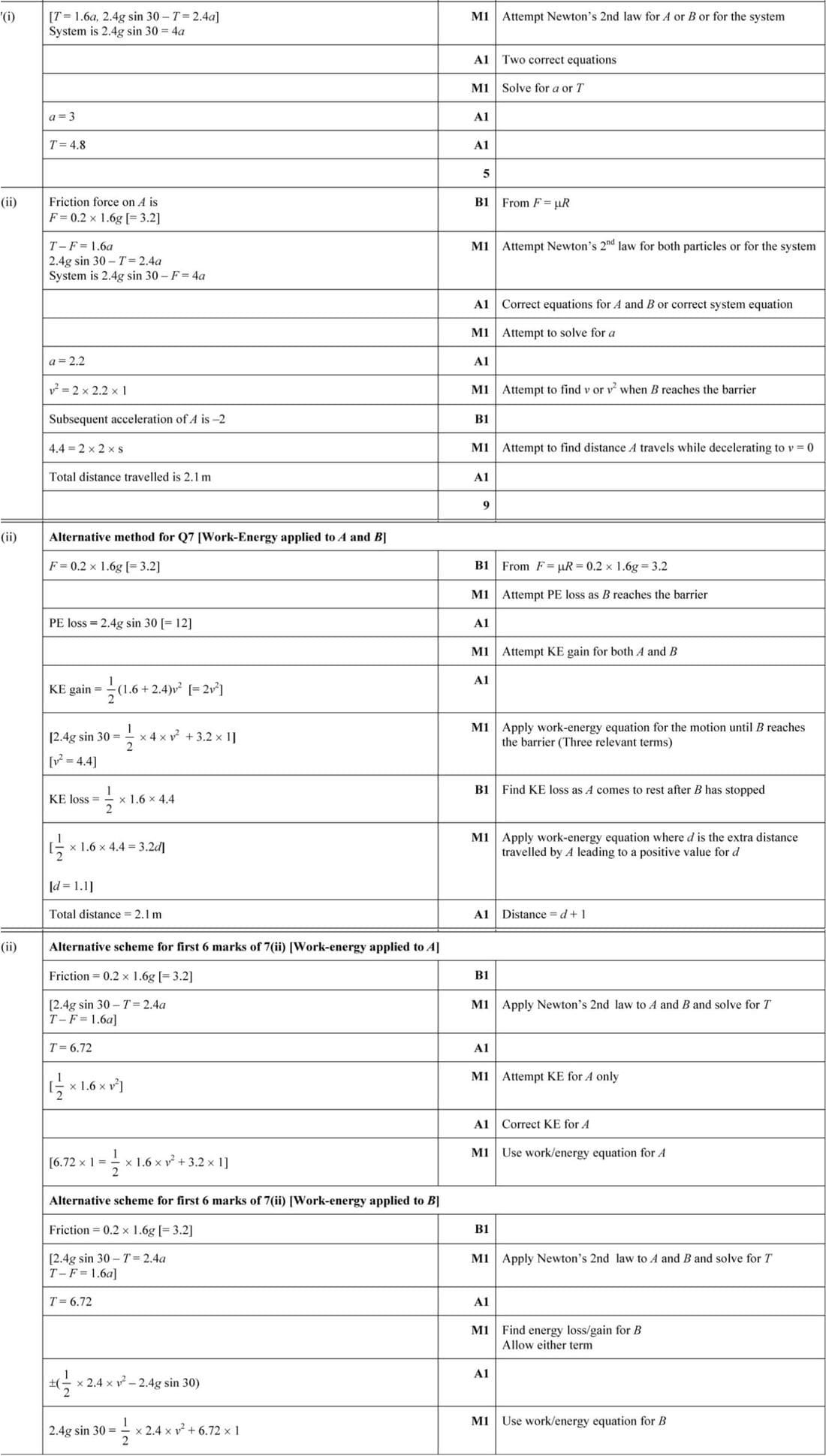
(i) Given that both planes are smooth, find the acceleration of A and the tension in the string. [5]
(ii) It is given instead that the horizontal plane is rough and that the coefficient of friction between A and the horizontal plane is 0.2. The inclined plane is smooth. Find the total distance travelled by A. [9]
June 2017 p42 q6
3901
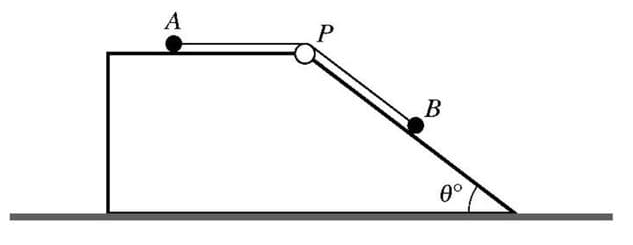
The diagram shows a fixed block with a horizontal top surface and a surface which is inclined at an angle of \(\theta^\circ\) to the horizontal, where \(\sin \theta = \frac{3}{5}\). A particle \(A\) of mass 0.3 kg rests on the horizontal surface and is attached to one end of a light inextensible string. The string passes over a small smooth pulley \(P\) fixed at the edge of the block. The other end of the string is attached to a particle \(B\) of mass 1.5 kg which rests on the sloping surface of the block. The system is released from rest with the string taut.
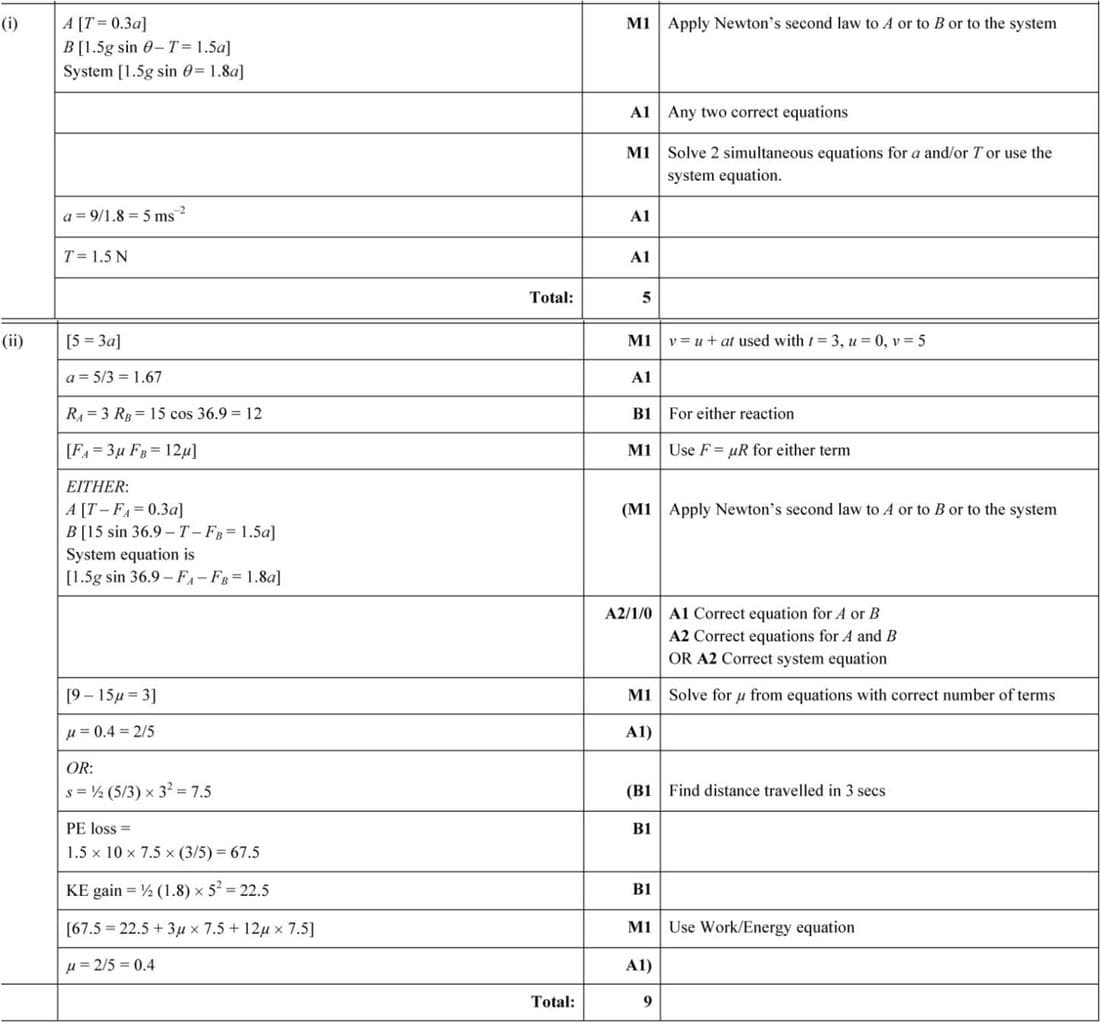
- Given that the block is smooth, find the acceleration of particle \(A\) and the tension in the string. [5]
- It is given instead that the block is rough. The coefficient of friction between \(A\) and the block is \(\mu\) and the coefficient of friction between \(B\) and the block is also \(\mu\). In the first 3 seconds of the motion, \(A\) does not reach \(P\) and \(B\) does not reach the bottom of the sloping surface. The speed of the particles after 3 s is 5 m s\(^{-1}\). Find the acceleration of particle \(A\) and the value of \(\mu\). [9]
Nov 2016 p41 q1
3902
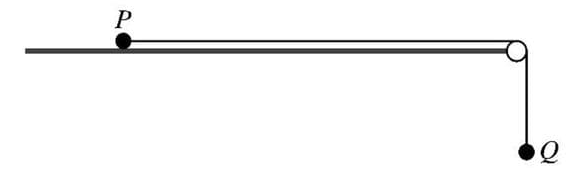
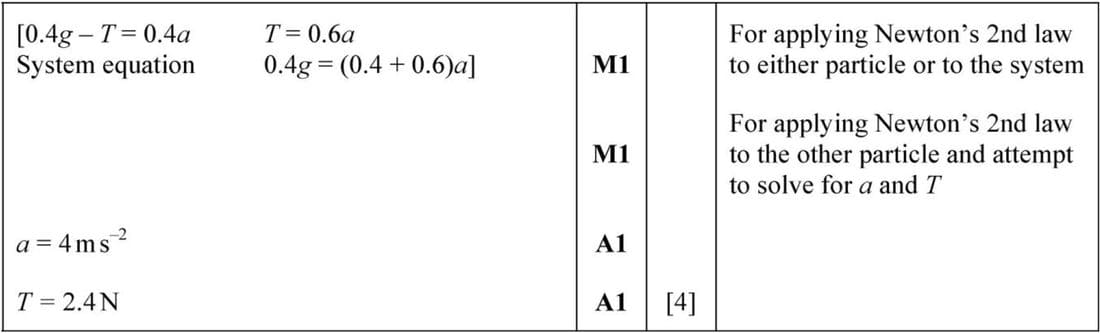
Two particles P and Q, of masses 0.6 kg and 0.4 kg respectively, are connected by a light inextensible string. The string passes over a small smooth light pulley fixed at the edge of a smooth horizontal table. Initially P is held at rest on the table and Q hangs vertically (see diagram). P is then released. Find the tension in the string and the acceleration of Q.
June 2010 p41 q6
3903
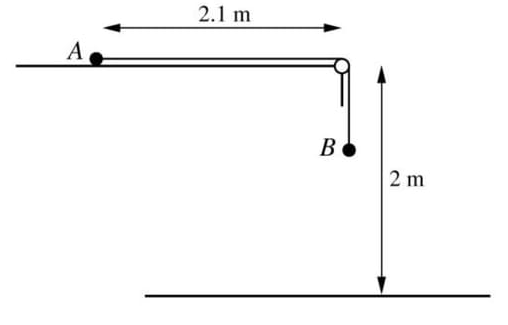
Particles A and B, of masses 0.2 kg and 0.45 kg respectively, are connected by a light inextensible string of length 2.8 m. The string passes over a small smooth pulley at the edge of a rough horizontal surface, which is 2 m above the floor. Particle A is held in contact with the surface at a distance of 2.1 m from the pulley and particle B hangs freely (see diagram). The coefficient of friction between A and the surface is 0.3. Particle A is released and the system begins to move.
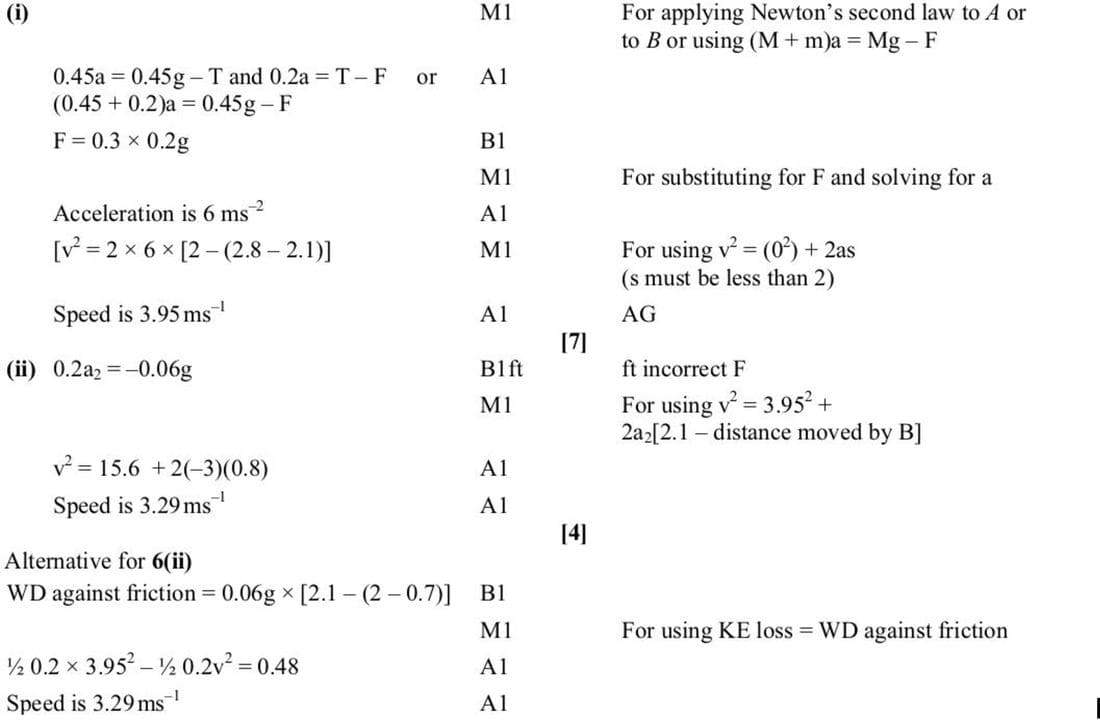
- Find the acceleration of the particles and show that the speed of B immediately before it hits the floor is 3.95 m s-1, correct to 3 significant figures.
- Given that B remains on the floor, find the speed with which A reaches the pulley.