Exam-Style Problems
⬅ Back to SubchapterJune 2014 p41 q4
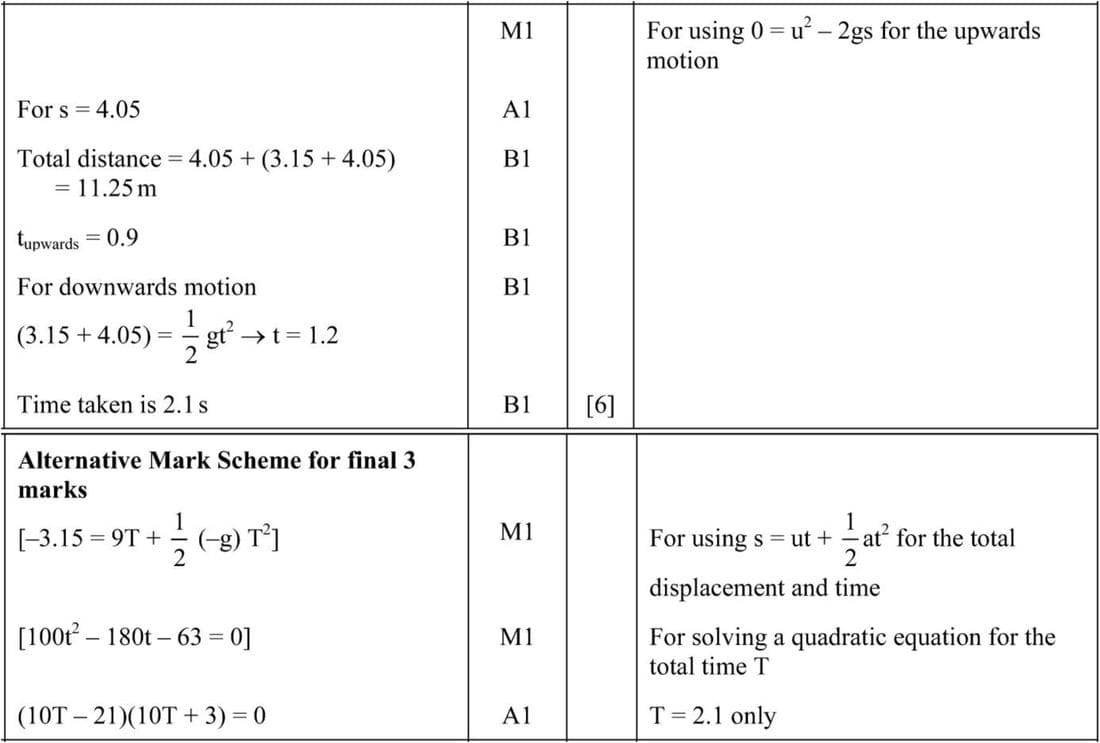
A particle is projected vertically upwards with speed 9 m s-1 from a point 3.15 m above horizontal ground. The particle moves freely under gravity until it hits the ground. For the particle’s motion from the instant of projection until the particle hits the ground, find the total distance travelled and the total time taken.
June 2013 p43 q5
A particle P is projected vertically upwards from a point on the ground with speed 17 m s-1. Another particle Q is projected vertically upwards from the same point with speed 7 m s-1. Particle Q is projected T seconds later than particle P.
- Given that the particles reach the ground at the same instant, find the value of T.
- At a certain instant when both P and Q are in motion, P is 5 m higher than Q. Find the magnitude and direction of the velocity of each of the particles at this instant.

June 2013 p41 q3
The top of a cliff is 40 metres above the level of the sea. A man in a boat, close to the bottom of the cliff, is in difficulty and fires a distress signal vertically upwards from sea level. Find
- the speed of projection of the signal given that it reaches a height of 5 m above the top of the cliff,
- the length of time for which the signal is above the level of the top of the cliff.
The man fires another distress signal vertically upwards from sea level. This signal is above the level of the top of the cliff for \(\sqrt{17}\) s.
- Find the speed of projection of the second signal.

Nov 2012 p43 q3
A particle P is projected vertically upwards, from a point O, with a velocity of 8 m s-1. The point A is the highest point reached by P. Find
- the speed of P when it is at the mid-point of OA,
- the time taken for P to reach the mid-point of OA while moving upwards.

Nov 2012 p41 q1
An object is released from rest at a height of 125 m above horizontal ground and falls freely under gravity, hitting a moving target \(P\). The target \(P\) is moving on the ground in a straight line, with constant acceleration \(0.8 \, \text{m/s}^2\). At the instant the object is released \(P\) passes through a point \(O\) with speed \(5 \, \text{m/s}\). Find the distance from \(O\) to the point where \(P\) is hit by the object.
