Exam-Style Problems
⬅ Back to SubchapterFeb/Mar 2019 p42 q5
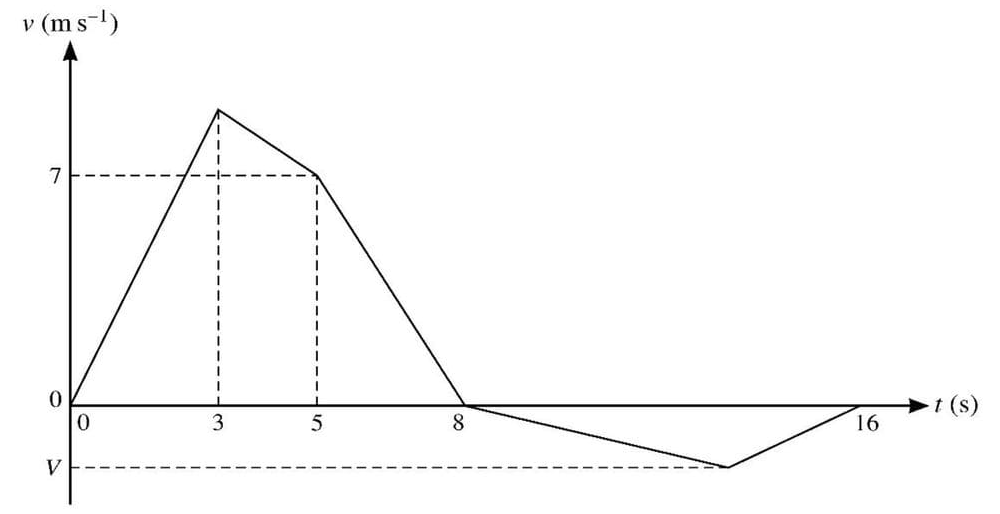
The velocity of a particle moving in a straight line is \(v \text{ m s}^{-1}\) at time \(t\) seconds after leaving a fixed point \(O\). The diagram shows a velocity-time graph which models the motion of the particle from \(t = 0\) to \(t = 16\). The graph consists of five straight line segments. The acceleration of the particle from \(t = 0\) to \(t = 3\) is \(3 \text{ m s}^{-2}\). The velocity of the particle at \(t = 5\) is \(7 \text{ m s}^{-1}\) and it comes to instantaneous rest at \(t = 8\). The particle then comes to rest again at \(t = 16\). The minimum velocity of the particle is \(V \text{ m s}^{-1}\).
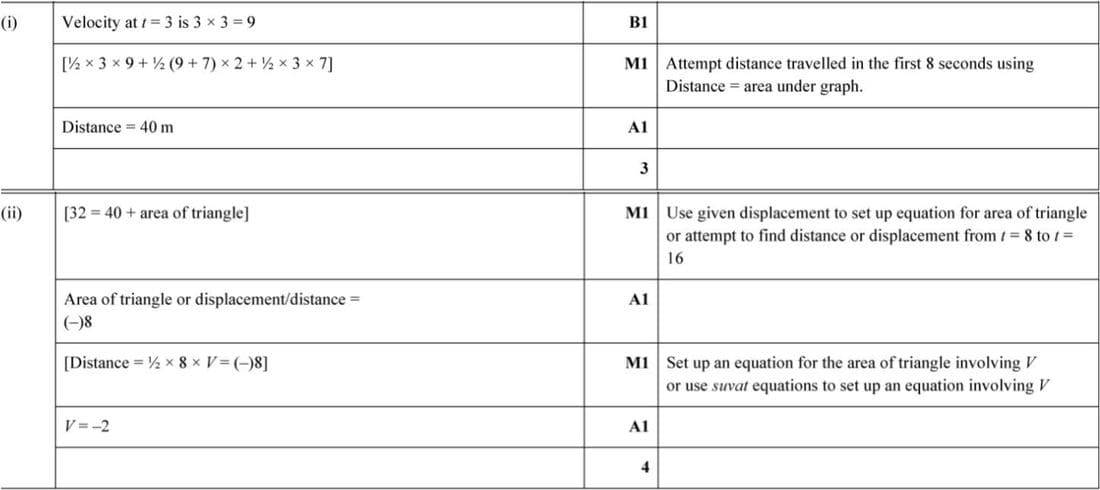
(i) Find the distance travelled by the particle in the first 8 s of its motion.
(ii) Given that when the particle comes to rest at \(t = 16\) its displacement from \(O\) is 32 m, find the value of \(V\).
Nov 2018 p42 q3
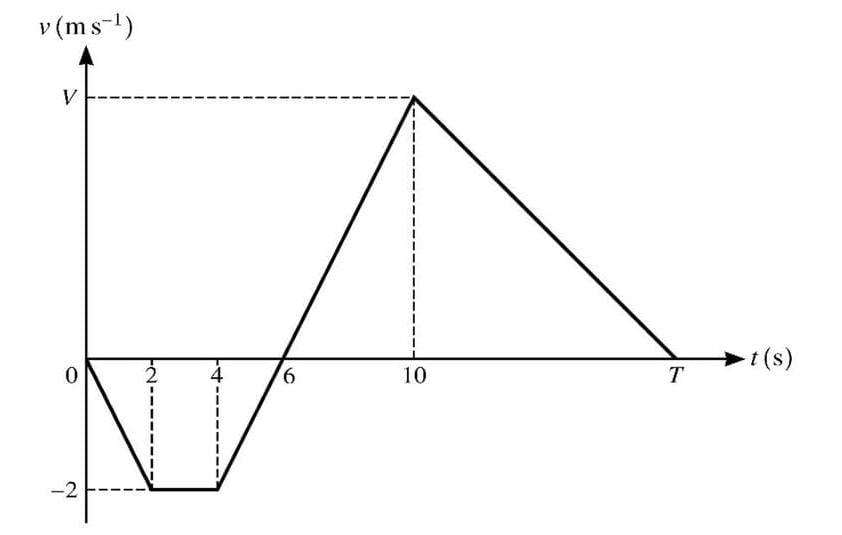
The velocity of a particle moving in a straight line is \(v\) m s-1 at time \(t\) seconds. The diagram shows a velocity-time graph which models the motion of the particle from \(t = 0\) to \(t = T\). The graph consists of four straight line segments. The particle reaches its maximum velocity \(V\) m s-1 at \(t = 10\).
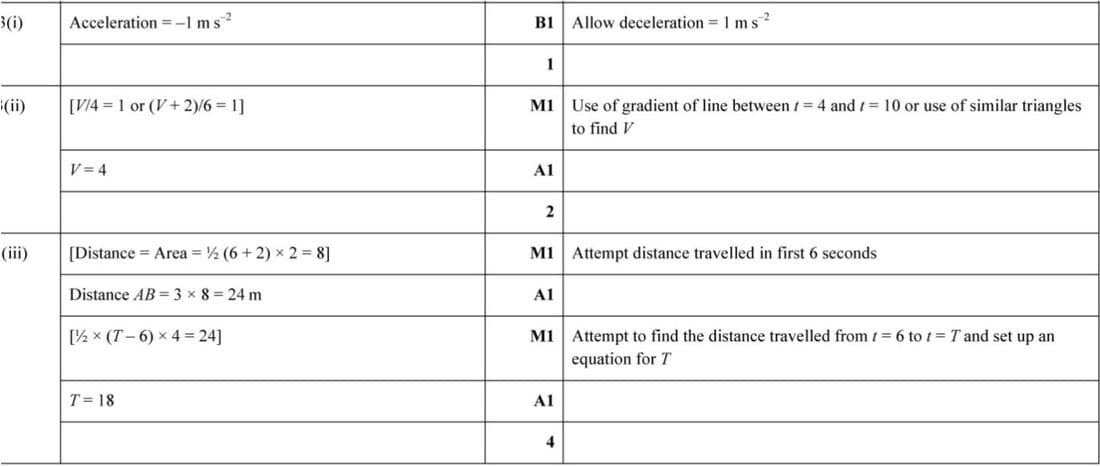
(i) Find the acceleration of the particle during the first 2 seconds.
(ii) Find the value of \(V\).
At \(t = 6\), the particle is instantaneously at rest at the point \(A\). At \(t = T\), the particle comes to rest at the point \(B\). At \(t = 0\) the particle starts from rest at a point one third of the way from \(A\) to \(B\).
(iii) Find the distance \(AB\) and hence find the value of \(T\).
June 2018 p43 q1
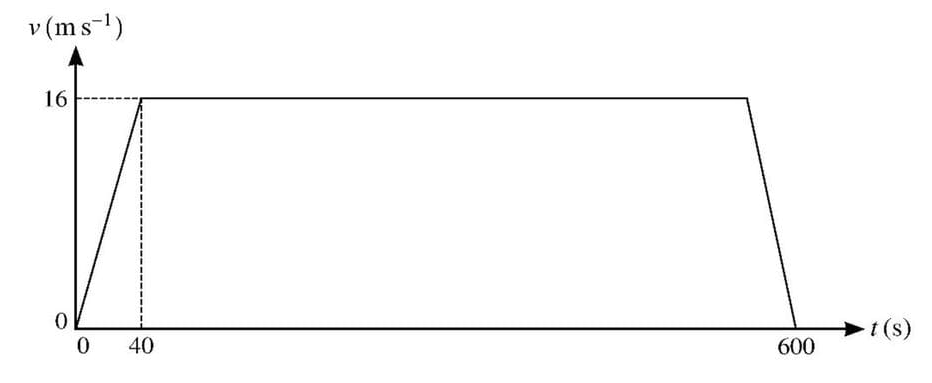
The diagram shows the velocity-time graph for a train which travels from rest at one station to rest at the next station. The graph consists of three straight line segments. The distance between the two stations is 9040 m.
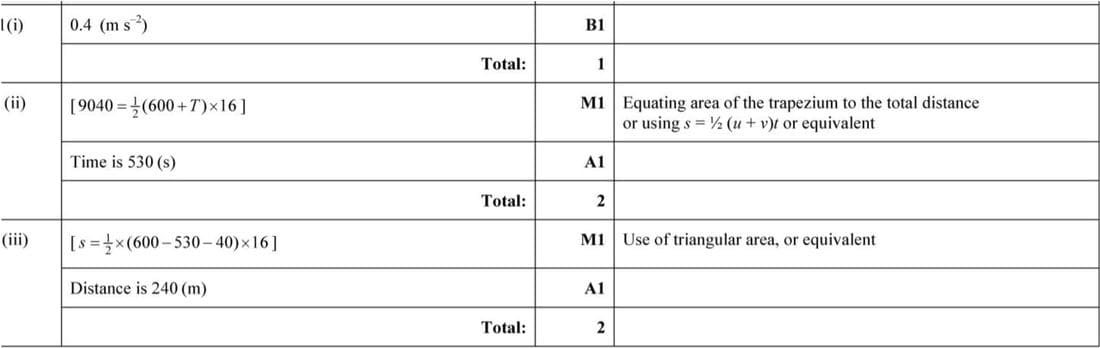
- Find the acceleration of the train during the first 40 s.
- Find the length of time for which the train is travelling at constant speed.
- Find the distance travelled by the train while it is decelerating.
Nov 2005 p4 q5
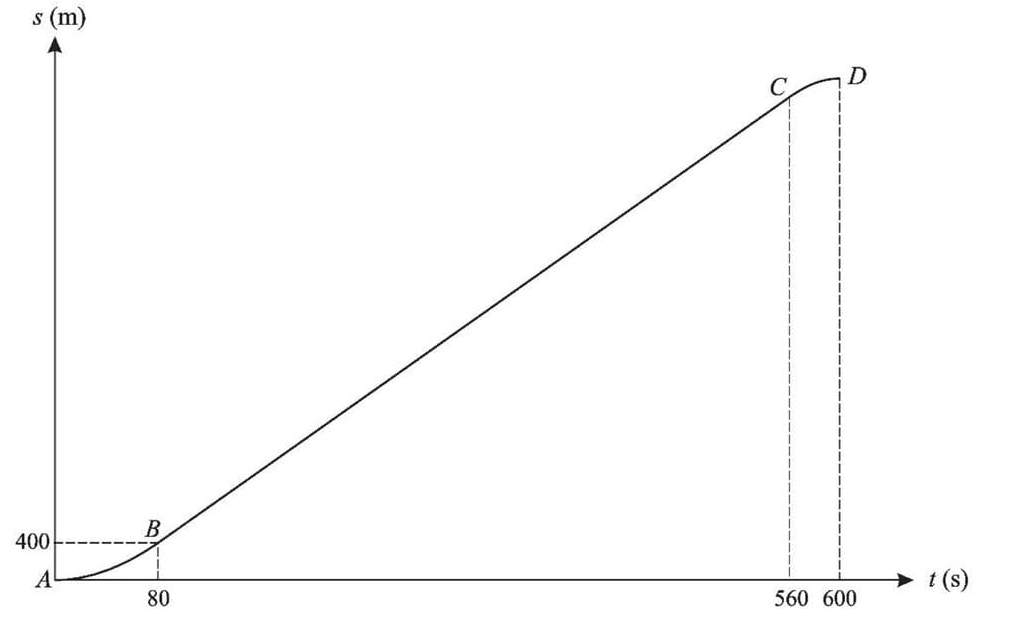
The diagram shows the displacement-time graph for a car’s journey. The graph consists of two curved parts AB and CD, and a straight line BC. The line BC is a tangent to the curve AB at B and a tangent to the curve CD at C. The gradient of the curves at t = 0 and t = 600 is zero, and the acceleration of the car is constant for 0 < t < 80 and for 560 < t < 600. The displacement of the car is 400 m when t = 80.
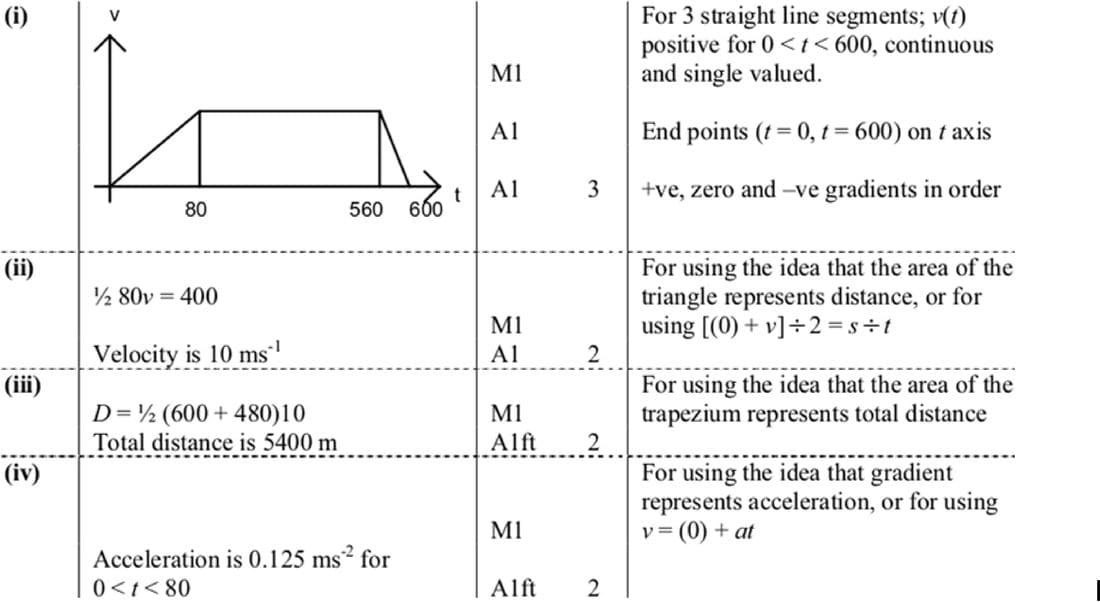
- Sketch the velocity-time graph for the journey.
- Find the velocity at t = 80.
- Find the total distance for the journey.
- Find the acceleration of the car for 0 < t < 80.
June 2022 p42 q4
A particle A, moving along a straight horizontal track with constant speed 8 m/s, passes a fixed point O. Four seconds later, another particle B passes O, moving along a parallel track in the same direction as A. Particle B has speed 20 m/s when it passes O and has a constant deceleration of 2 m/s². B comes to rest when it returns to O.
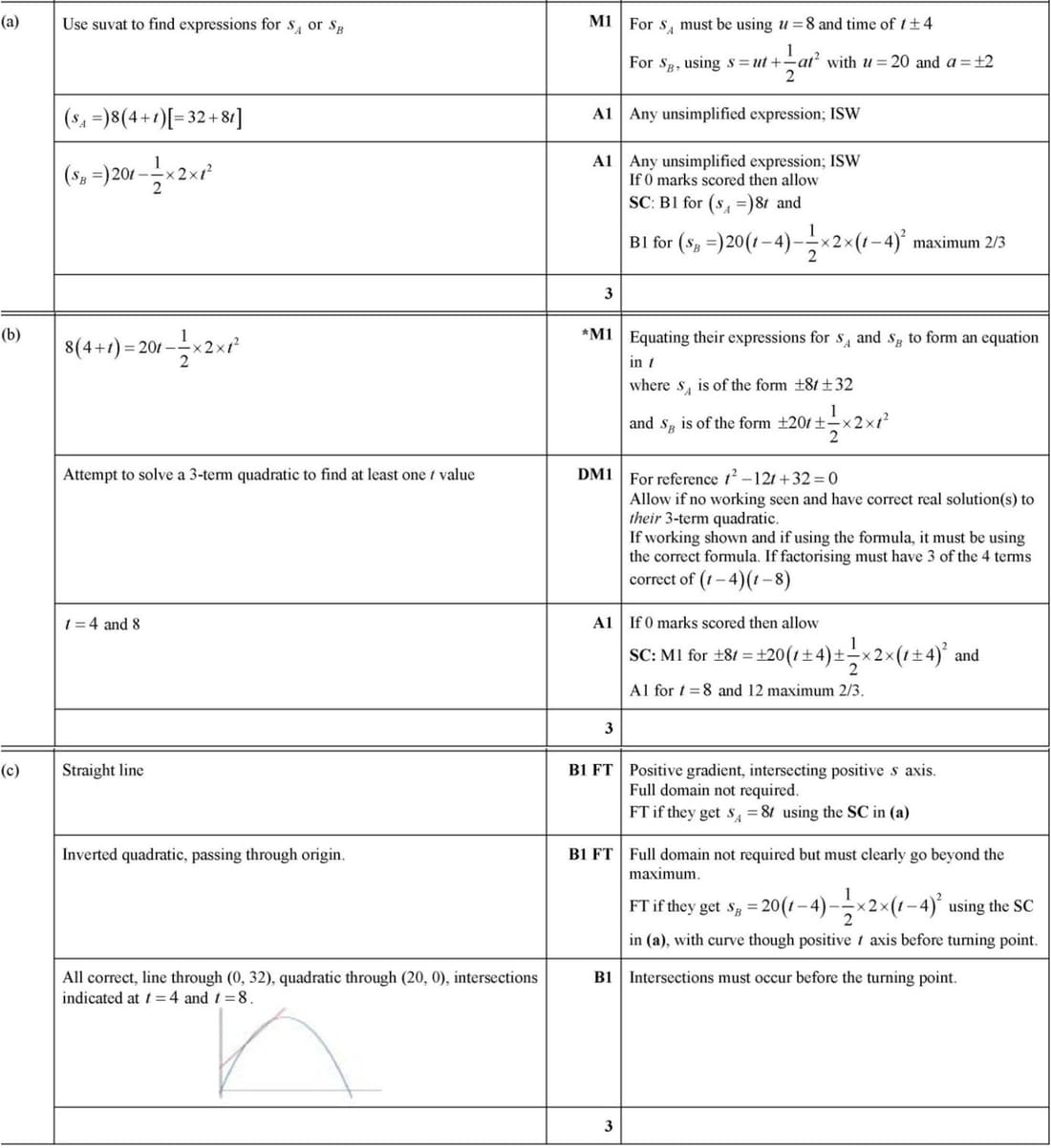
(a) Find expressions, in terms of t, for the displacement from O of each particle t seconds after B passes O.
(b) Find the values of t when the particles are the same distance from O.
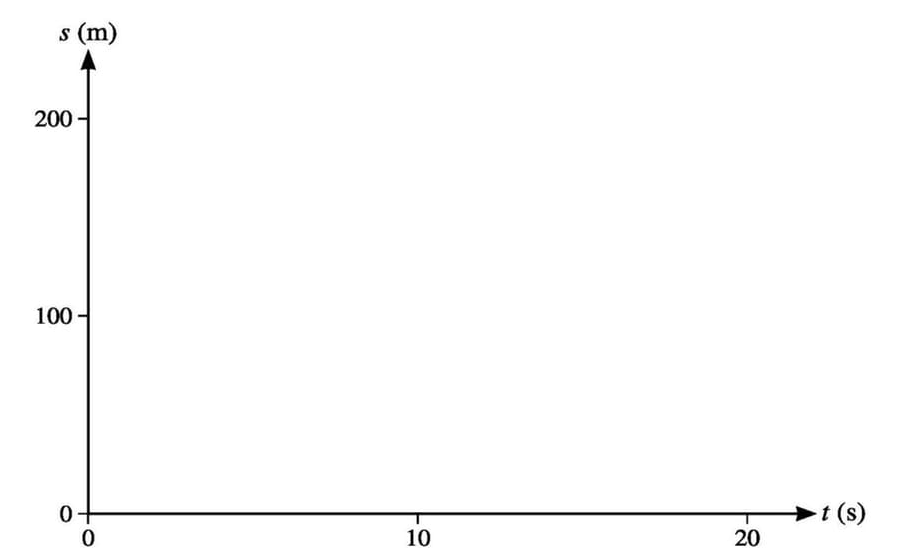
(c) On the given axes, sketch the displacement-time graphs for both particles, for values of t from 0 to 20.
Diagram: A graph with s (m) on the vertical axis and t (s) on the horizontal axis, ranging from 0 to 20.