Exam-Style Problems
⬅ Back to SubchapterJune 2019 p63 q6
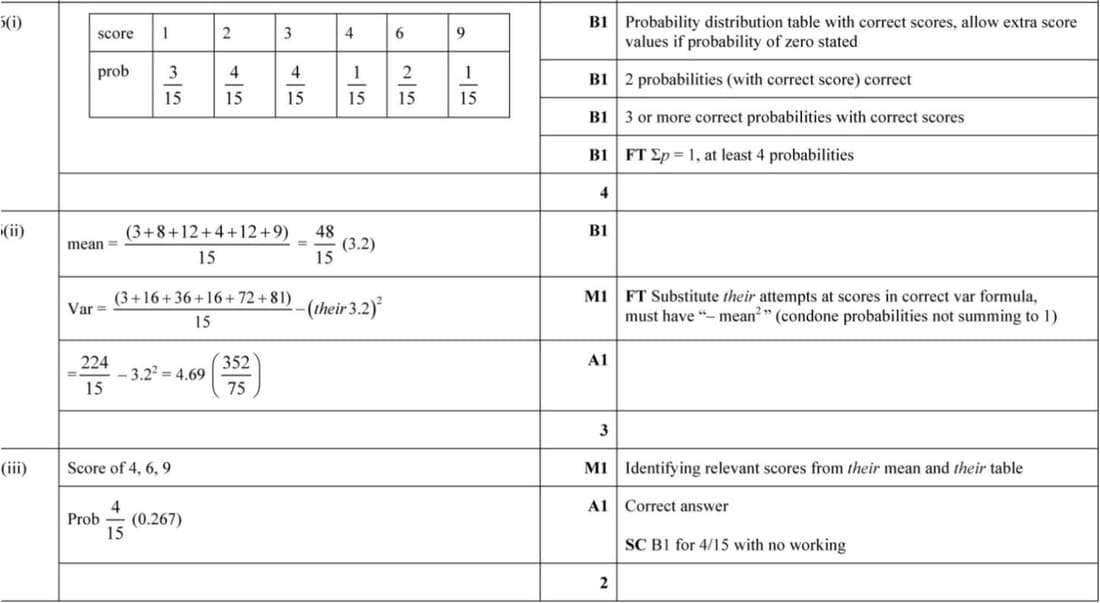
A fair five-sided spinner has sides numbered 1, 1, 1, 2, 3. A fair three-sided spinner has sides numbered 1, 2, 3. Both spinners are spun once and the score is the product of the numbers on the sides the spinners land on.
- Draw up the probability distribution table for the score.
- Find the mean and the variance of the score.
- Find the probability that the score is greater than the mean score.
June 2019 p62 q5
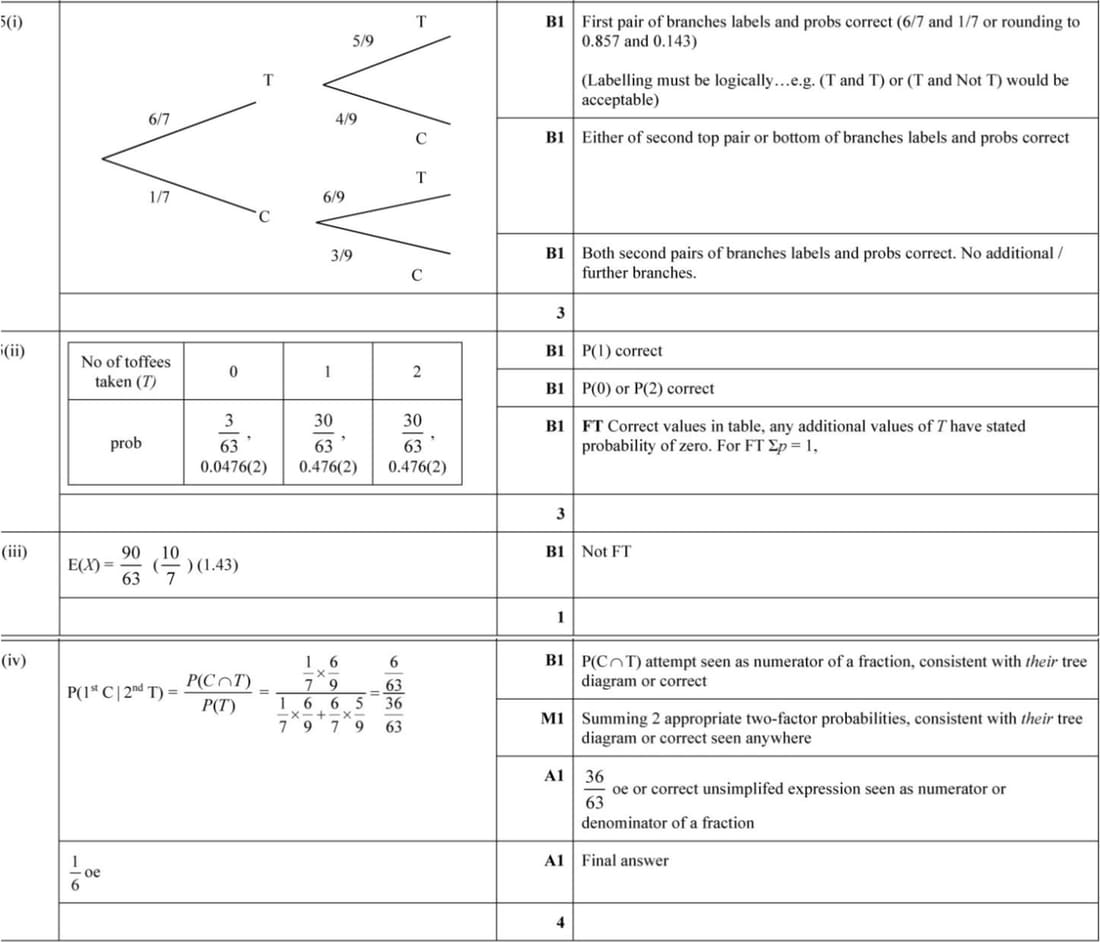
Maryam has 7 sweets in a tin; 6 are toffees and 1 is a chocolate. She chooses one sweet at random and takes it out. Her friend adds 3 chocolates to the tin. Then Maryam takes another sweet at random out of the tin.
- Draw a fully labelled tree diagram to illustrate this situation.
- Draw up the probability distribution table for the number of toffees taken.
- Find the mean number of toffees taken.
- Find the probability that the first sweet taken is a chocolate, given that the second sweet taken is a toffee.
June 2019 p61 q6
At a funfair, Amy pays $1 for two attempts to make a bell ring by shooting at it with a water pistol.
- If she makes the bell ring on her first attempt, she receives $3 and stops playing. This means that overall she has gained $2.
- If she makes the bell ring on her second attempt, she receives $1.50 and stops playing. This means that overall she has gained $0.50.
- If she does not make the bell ring in the two attempts, she has lost her original $1.
The probability that Amy makes the bell ring on any attempt is 0.2, independently of other attempts.
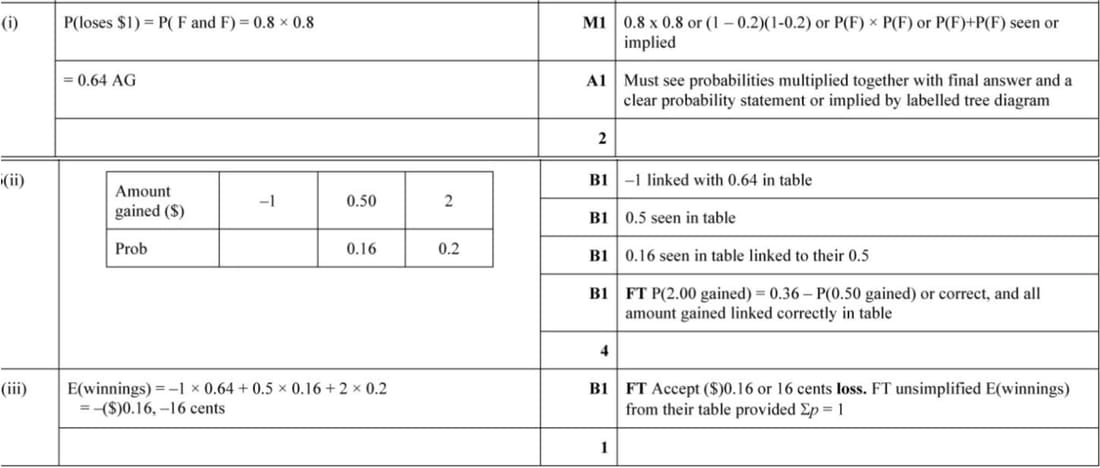
- Show that the probability that Amy loses her original $1 is 0.64. [2]
- Complete the probability distribution table for the amount that Amy gains. [4]
- Calculate Amy’s expected gain. [1]
Feb/Mar 2019 p62 q4
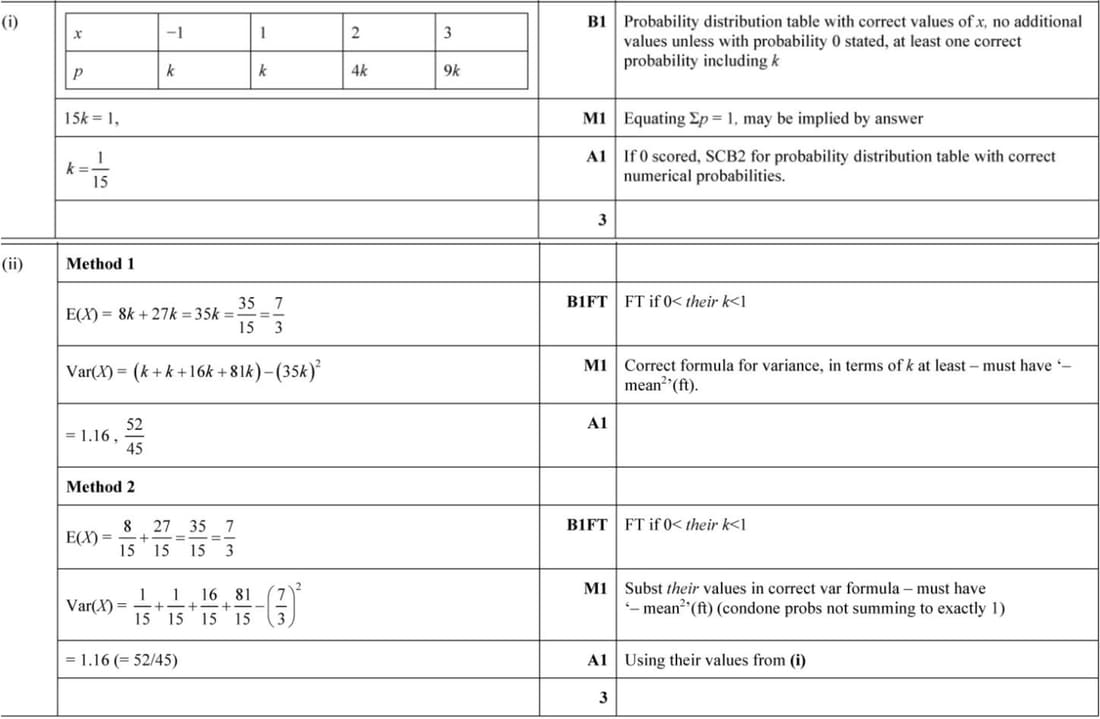
The random variable X takes the values -1, 1, 2, 3 only. The probability that X takes the value x is kx2, where k is a constant.
- Draw up the probability distribution table for X, in terms of k, and find the value of k.
- Find E(X) and Var(X).
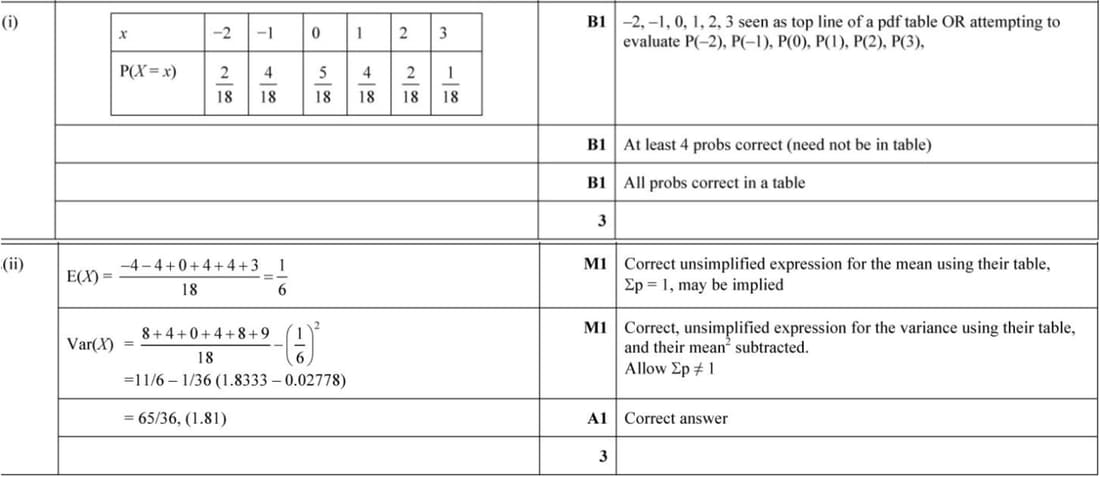
Nov 2018 p63 q2
A fair 6-sided die has the numbers -1, -1, 0, 0, 1, 2 on its faces. A fair 3-sided spinner has edges numbered -1, 0, 1. The die is thrown and the spinner is spun. The number on the uppermost face of the die and the number on the edge on which the spinner comes to rest are noted. The sum of these two numbers is denoted by X.
- Draw up a table showing the probability distribution of X.
- Find \(\text{Var}(X)\).