Exam-Style Problems
⬅ Back to SubchapterJune 2012 p63 q5
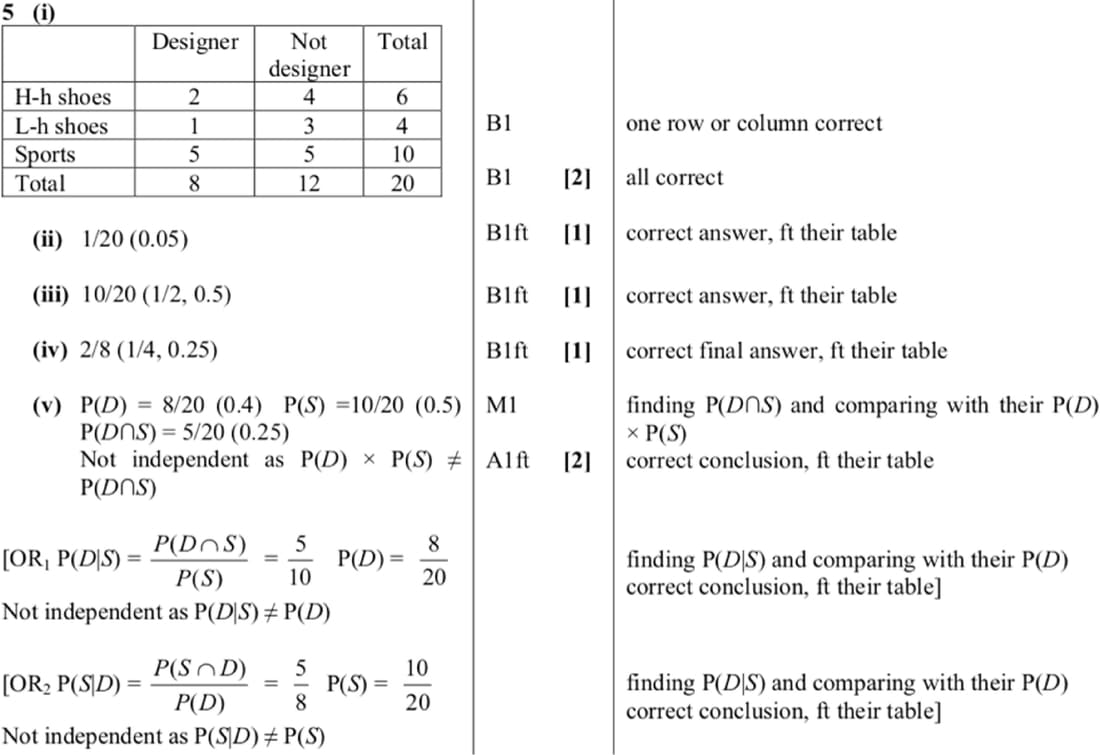
Suzanne has 20 pairs of shoes, some of which have designer labels. She has 6 pairs of high-heeled shoes, of which 2 pairs have designer labels. She has 4 pairs of low-heeled shoes, of which 1 pair has designer labels. The rest of her shoes are pairs of sports shoes. Suzanne has 8 pairs of shoes with designer labels in total.
(i) Copy and complete the table below to show the number of pairs in each category.
| Designer labels | No designer labels | Total |
|---|---|---|
| High-heeled shoes | 6 | |
| Low-heeled shoes | 4 | |
| Sports shoes | ||
| Total | 20 |
Suzanne chooses 1 pair of shoes at random to wear.
(ii) Find the probability that she wears the pair of low-heeled shoes with designer labels.
(iii) Find the probability that she wears a pair of sports shoes.
(iv) Find the probability that she wears a pair of high-heeled shoes, given that she wears a pair of shoes with designer labels.
(v) State with a reason whether the events ‘Suzanne wears a pair of shoes with designer labels’ and ‘Suzanne wears a pair of sports shoes’ are independent.
Nov 2011 p63 q2
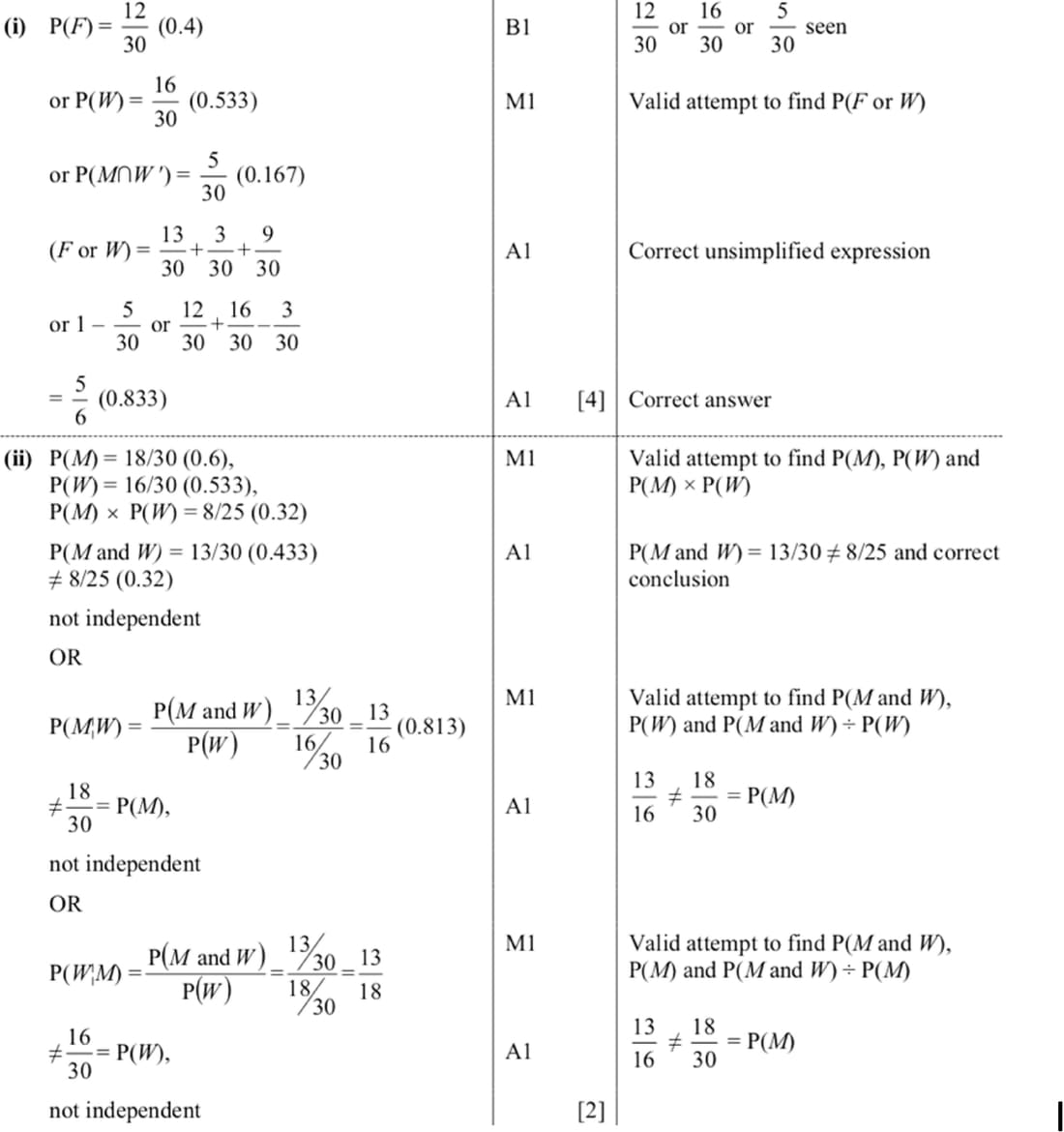
In a group of 30 teenagers, 13 of the 18 males watch 'Kops are Kids' on television and 3 of the 12 females watch 'Kops are Kids'.
(i) Find the probability that a person chosen at random from the group is either female or watches 'Kops are Kids' or both.
(ii) Showing your working, determine whether the events 'the person chosen is male' and 'the person chosen watches Kops are Kids' are independent or not.
Nov 2011 p61 q7
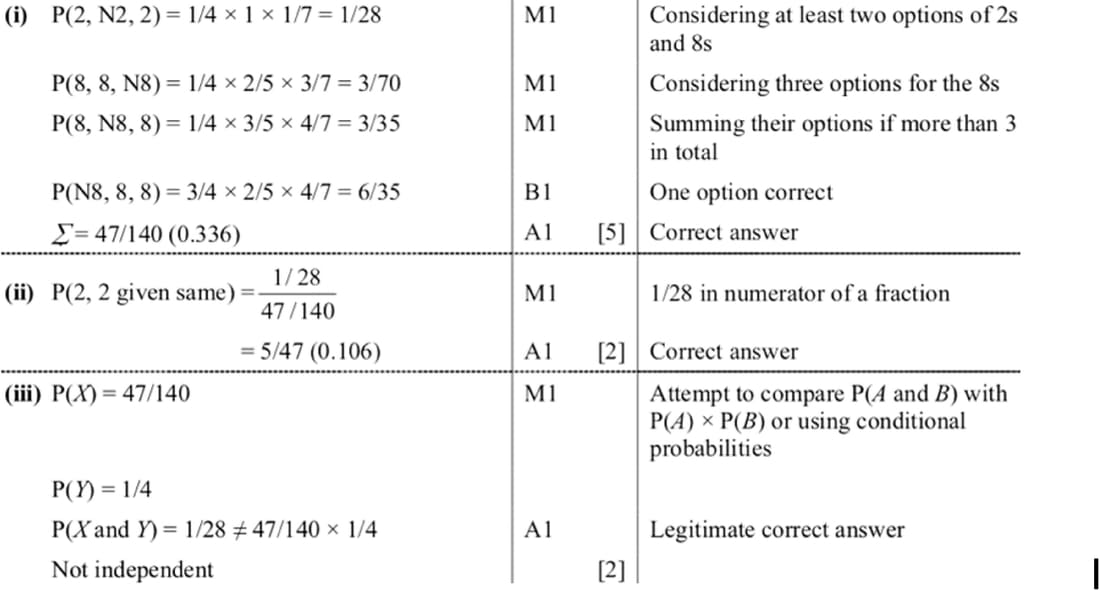
Bag A contains 4 balls numbered 2, 4, 5, 8. Bag B contains 5 balls numbered 1, 3, 6, 8, 8. Bag C contains 7 balls numbered 2, 7, 8, 8, 8, 8, 9. One ball is selected at random from each bag.
- Find the probability that exactly two of the selected balls have the same number.
- Given that exactly two of the selected balls have the same number, find the probability that they are both numbered 2.
- Event X is ‘exactly two of the selected balls have the same number’. Event Y is ‘the ball selected from bag A has number 2’. Showing your working, determine whether events X and Y are independent or not.
June 2011 p63 q4
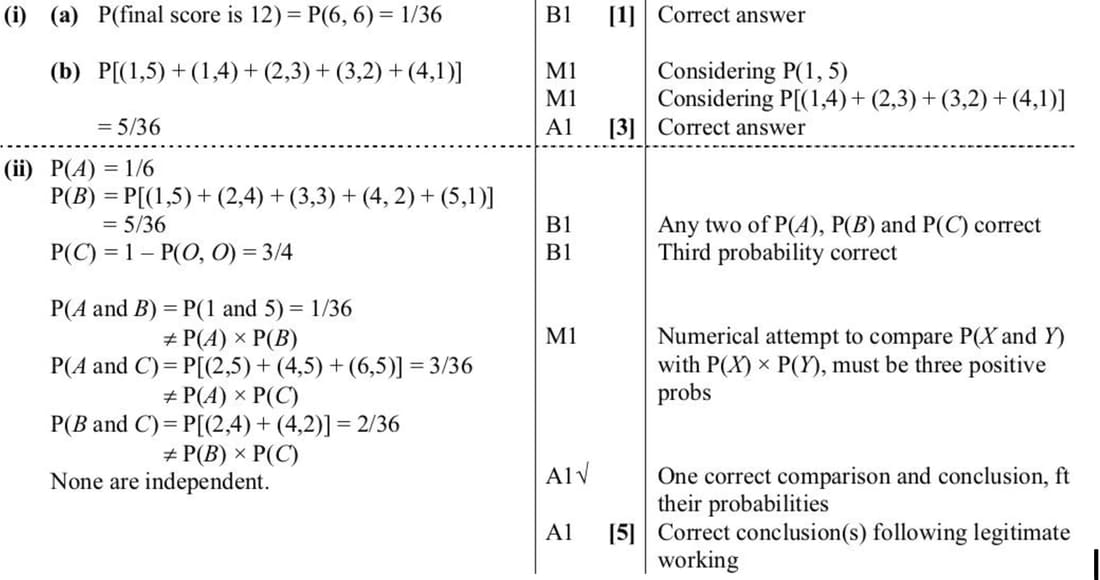
Tim throws a fair die twice and notes the number on each throw.
(i) Tim calculates his final score as follows. If the number on the second throw is a 5 he multiplies the two numbers together, and if the number on the second throw is not a 5 he adds the two numbers together. Find the probability that his final score is
(a) 12,
(b) 5.
(ii) Events A, B, C are defined as follows.
A: the number on the second throw is 5
B: the sum of the numbers is 6
C: the product of the numbers is even
By calculation find which pairs, if any, of the events A, B and C are independent.
June 2010 p62 q5
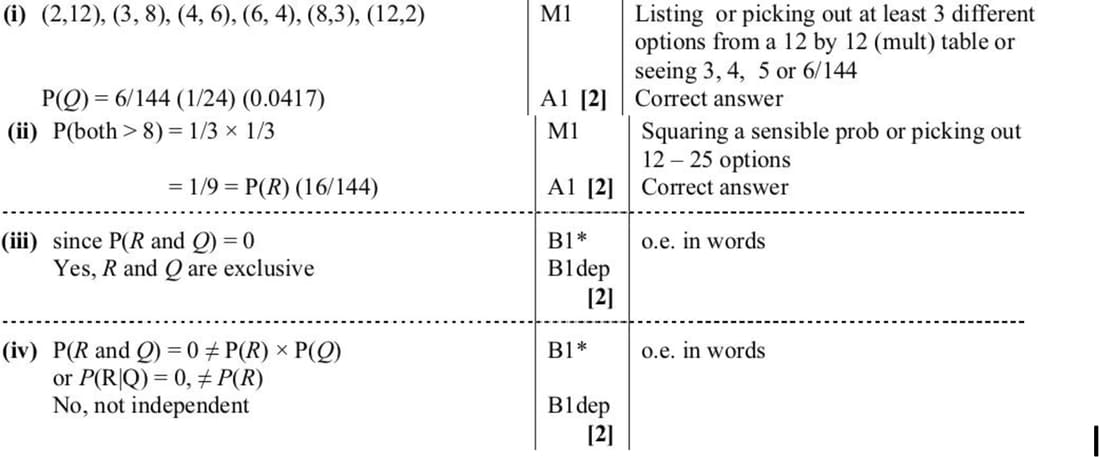
Two fair twelve-sided dice with sides marked 1, 2, 3, 4, 5, 6, 7, 8, 9, 10, 11, 12 are thrown, and the numbers on the sides which land face down are noted. Events \(Q\) and \(R\) are defined as follows.
\(Q\): the product of the two numbers is 24.
\(R\): both of the numbers are greater than 8.
- Find \(P(Q)\). [2]
- Find \(P(R)\). [2]
- Are events \(Q\) and \(R\) exclusive? Justify your answer. [2]
- Are events \(Q\) and \(R\) independent? Justify your answer. [2]