Exam-Style Problems
⬅ Back to SubchapterJune 2012 p31 q7
2339
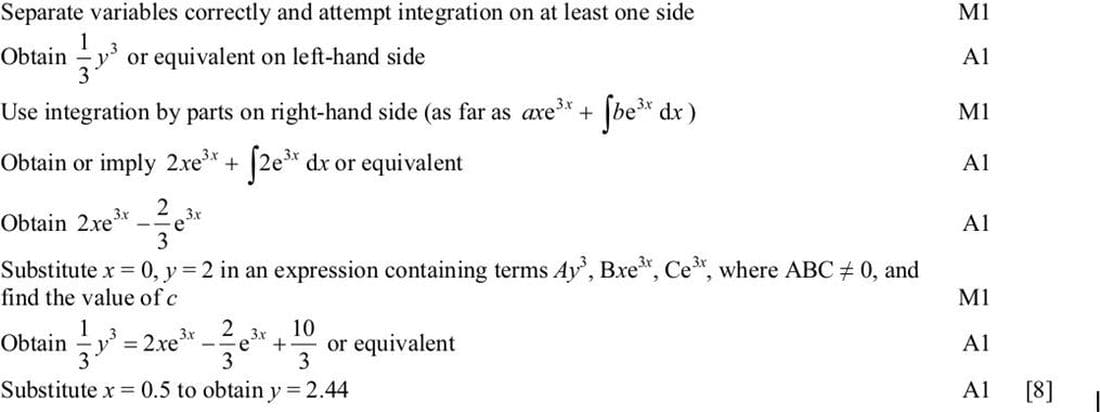
The variables x and y are related by the differential equation \(\frac{dy}{dx} = \frac{6xe^{3x}}{y^2}\).
It is given that \(y = 2\) when \(x = 0\). Solve the differential equation and hence find the value of \(y\) when \(x = 0.5\), giving your answer correct to 2 decimal places.
Nov 2023 p33 q8
2340
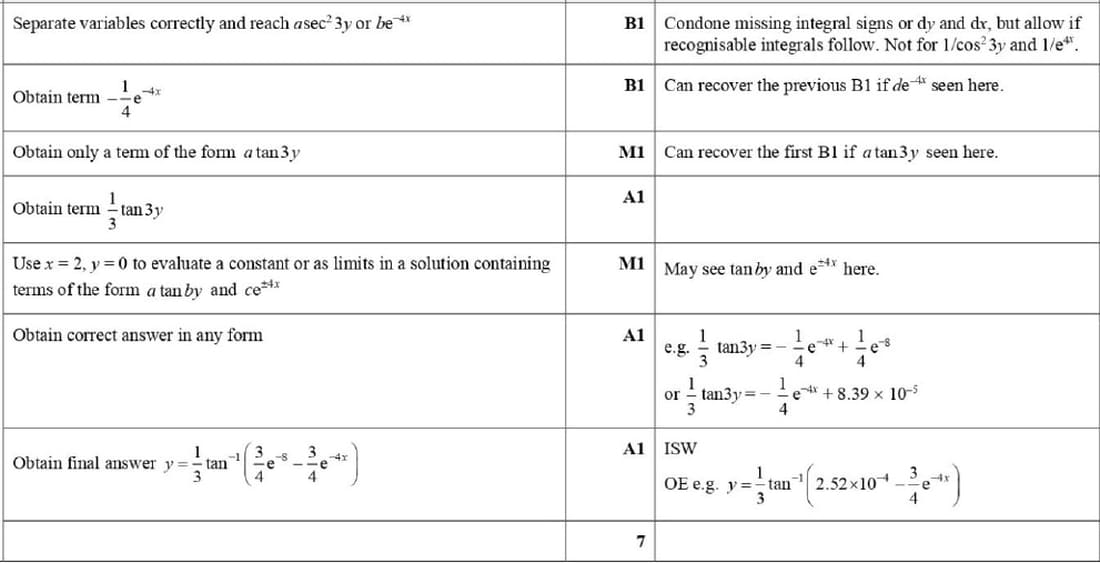
The variables x and y satisfy the differential equation
\(e^{4x} \frac{dy}{dx} = \cos^2 3y\).
It is given that \(y = 0\) when \(x = 2\).
Solve the differential equation, obtaining an expression for y in terms of x.
Feb/Mar 2020 p32 q6
2341
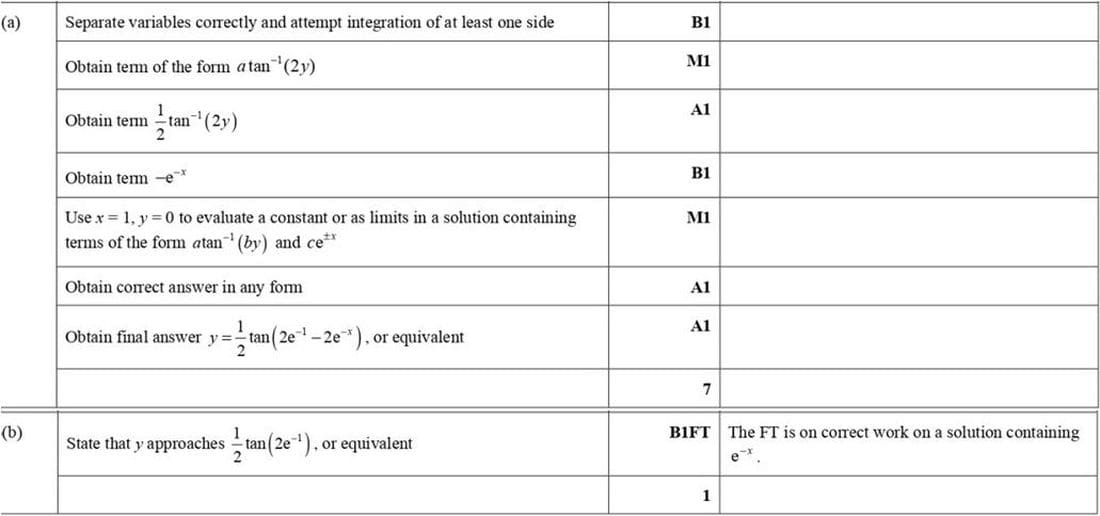
The variables x and y satisfy the differential equation \(\frac{dy}{dx} = \frac{1 + 4y^2}{e^x}\).
It is given that \(y = 0\) when \(x = 1\).
(a) Solve the differential equation, obtaining an expression for y in terms of x.
(b) State what happens to the value of y as x tends to infinity.
Nov 2019 p32 q6
2342
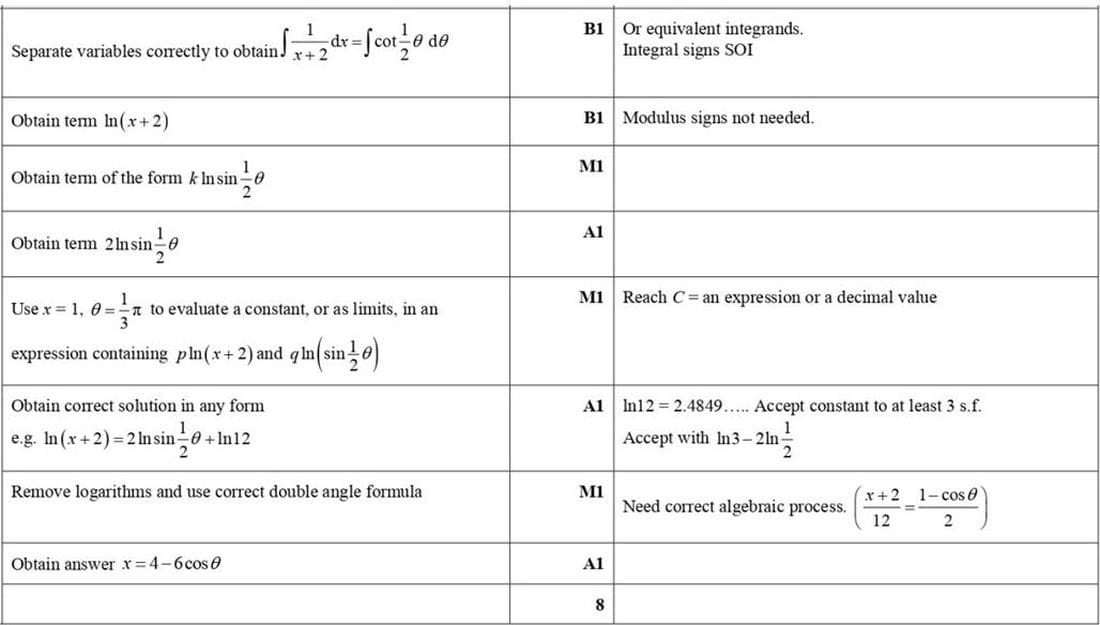
The variables x and θ satisfy the differential equation
\(\sin \frac{1}{2} \theta \frac{dx}{d\theta} = (x + 2) \cos \frac{1}{2} \theta\)
for \(0 < \theta < \pi\). It is given that \(x = 1\) when \(\theta = \frac{1}{3} \pi\). Solve the differential equation and obtain an expression for \(x\) in terms of \(\cos \theta\).
June 2019 p31 q5
2343
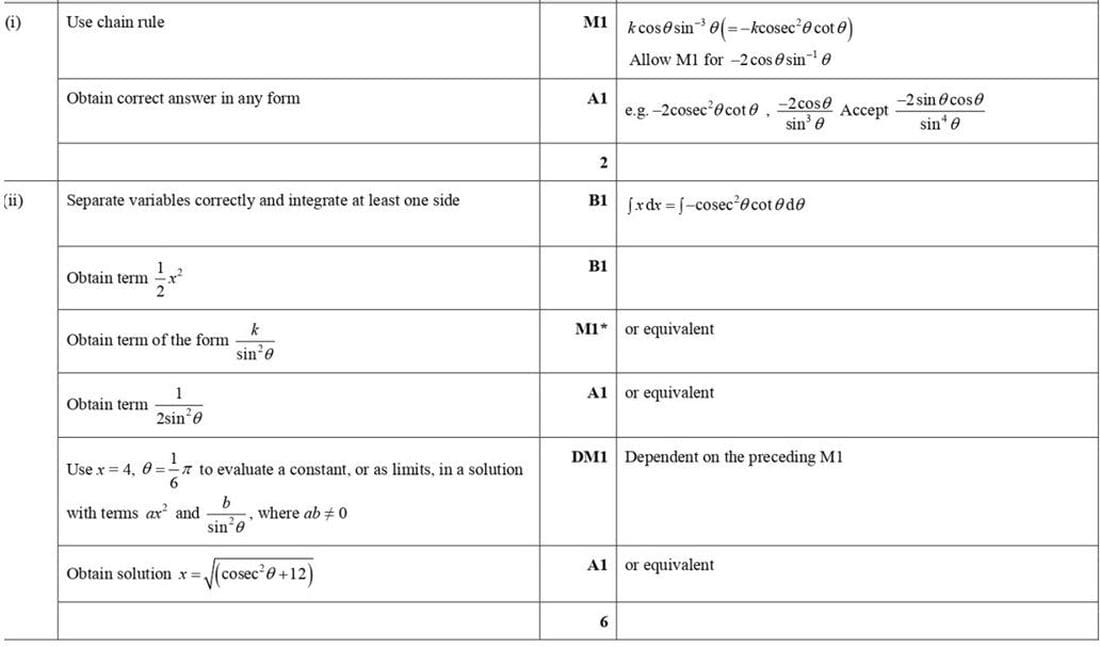
(i) Differentiate \(\frac{1}{\sin^2 \theta}\) with respect to \(\theta\).
(ii) The variables \(x\) and \(\theta\) satisfy the differential equation \(x \tan \theta \frac{dx}{d\theta} + \csc^2 \theta = 0\), for \(0 < \theta < \frac{1}{2}\pi\) and \(x > 0\). It is given that \(x = 4\) when \(\theta = \frac{1}{6}\pi\). Solve the differential equation, obtaining an expression for \(x\) in terms of \(\theta\).