Exam-Style Problems
⬅ Back to SubchapterNov 2021 p33 q10
2294
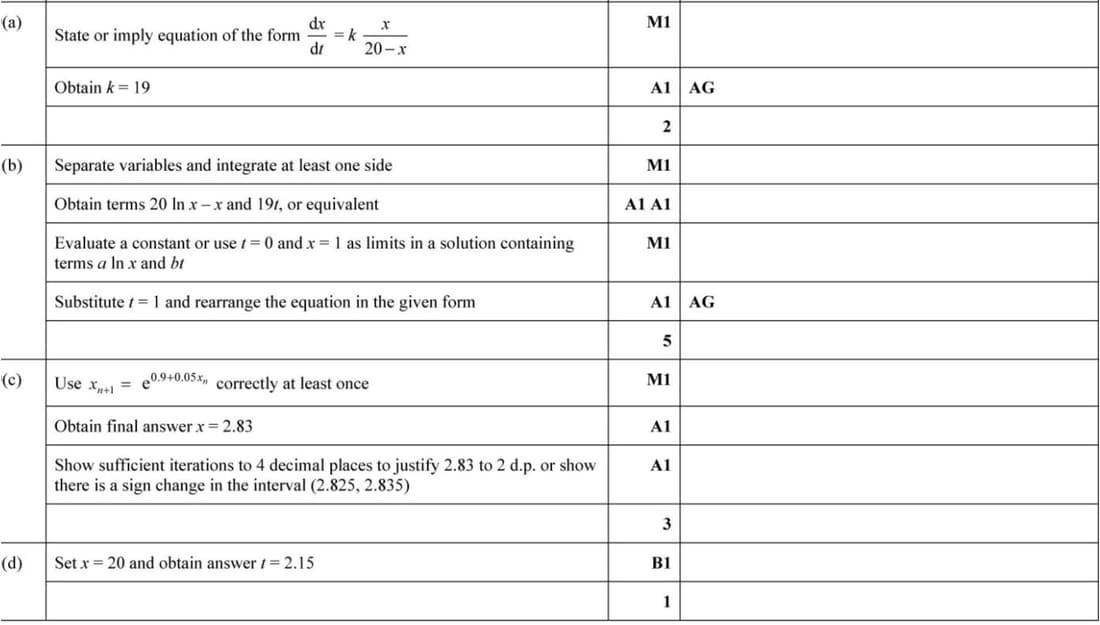
A large plantation of area 20 km2 is becoming infected with a plant disease. At time t years the area infected is x km2 and the rate of increase of x is proportional to the ratio of the area infected to the area not yet infected.
When t = 0, x = 1 and \(\frac{dx}{dt} = 1\).
(a) Show that x and t satisfy the differential equation \(\frac{dx}{dt} = \frac{19x}{20-x}\).
(b) Solve the differential equation and show that when t = 1 the value of x satisfies the equation \(x = e^{0.9 + 0.05x}\).
(c) Use an iterative formula based on the equation in part (b), with an initial value of 2, to determine x correct to 2 decimal places. Give the result of each iteration to 4 decimal places.
(d) Calculate the value of t at which the entire plantation becomes infected.
Feb/Mar 2017 p32 q7
2295
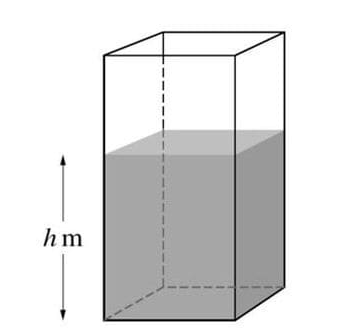
A water tank has vertical sides and a horizontal rectangular base, as shown in the diagram. The area of the base is 2 m2. At time t = 0 the tank is empty and water begins to flow into it at a rate of 1 m3 per hour. At the same time water begins to flow out from the base at a rate of 0.2√h m3 per hour, where h m is the depth of water in the tank at time t hours.
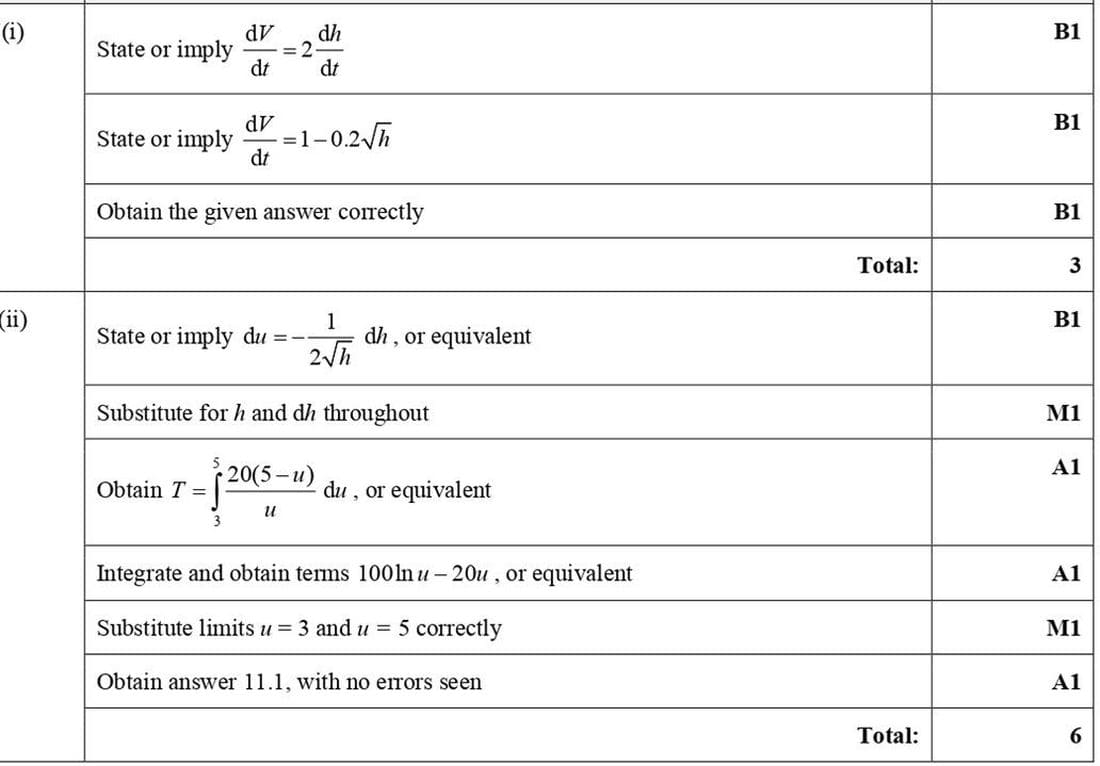
(i) Form a differential equation satisfied by h and t, and show that the time T hours taken for the depth of water to reach 4 m is given by
\(T = \int_0^4 \frac{10}{5 - \sqrt{h}} \, dh.\)
\((ii) Using the substitution u = 5 - √h, find the value of T.\)
Nov 2016 p33 q5
2296
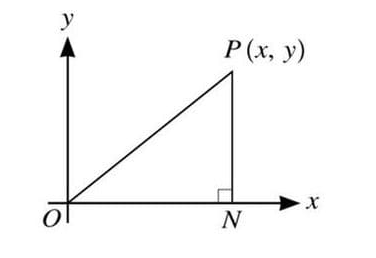
The diagram shows a variable point \(P\) with coordinates \((x, y)\) and the point \(N\) which is the foot of the perpendicular from \(P\) to the \(x\)-axis. \(P\) moves on a curve such that, for all \(x \geq 0\), the gradient of the curve is equal in value to the area of the triangle \(OPN\), where \(O\) is the origin.
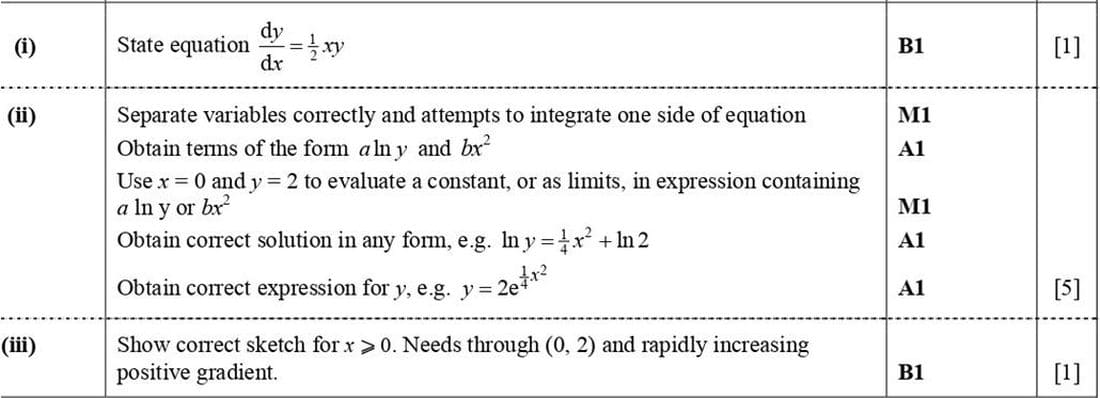
(i) State a differential equation satisfied by \(x\) and \(y\).
The point with coordinates \((0, 2)\) lies on the curve.
(ii) Solve the differential equation to obtain the equation of the curve, expressing \(y\) in terms of \(x\).
(iii) Sketch the curve.
Nov 2015 p33 q10
2297
Naturalists are managing a wildlife reserve to increase the number of plants of a rare species. The number of plants at time t years is denoted by N, where N is treated as a continuous variable.
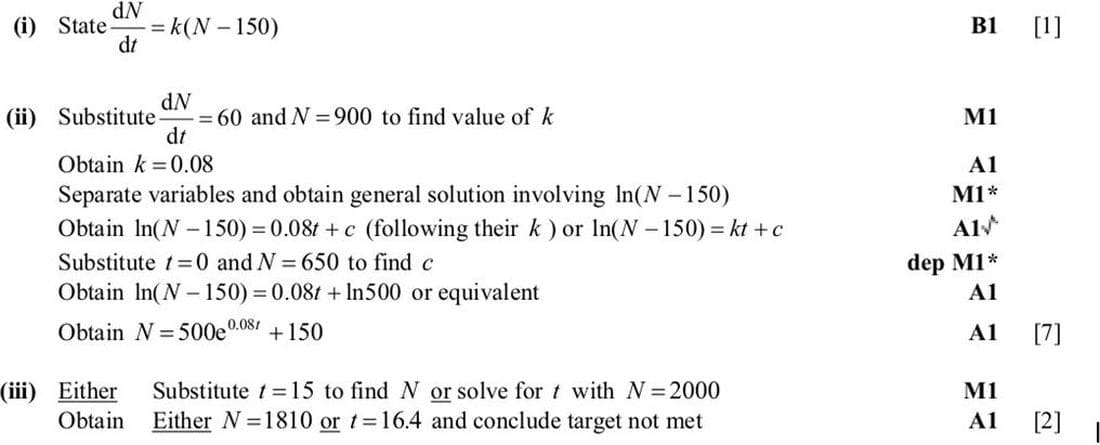
(i) It is given that the rate of increase of N with respect to t is proportional to (N - 150). Write down a differential equation relating N, t and a constant of proportionality.
(ii) Initially, when t = 0, the number of plants was 650. It was noted that, at a time when there were 900 plants, the number of plants was increasing at a rate of 60 per year. Express N in terms of t.
(iii) The naturalists had a target of increasing the number of plants from 650 to 2000 within 15 years. Will this target be met?
June 2014 p32 q9
2298
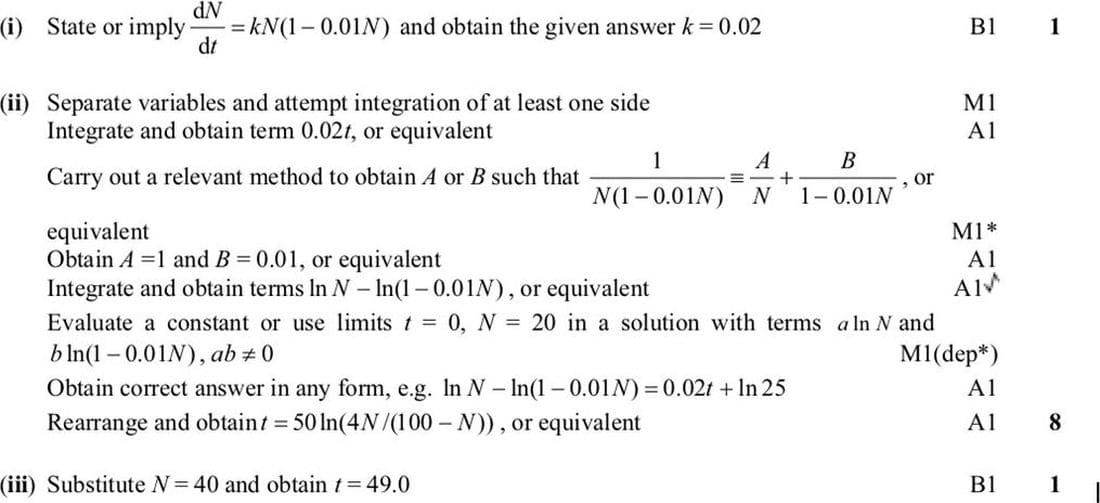
The population of a country at time t years is N millions. At any time, N is assumed to increase at a rate proportional to the product of N and (1 - 0.01N). When t = 0, N = 20 and \(\frac{dN}{dt} = 0.32\).
(i) Treating N and t as continuous variables, show that they satisfy the differential equation \(\frac{dN}{dt} = 0.02N(1 - 0.01N)\).
(ii) Solve the differential equation, obtaining an expression for t in terms of N.
\((iii) Find the time at which the population will be double its value at t = 0.\)