Exam-Style Problems
⬅ Back to SubchapterJune 2011 p13 q5
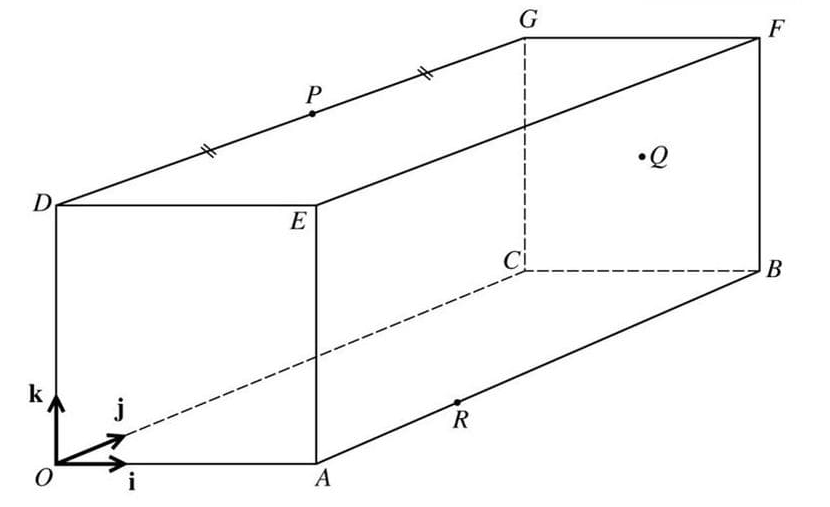
In the diagram, OABCDEFG is a rectangular block in which OA = OD = 6 cm and AB = 12 cm. The unit vectors i, j and k are parallel to \(\overrightarrow{OA}\), \(\overrightarrow{OC}\) and \(\overrightarrow{OD}\) respectively. The point P is the mid-point of DG, Q is the centre of the square face CBFG and R lies on AB such that AR = 4 cm.
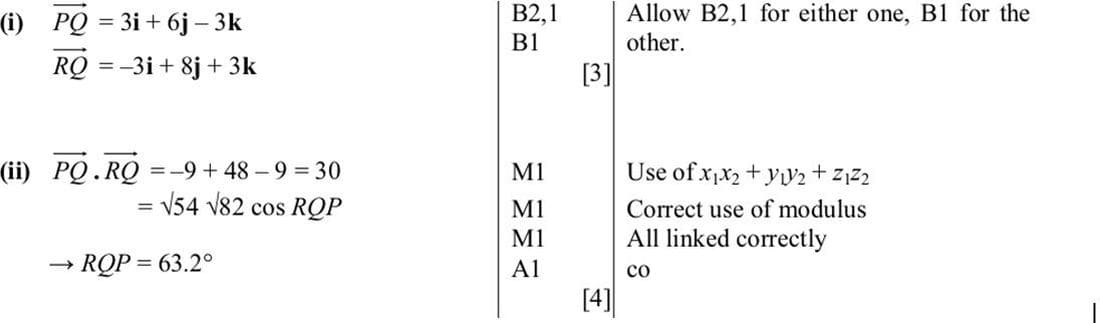
(i) Express each of the vectors \(\overrightarrow{PQ}\) and \(\overrightarrow{RQ}\) in terms of i, j and k.
(ii) Use a scalar product to find angle RQP.
June 2011 p11 q4
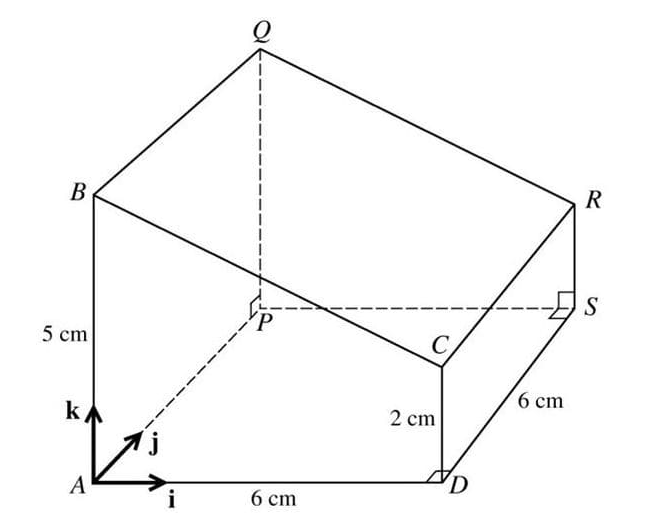
The diagram shows a prism ABCDPQRS with a horizontal square base APSD with sides of length 6 cm. The cross-section ABCD is a trapezium and is such that the vertical edges AB and DC are of lengths 5 cm and 2 cm respectively. Unit vectors i, j and k are parallel to AD, AP and AB respectively.
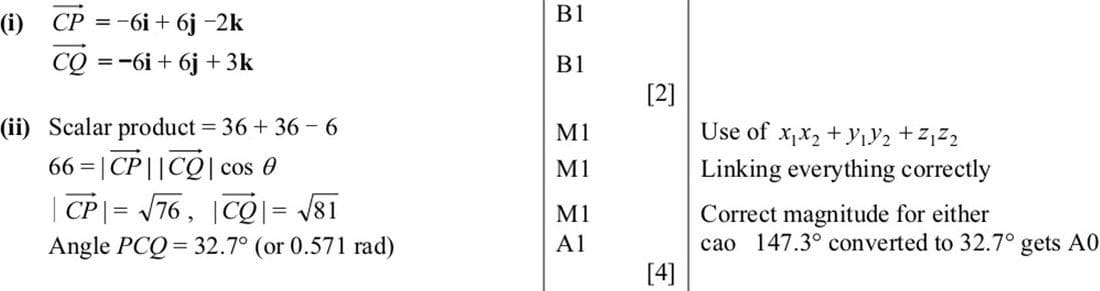
(i) Express each of the vectors \(\overrightarrow{CP}\) and \(\overrightarrow{CQ}\) in terms of i, j and k.
(ii) Use a scalar product to calculate angle PCQ.
Nov 2010 p13 q10
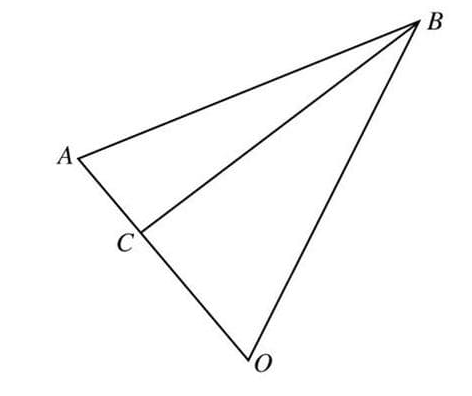
The diagram shows triangle OAB, in which the position vectors of A and B with respect to O are given by \(\overrightarrow{OA} = 2\mathbf{i} + \mathbf{j} - 3\mathbf{k}\) and \(\overrightarrow{OB} = -3\mathbf{i} + 2\mathbf{j} - 4\mathbf{k}\).
C is a point on OA such that \(\overrightarrow{OC} = p \overrightarrow{OA}\), where p is a constant.
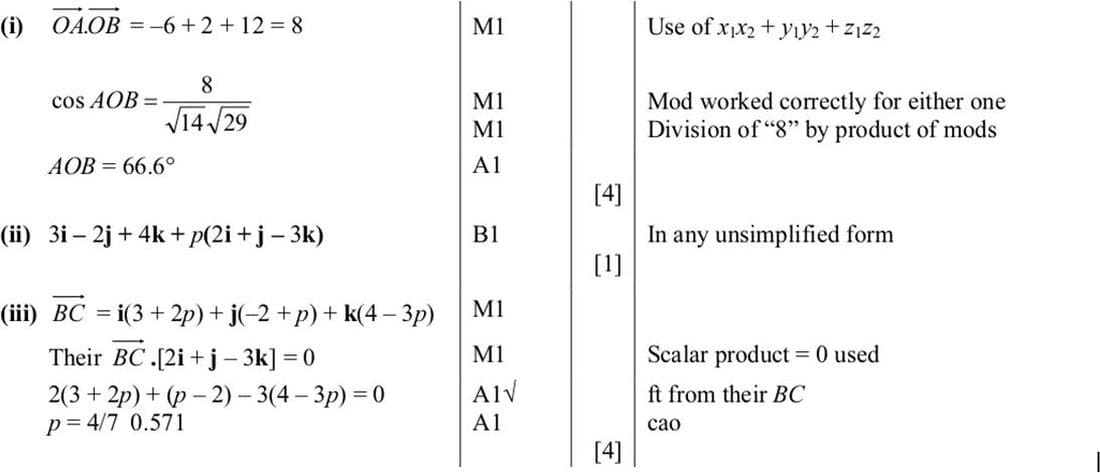
- Find angle AOB. [4]
- Find \(\overrightarrow{BC}\) in terms of p and vectors \(\mathbf{i}, \mathbf{j}\) and \(\mathbf{k}\). [1]
- Find the value of p given that BC is perpendicular to OA. [4]
Nov 2010 p12 q9
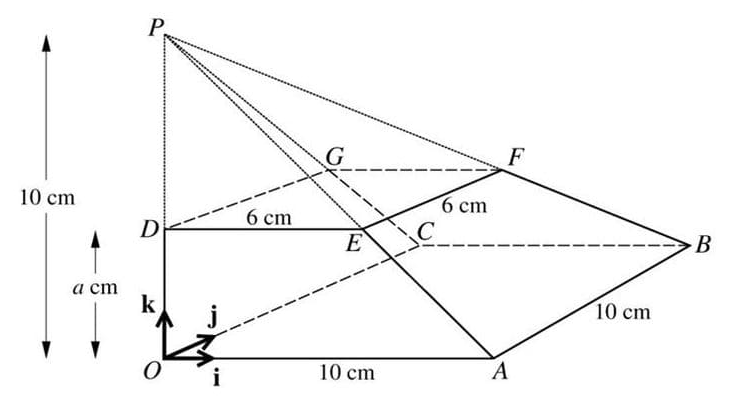
The diagram shows a pyramid OABCP in which the horizontal base OABC is a square of side 10 cm and the vertex P is 10 cm vertically above O. The points D, E, F, G lie on OP, AP, BP, CP respectively and DEFG is a horizontal square of side 6 cm. The height of DEFG above the base is a cm. Unit vectors i, j and k are parallel to OA, OC and OD respectively.
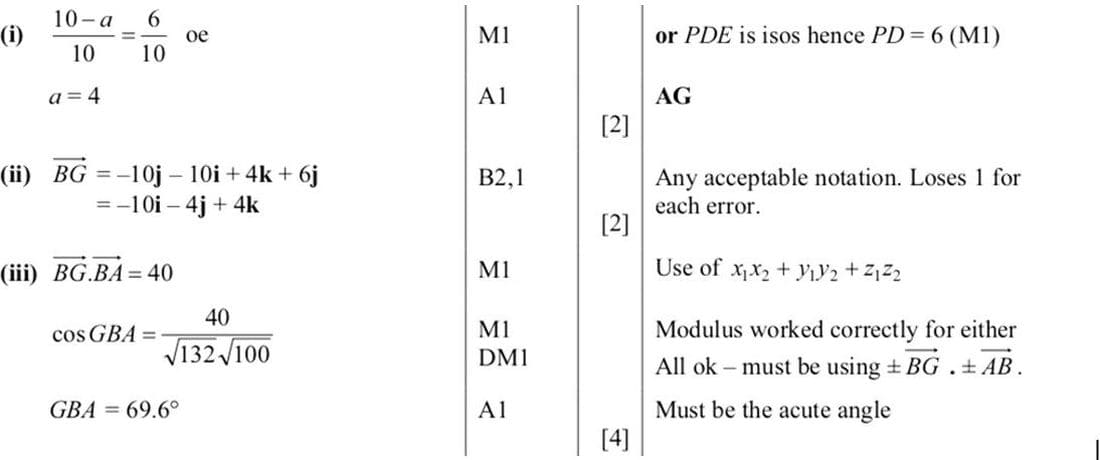
- Show that a = 4.
- Express the vector \(\overrightarrow{BG}\) in terms of i, j and k.
- Use a scalar product to find angle GBA.
Nov 2010 p11 q5
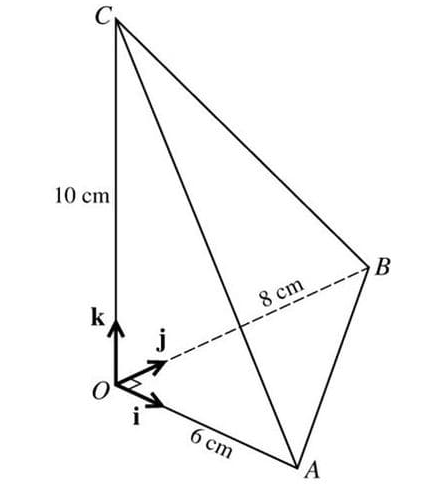
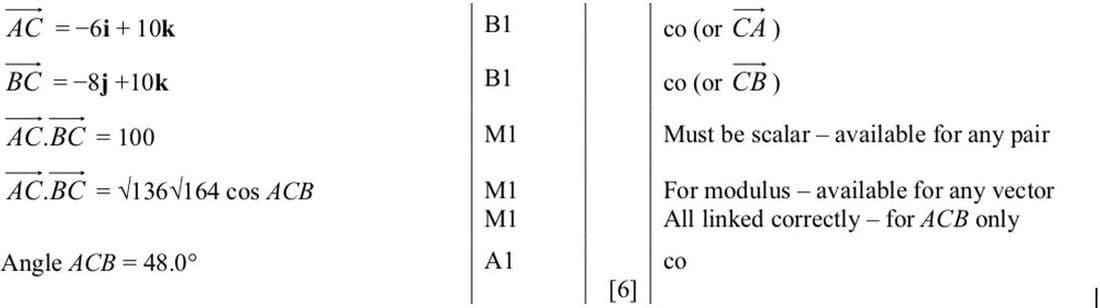
The diagram shows a pyramid OABC with a horizontal base OAB where OA = 6 cm, OB = 8 cm and angle AOB = 90°. The point C is vertically above O and OC = 10 cm. Unit vectors i, j and k are parallel to OA, OB and OC as shown. Use a scalar product to find angle ACB.