Exam-Style Problems
⬅ Back to SubchapterJune 2015 p11 q4
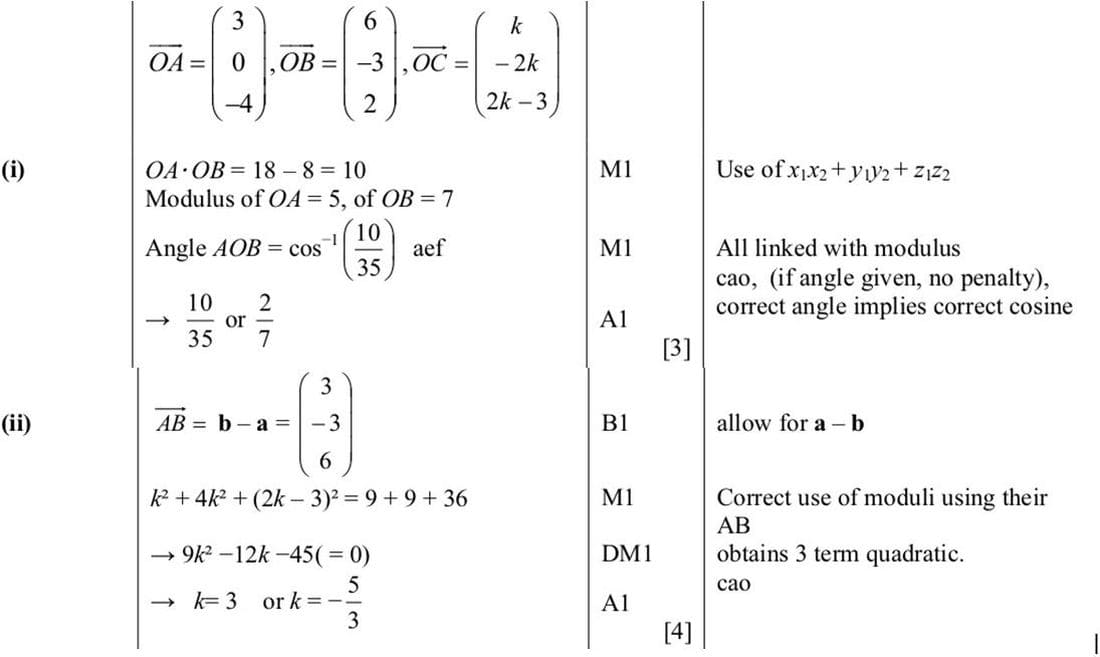
Relative to the origin \(O\), the position vectors of points \(A\) and \(B\) are given by
\(\overrightarrow{OA} = \begin{pmatrix} 3 \\ 0 \\ -4 \end{pmatrix}\) and \(\overrightarrow{OB} = \begin{pmatrix} 6 \\ -3 \\ 2 \end{pmatrix}\).
(i) Find the cosine of angle \(AOB\).
The position vector of \(C\) is given by \(\overrightarrow{OC} = \begin{pmatrix} k \\ -2k \\ 2k - 3 \end{pmatrix}\).
(ii) Given that \(AB\) and \(OC\) have the same length, find the possible values of \(k\).
Nov 2014 p13 q7
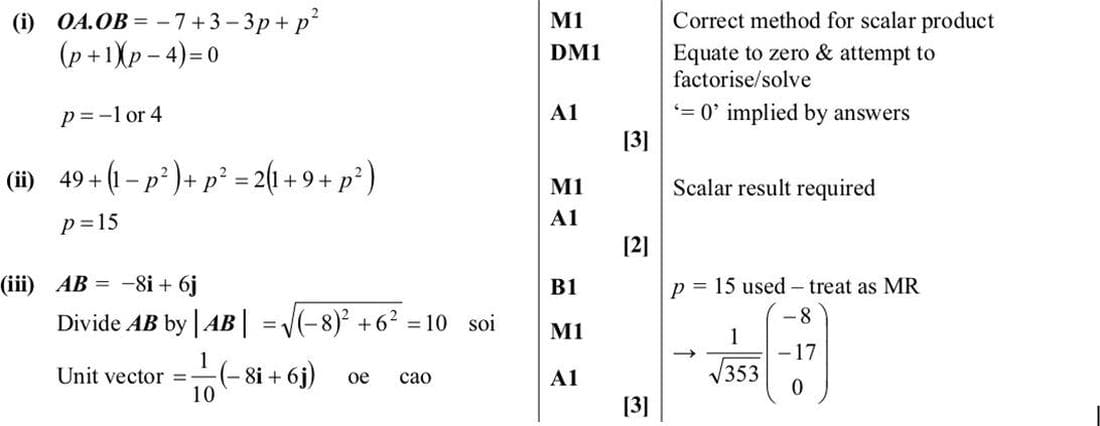
Three points, O, A and B, are such that \(\overrightarrow{OA} = \mathbf{i} + 3\mathbf{j} + p\mathbf{k}\) and \(\overrightarrow{OB} = -7\mathbf{i} + (1-p)\mathbf{j} + p\mathbf{k}\), where \(p\) is a constant.
(i) Find the values of \(p\) for which \(\overrightarrow{OA}\) is perpendicular to \(\overrightarrow{OB}\).
(ii) The magnitudes of \(\overrightarrow{OA}\) and \(\overrightarrow{OB}\) are \(a\) and \(b\) respectively. Find the value of \(p\) for which \(b^2 = 2a^2\).
(iii) Find the unit vector in the direction of \(\overrightarrow{AB}\) when \(p = -8\).
Nov 2014 p11 q6
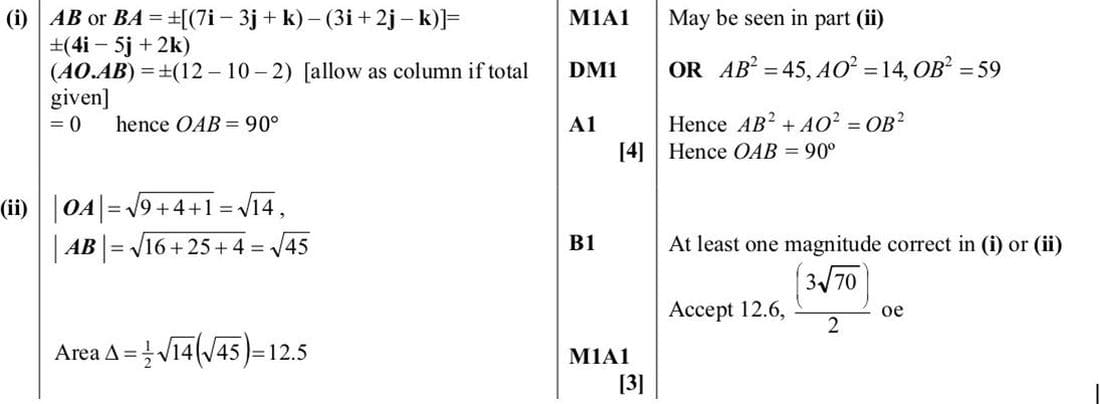
Relative to an origin O, the position vector of A is 3i + 2j - k and the position vector of B is 7i - 3j + k.
- Show that angle OAB is a right angle.
- Find the area of triangle OAB.
June 2014 p13 q7
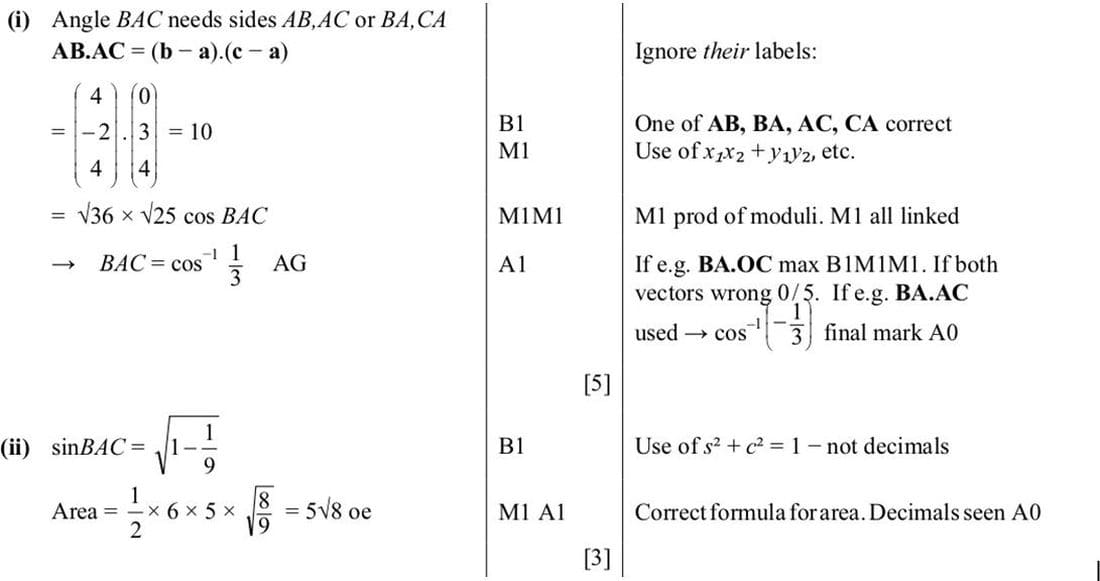
The position vectors of points A, B and C relative to an origin O are given by
\(\overrightarrow{OA} = \begin{pmatrix} 2 \\ 1 \\ 3 \end{pmatrix}, \quad \overrightarrow{OB} = \begin{pmatrix} 6 \\ -1 \\ 7 \end{pmatrix} \quad \text{and} \quad \overrightarrow{OC} = \begin{pmatrix} 2 \\ 4 \\ 7 \end{pmatrix}.\)
(i) Show that angle \(BAC = \cos^{-1}\left(\frac{1}{3}\right).\)
(ii) Use the result in part (i) to find the exact value of the area of triangle \(ABC.\)
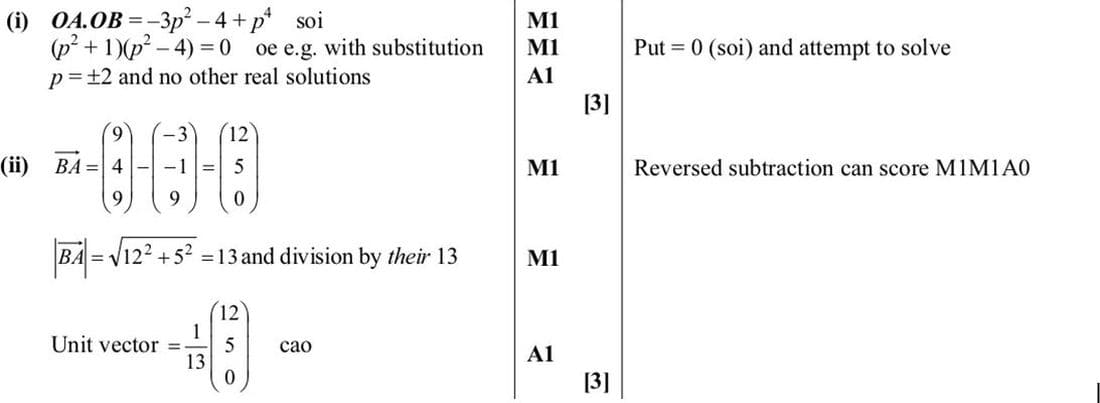
June 2014 p11 q8
Relative to an origin O, the position vectors of points A and B are given by
\(\overrightarrow{OA} = \begin{pmatrix} 3p \\ 4 \\ p^2 \end{pmatrix}\) and \(\overrightarrow{OB} = \begin{pmatrix} -p \\ -1 \\ p^2 \end{pmatrix}\).
(i) Find the values of \(p\) for which angle \(AOB\) is 90°.
(ii) For the case where \(p = 3\), find the unit vector in the direction of \(\overrightarrow{BA}\).