Exam-Style Problems
⬅ Back to SubchapterProblem 2141
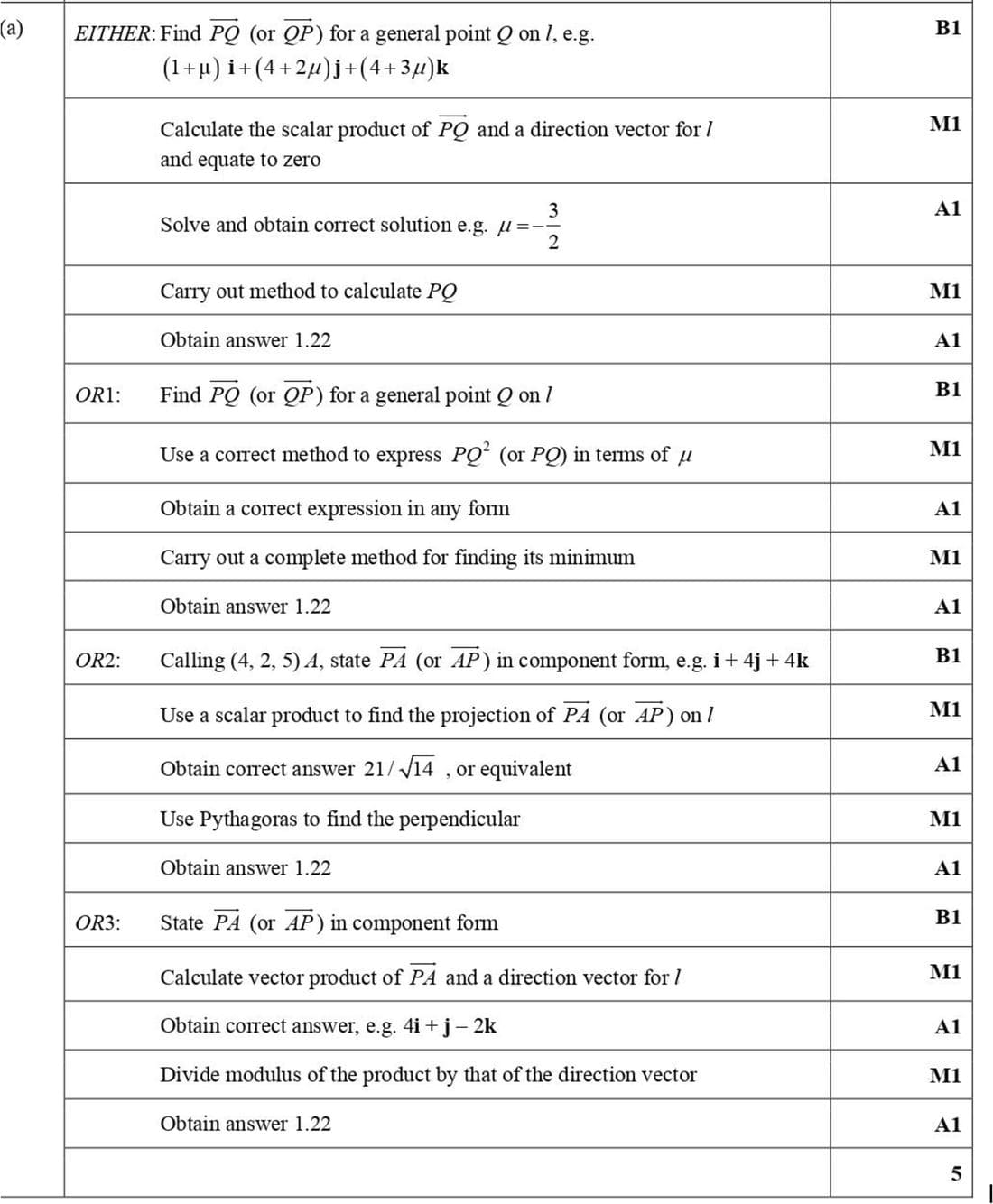
\(The line l has equation r = i + 2j + 3k + μ(2i - j - 2k).\)
The point P has position vector 4i + 2j - 3k. Find the length of the perpendicular from P to l.
June 2019 p32 q9
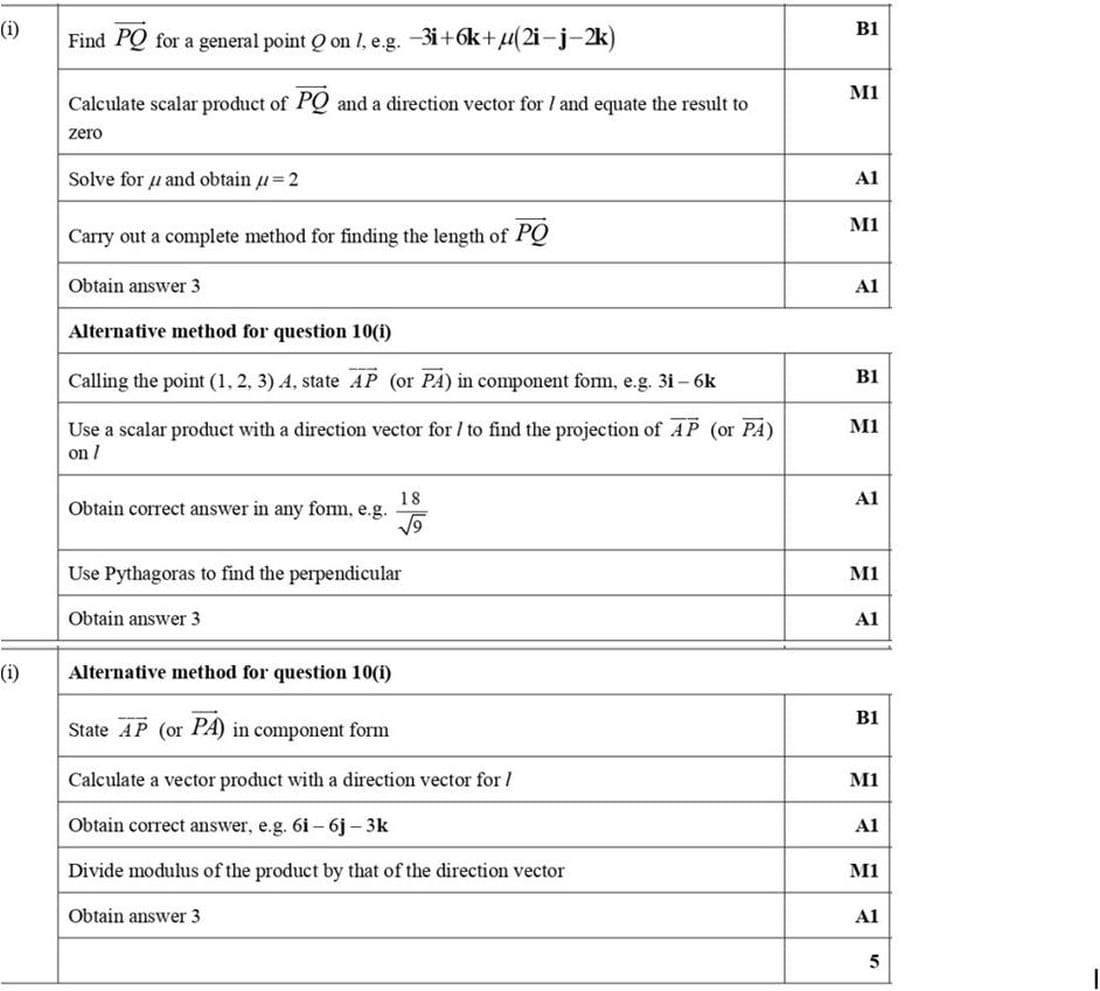
The points A and B have position vectors i + 2j - k and 3i + j + k respectively. The line l has equation r = 2i + j + k + μ(i + j + 2k).
Show that l does not intersect the line passing through A and B.
June 2018 p33 q10
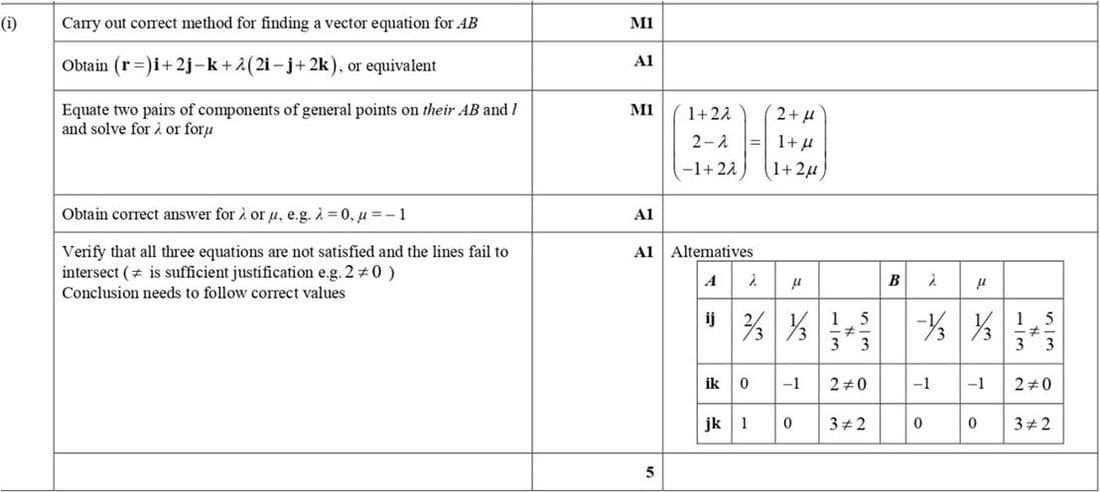
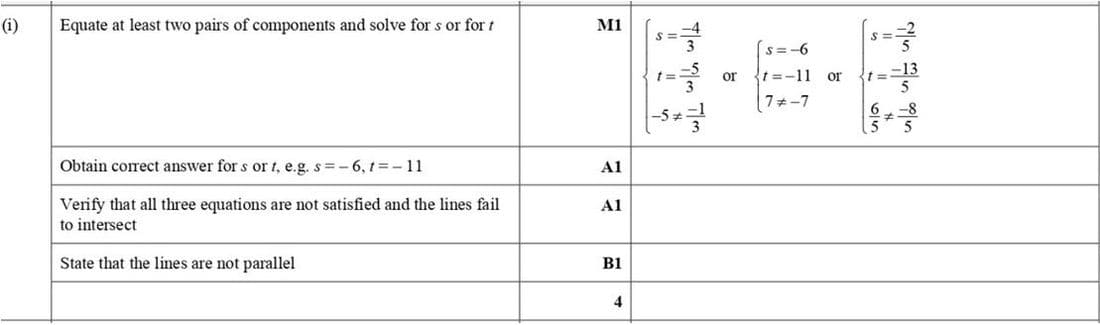
The points A and B have position vectors \(2\mathbf{i} + \mathbf{j} + 3\mathbf{k}\) and \(4\mathbf{i} + \mathbf{j} + \mathbf{k}\) respectively. The line l has equation \(\mathbf{r} = 4\mathbf{i} + 6\mathbf{j} + \mu(\mathbf{i} + 2\mathbf{j} - 2\mathbf{k})\).
(i) Show that l does not intersect the line passing through A and B.
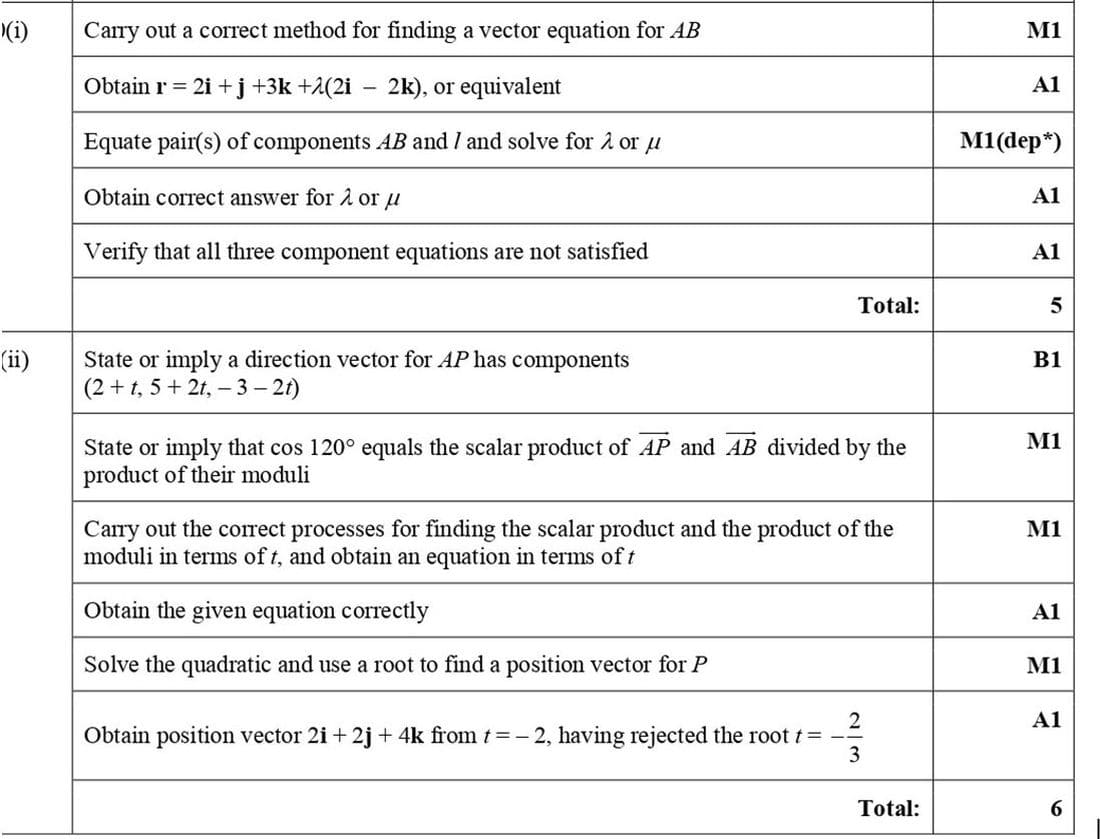
The point P, with parameter t, lies on l and is such that angle PAB is equal to 120°.
(ii) Show that \(3t^2 + 8t + 4 = 0\). Hence find the position vector of P.
Problem 2144
Two lines l and m have equations r = 2i - j + k + s(2i + 3j - k) and r = i + 3j + 4k + t(i + 2j + k) respectively.
Show that the lines are skew.
Problem 2145
The point P has position vector \(3\mathbf{i} - 2\mathbf{j} + \mathbf{k}\). The line \(l\) has equation \(\mathbf{r} = 4\mathbf{i} + 2\mathbf{j} + 5\mathbf{k} + \mu(\mathbf{i} + 2\mathbf{j} + 3\mathbf{k})\).
Find the length of the perpendicular from P to l, giving your answer correct to 3 significant figures.