Exam-Style Problems
⬅ Back to SubchapterNov 2011 p33 q1
2031
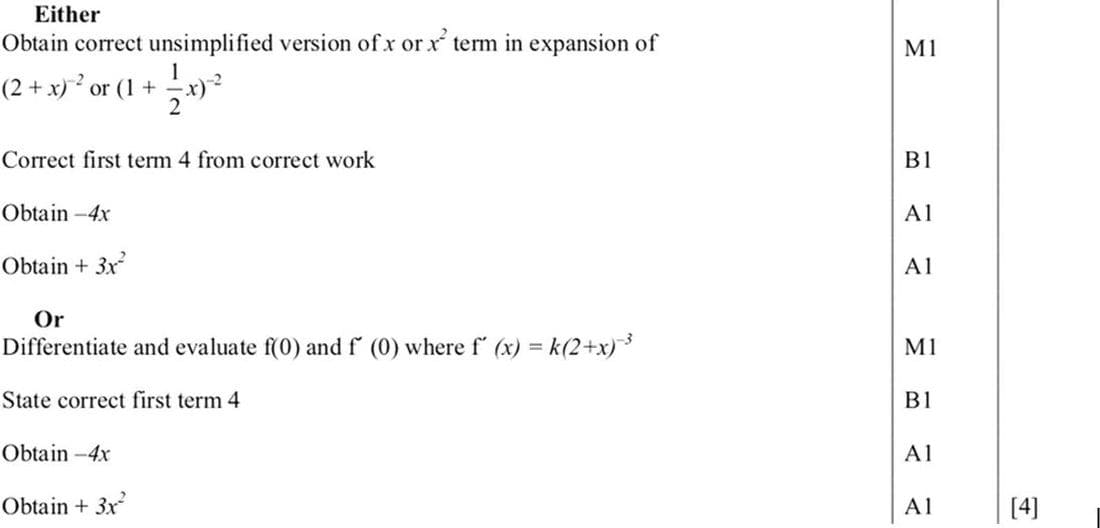
Expand \(\frac{16}{(2+x)^2}\) in ascending powers of \(x\), up to and including the term in \(x^2\), simplifying the coefficients.
June 2011 p21 q1
2032
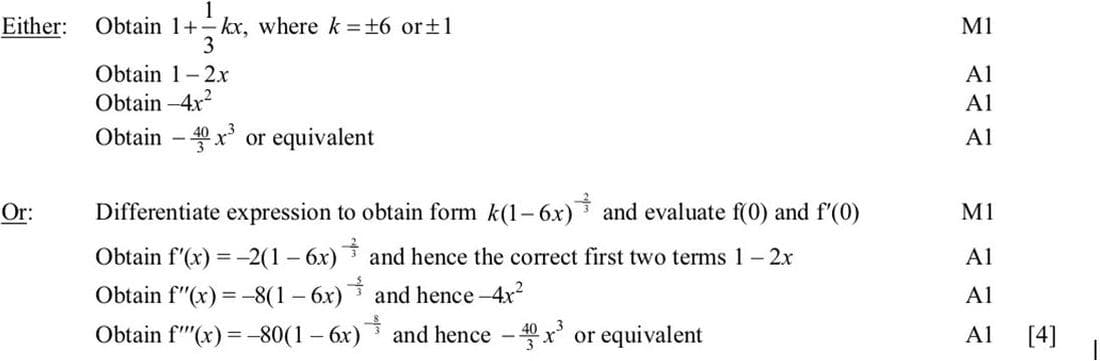
Expand \(\sqrt[3]{1 - 6x}\) in ascending powers of \(x\) up to and including the term in \(x^3\), simplifying the coefficients.
Nov 2010 p23 q1
2033
Expand \((1 + 2x)^{-3}\) in ascending powers of \(x\), up to and including the term in \(x^2\), simplifying the coefficients.

June 2009 p3 q5
2034
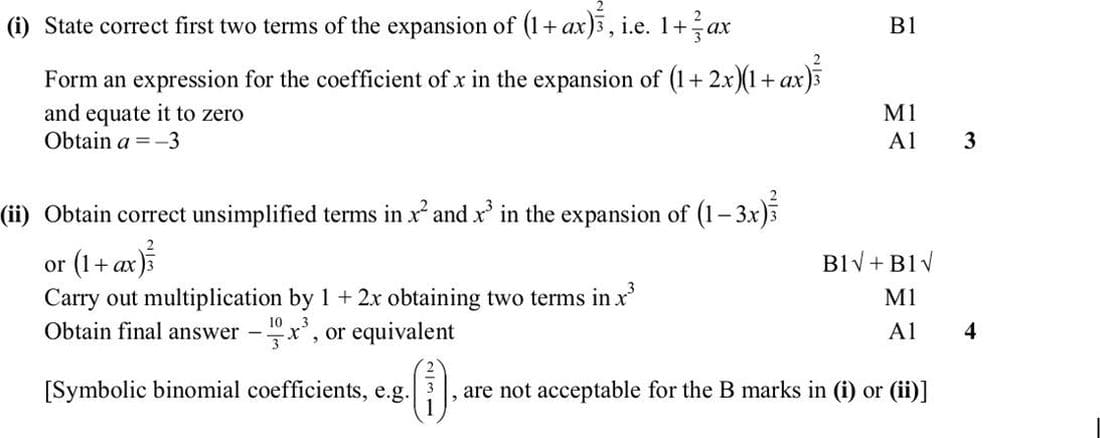
When \((1 + 2x)(1 + ax)^{\frac{2}{3}}\), where \(a\) is a constant, is expanded in ascending powers of \(x\), the coefficient of the term in \(x\) is zero.
(i) Find the value of \(a\).
(ii) When \(a\) has this value, find the term in \(x^3\) in the expansion of \((1 + 2x)(1 + ax)^{\frac{2}{3}}\), simplifying the coefficient.
Nov 2008 p3 q2
2035
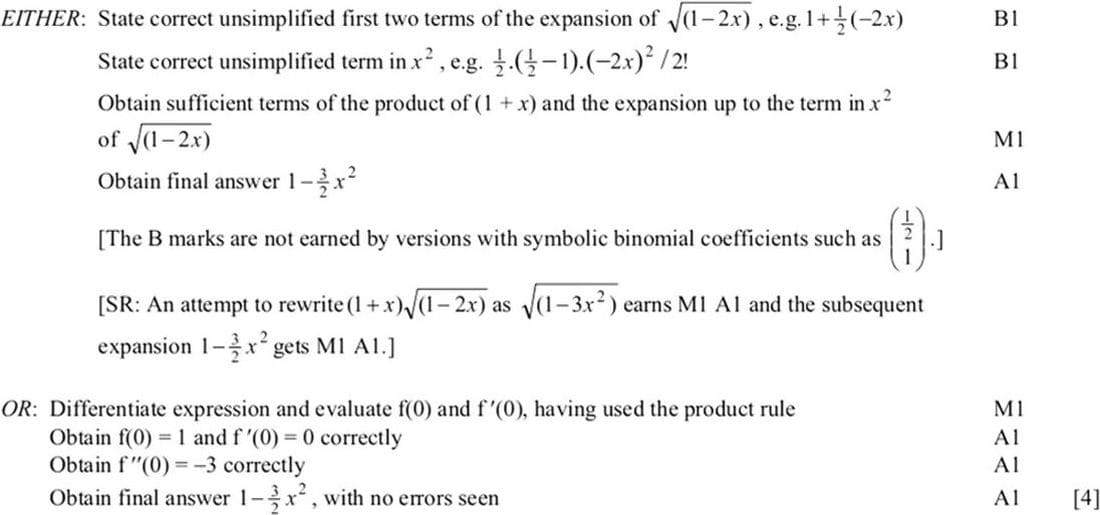
Expand \((1 + x) \sqrt{(1 - 2x)}\) in ascending powers of \(x\), up to and including the term in \(x^2\), simplifying the coefficients.