Exam-Style Problems
⬅ Back to SubchapterMar 2023 p32 q4
1920
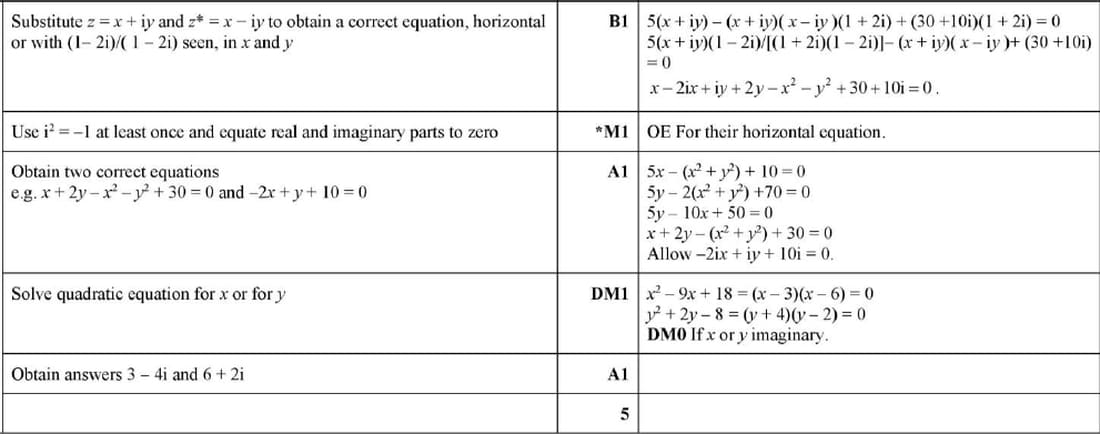
Solve the equation \(\frac{5z}{1 + 2i} - zz^* + 30 + 10i = 0\), giving your answers in the form \(x + iy\), where \(x\) and \(y\) are real.
Feb/Mar 2023 p32 q2
1921
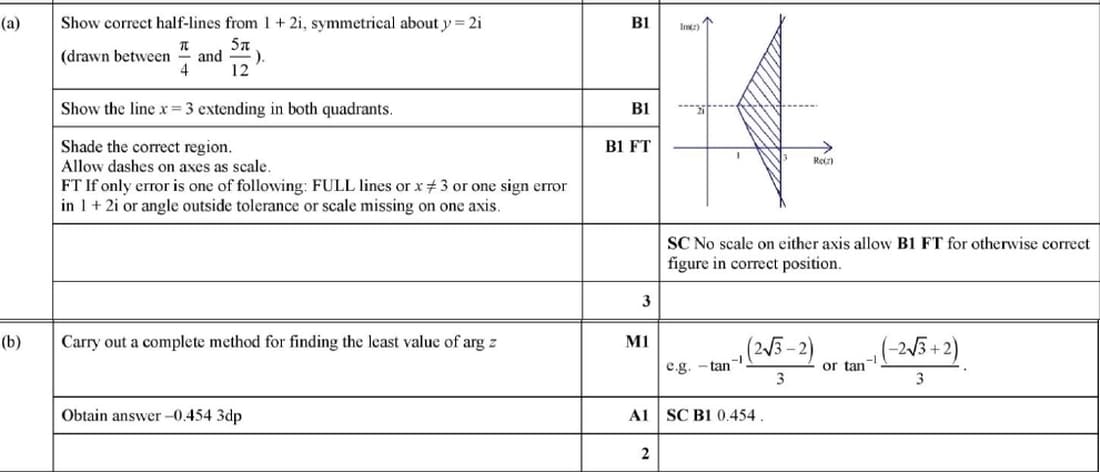
(a) On an Argand diagram, shade the region whose points represent complex numbers \(z\) satisfying the inequalities \(-\frac{1}{3}\pi \leq \arg(z - 1 - 2i) \leq \frac{1}{3}\pi\) and \(\text{Re} \, z \leq 3\).
(b) Calculate the least value of \(\arg z\) for points in the region from (a). Give your answer in radians correct to 3 decimal places.
Nov 2022 p33 q6
1922
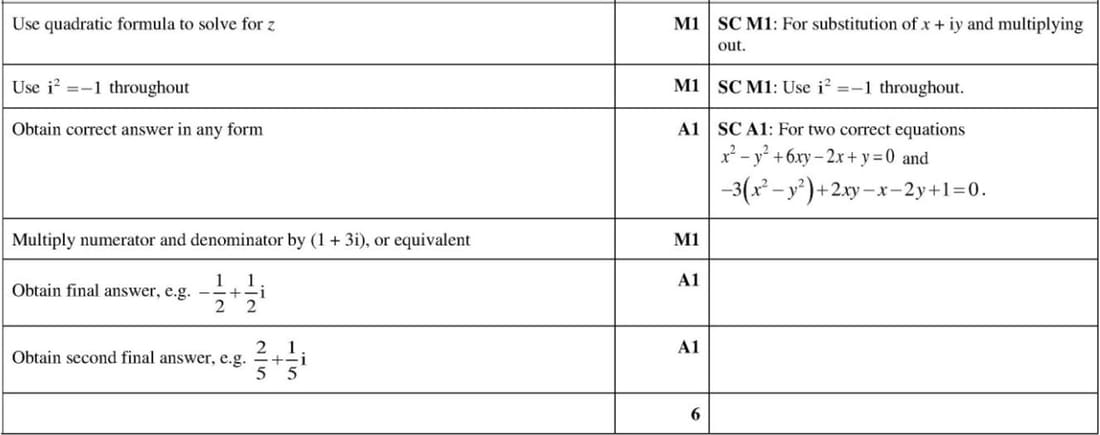
Solve the quadratic equation \((1 - 3i)z^2 - (2 + i)z + i = 0\), giving your answers in the form \(x + iy\), where \(x\) and \(y\) are real.
Nov 2022 p33 q5
1923
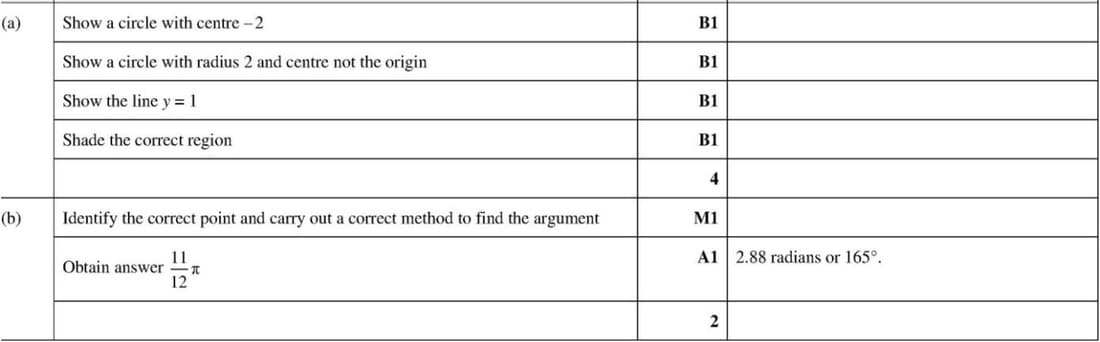
(a) On a sketch of an Argand diagram, shade the region whose points represent complex numbers \(z\) satisfying the inequalities \(|z + 2| \leq 2\) and \(\text{Im} \, z \geq 1\).
(b) Find the greatest value of \(\arg z\) for points in the shaded region.
Nov 2022 p32 q5
1924
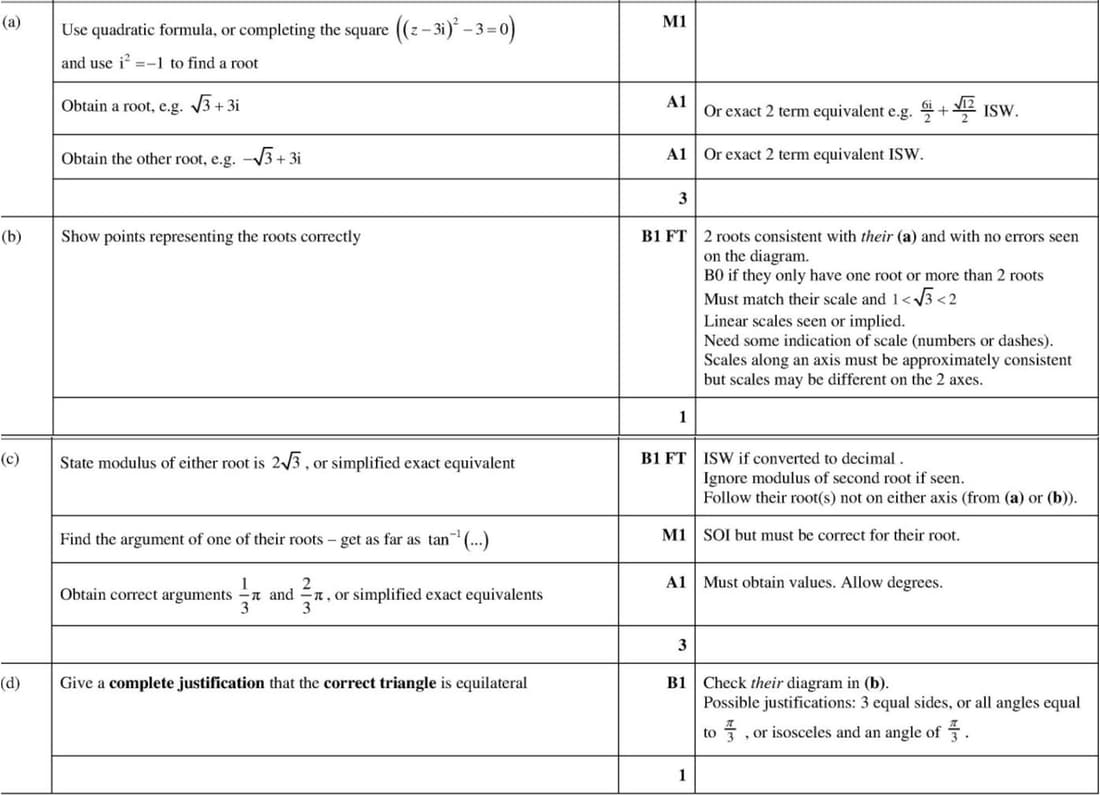
(a) Solve the equation \(z^2 - 6iz - 12 = 0\), giving the answers in the form \(x + iy\), where \(x\) and \(y\) are real and exact.
(b) On a sketch of an Argand diagram with origin \(O\), show points \(A\) and \(B\) representing the roots of the equation in part (a).
(c) Find the exact modulus and argument of each root.
(d) Hence show that the triangle \(OAB\) is equilateral.