Exam-Style Problems
⬅ Back to SubchapterJune 2017 p33 q6
The equation \(\cot x = 1 - x\) has one root in the interval \(0 < x < \pi\), denoted by \(\alpha\).
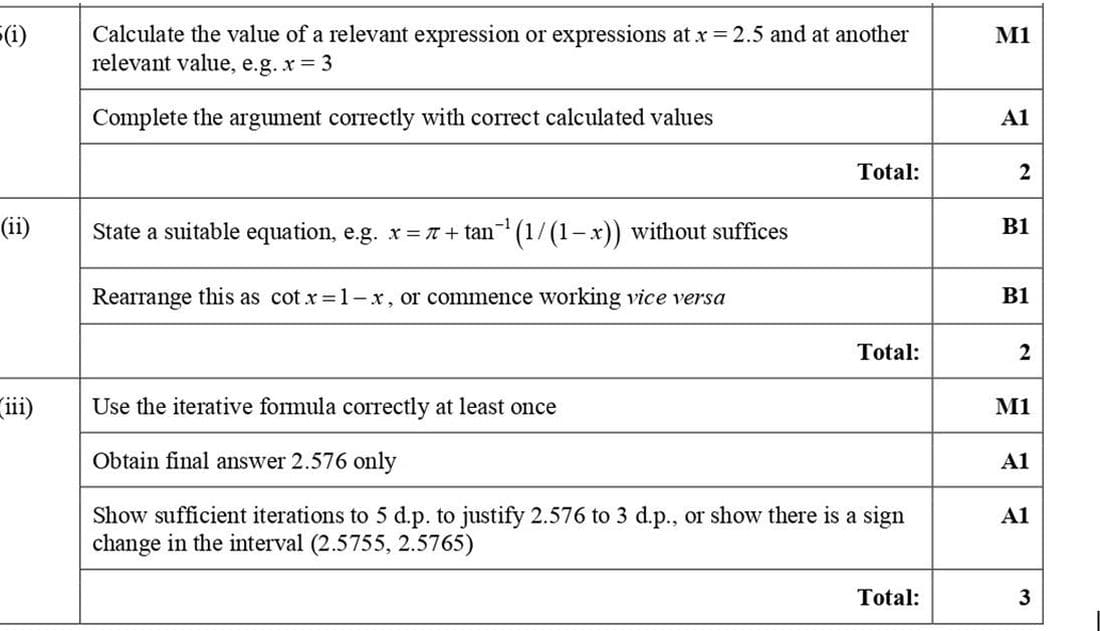
(i) Show by calculation that \(\alpha\) is greater than 2.5.
(ii) Show that, if a sequence of values in the interval \(0 < x < \pi\) given by the iterative formula \(x_{n+1} = \pi + \arctan \left( \frac{1}{1-x_n} \right)\) converges, then it converges to \(\alpha\).
(iii) Use this iterative formula to determine \(\alpha\) correct to 3 decimal places. Give the result of each iteration to 5 decimal places.
Nov 2016 p33 q9
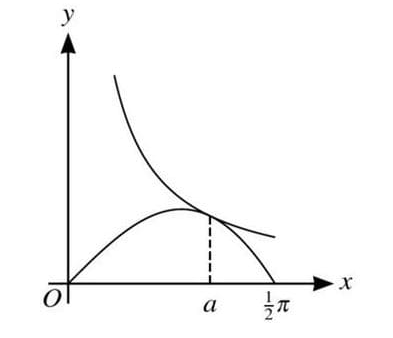
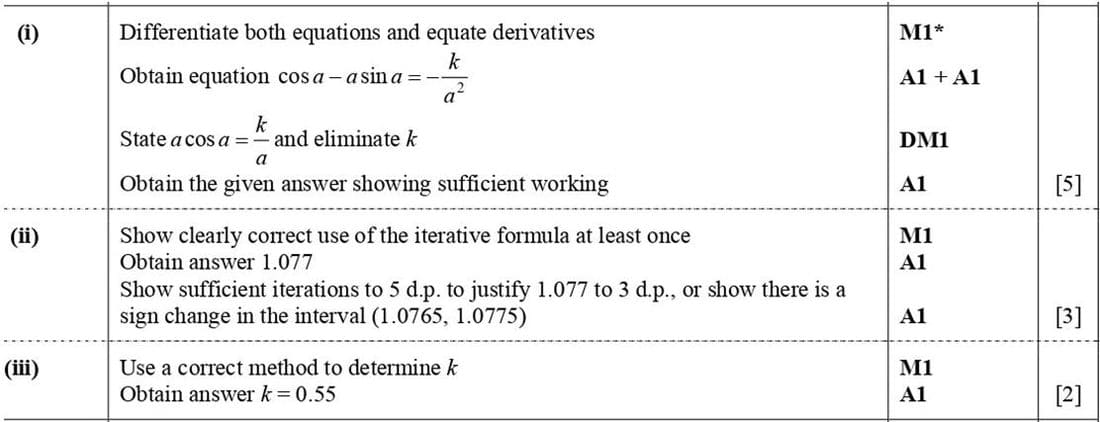
The diagram shows the curves \(y = x \cos x\) and \(y = \frac{k}{x}\), where \(k\) is a constant, for \(0 < x \leq \frac{1}{2} \pi\). The curves touch at the point where \(x = a\).
- Show that \(a\) satisfies the equation \(\tan a = \frac{2}{a}\).
- Use the iterative formula \(a_{n+1} = \arctan \left( \frac{2}{a_n} \right)\) to determine \(a\) correct to 3 decimal places. Give the result of each iteration to 5 decimal places.
- Hence find the value of \(k\) correct to 2 decimal places.
Feb/Mar 2016 p32 q3
The equation \(x^5 - 3x^3 + x^2 - 4 = 0\) has one positive root.
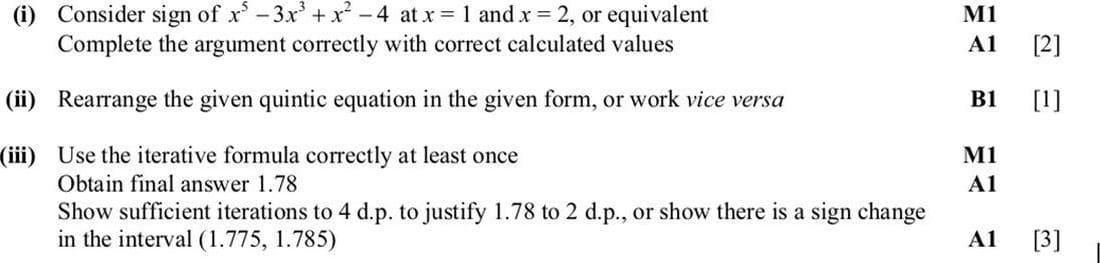
- Verify by calculation that this root lies between 1 and 2. [2]
- Show that the equation can be rearranged in the form \(x = \sqrt[3]{3x + \frac{4}{x^2} - 1}\). [1]
- Use an iterative formula based on this rearrangement to determine the positive root correct to 2 decimal places. Give the result of each iteration to 4 decimal places. [3]
Nov 2015 p31 q4
The equation \(x^3 - x^2 - 6 = 0\) has one real root, denoted by \(\alpha\).
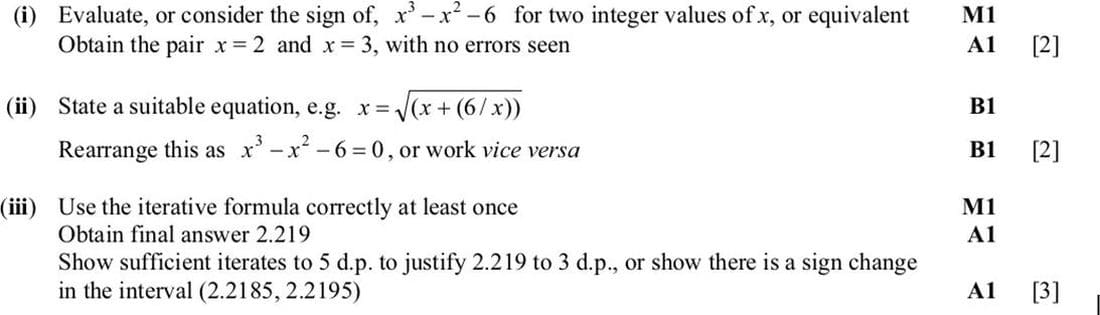
(i) Find by calculation the pair of consecutive integers between which \(\alpha\) lies.
(ii) Show that, if a sequence of values given by the iterative formula \(x_{n+1} = \sqrt{x_n + \frac{6}{x_n}}\) converges, then it converges to \(\alpha\).
(iii) Use this iterative formula to determine \(\alpha\) correct to 3 decimal places. Give the result of each iteration to 5 decimal places.
June 2023 p33 q5
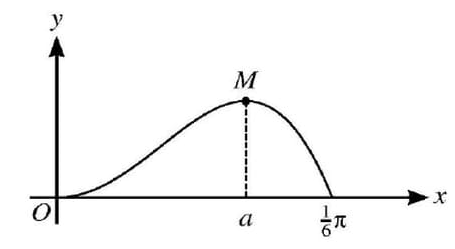
The diagram shows the part of the curve \(y = x^2 \cos 3x\) for \(0 \leq x \leq \frac{1}{6}\pi\), and its maximum point \(M\), where \(x = a\).
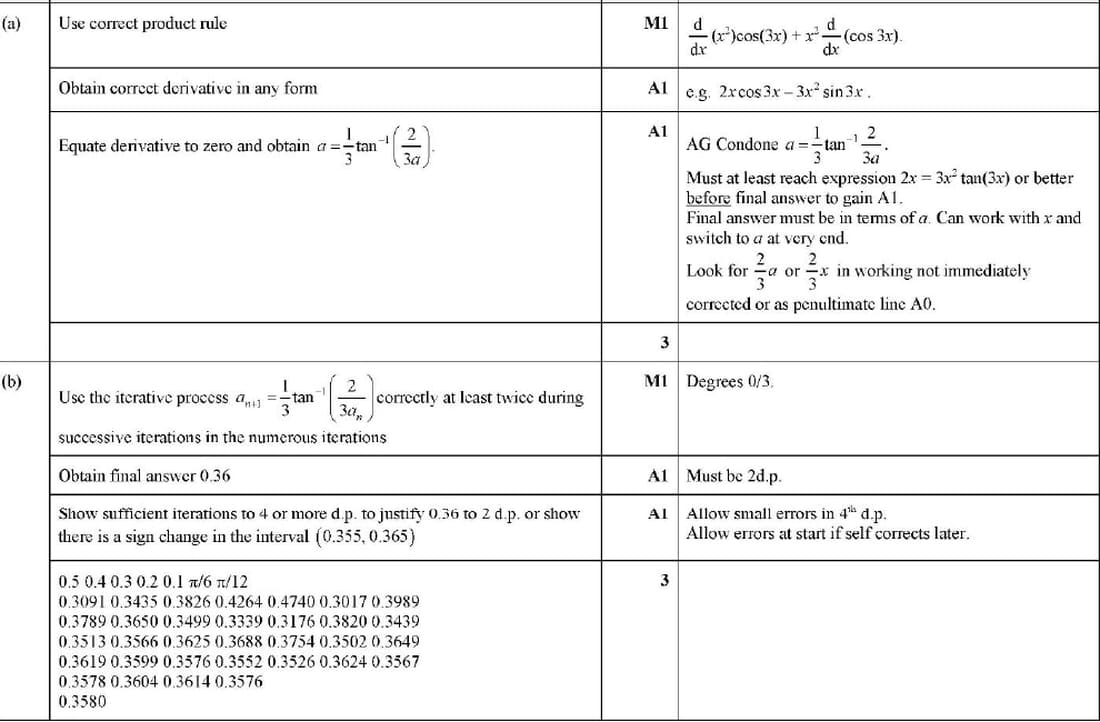
(a) Show that \(a\) satisfies the equation \(a = \frac{1}{3} \arctan \left( \frac{2}{3a} \right)\).
(b) Use an iterative formula based on the equation in (a) to determine \(a\) correct to 2 decimal places. Give the result of each iteration to 4 decimal places.