Exam-Style Problems
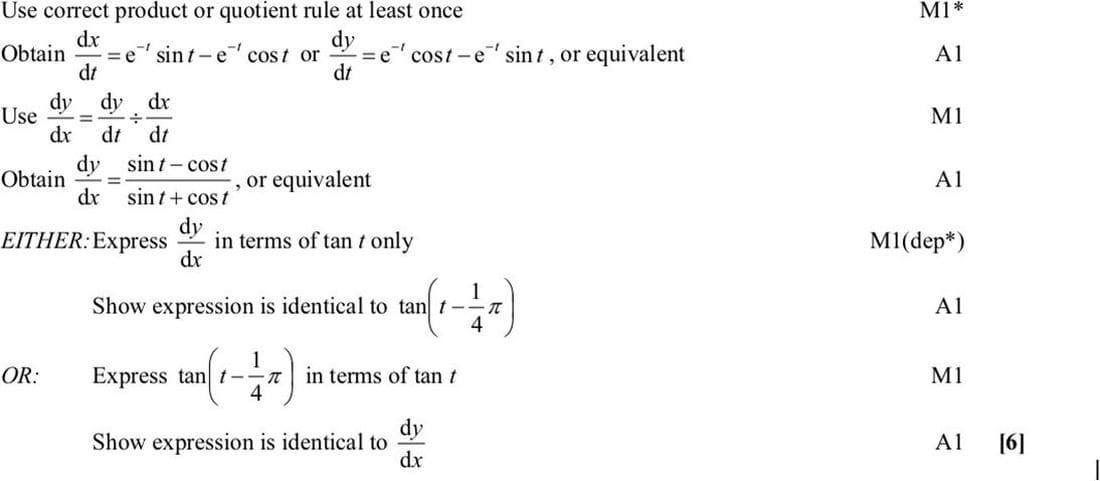
⬅ Back to SubchapterNov 2013 p31 q4
The parametric equations of a curve are
\(x = e^{-t} \cos t, \quad y = e^{-t} \sin t.\)
Show that \(\frac{dy}{dx} = \tan \left( t - \frac{1}{4} \pi \right).\)
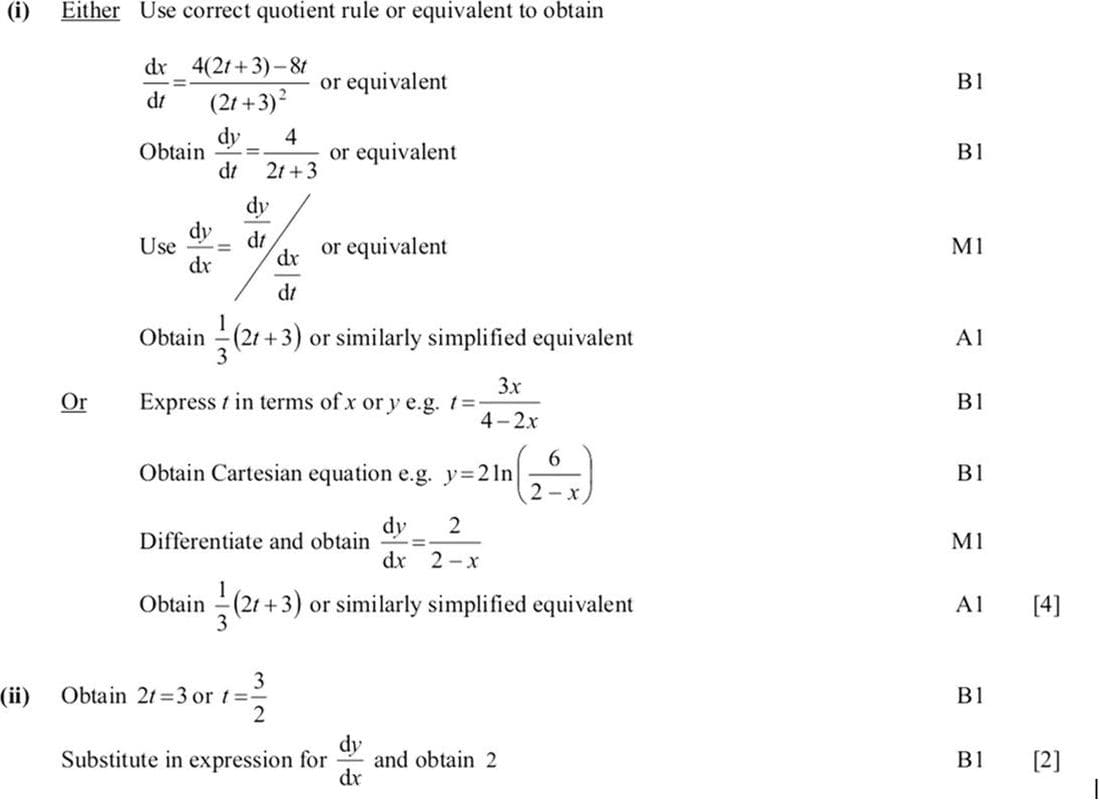
Nov 2012 p33 q3
The parametric equations of a curve are
\(x = \frac{4t}{2t + 3}\), \(y = 2 \ln(2t + 3)\).
- Express \(\frac{dy}{dx}\) in terms of \(t\), simplifying your answer.
- Find the gradient of the curve at the point for which \(x = 1\).
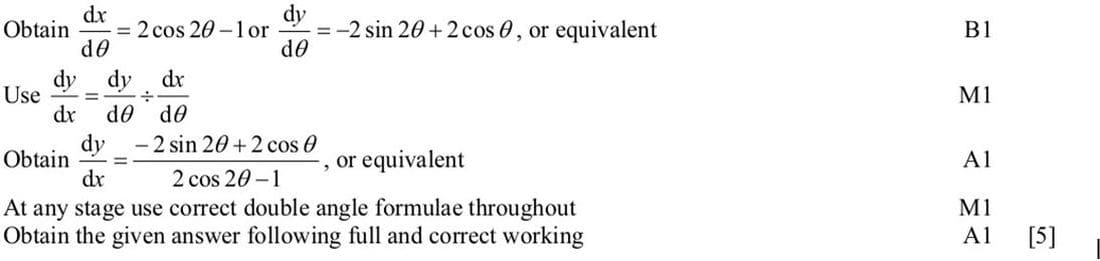
June 2012 p33 q3
The parametric equations of a curve are
\(x = \sin 2\theta - \theta\), \(y = \cos 2\theta + 2 \sin \theta\).
Show that \(\frac{dy}{dx} = \frac{2 \cos \theta}{1 + 2 \sin \theta}\).
Nov 2011 p33 q8
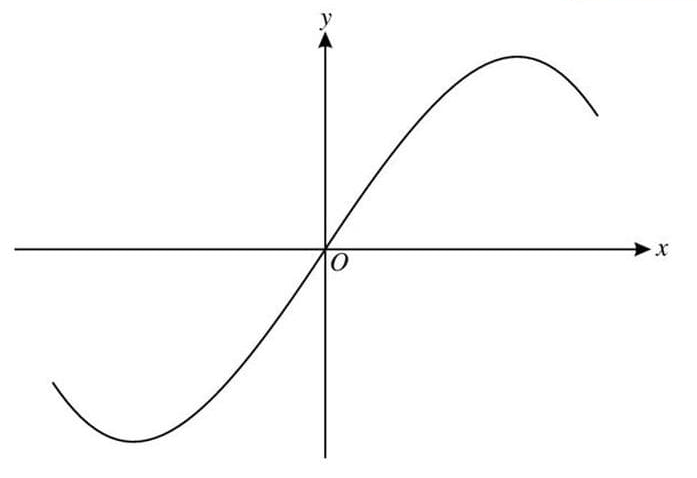
The diagram shows the curve with parametric equations
\(x = \\sin t + \\cos t, \quad y = \\sin^3 t + \\cos^3 t,\)
for \(\frac{1}{4}\pi < t < \frac{5}{4}\pi.\)
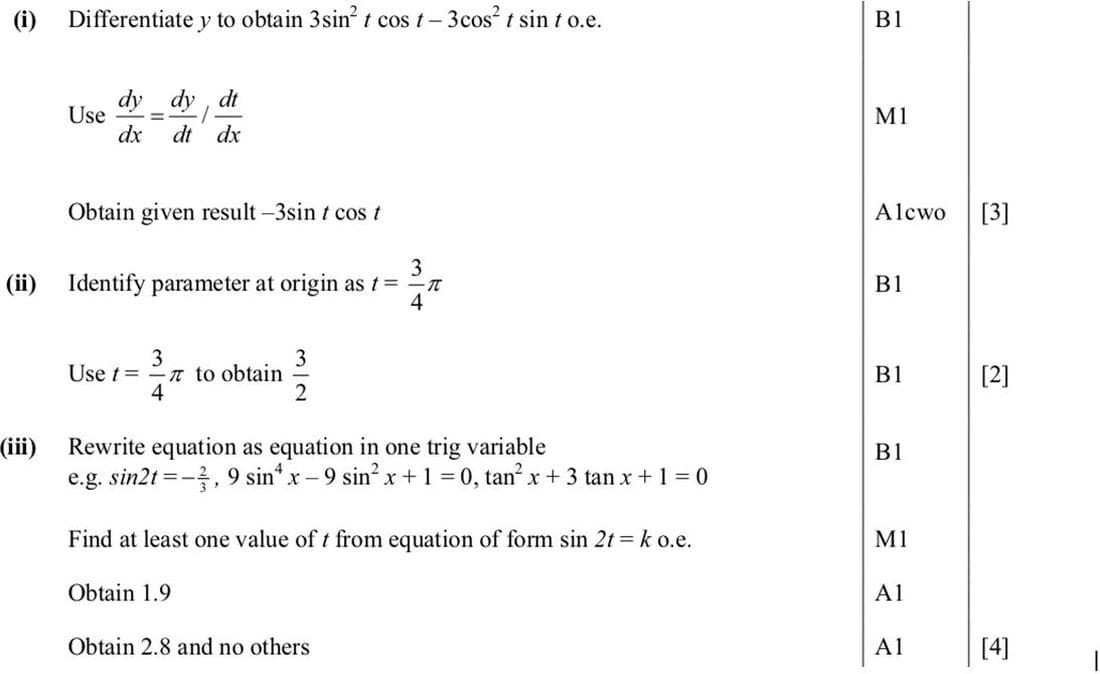
(i) Show that \(\frac{dy}{dx} = -3 \sin t \cos t.\)
(ii) Find the gradient of the curve at the origin.
(iii) Find the values of \(t\) for which the gradient of the curve is 1, giving your answers correct to 2 significant figures.
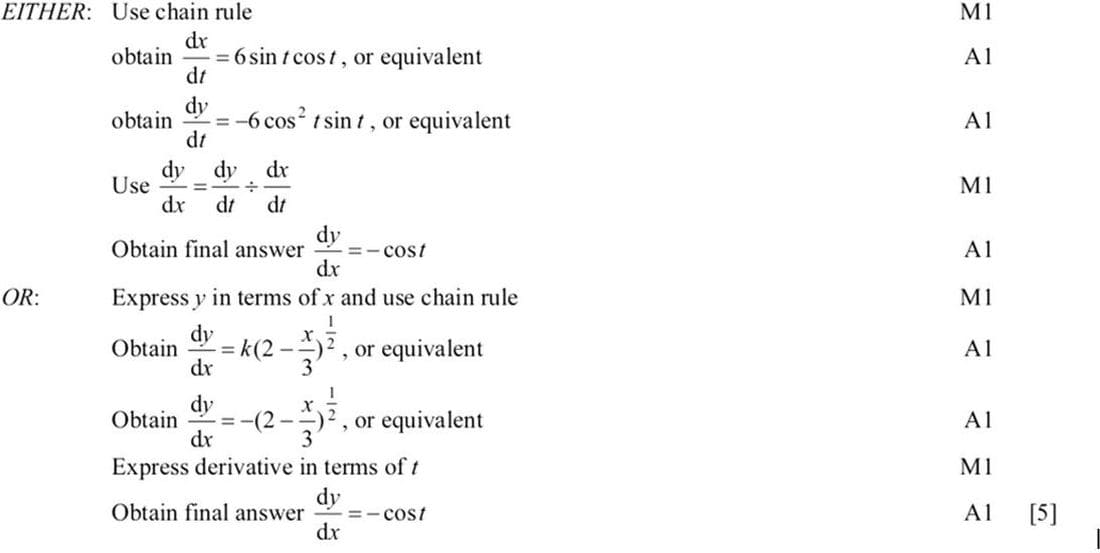
Nov 2011 p31 q2
The parametric equations of a curve are
\(x = 3(1 + \\sin^2 t)\), \(y = 2 \\cos^3 t\).
Find \(\frac{dy}{dx}\) in terms of \(t\), simplifying your answer as far as possible.