Exam-Style Problems
⬅ Back to SubchapterJune 2010 p31 q7
2010
The complex number 2 + 2i is denoted by u.
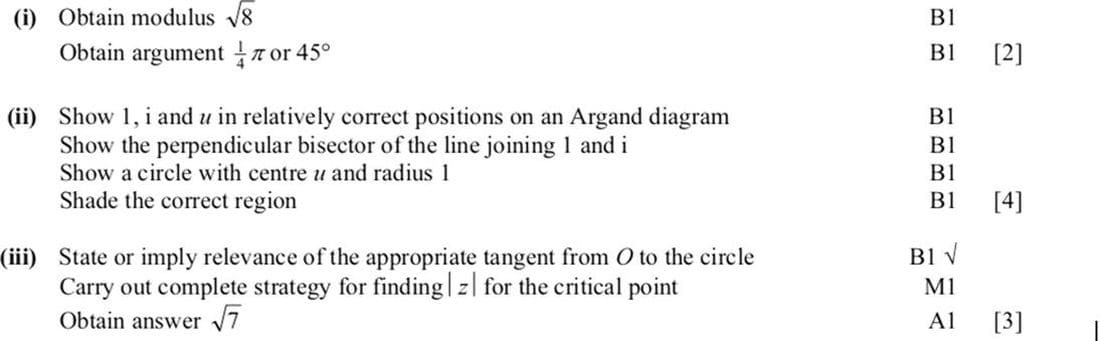
(i) Find the modulus and argument of u.
(ii) Sketch an Argand diagram showing the points representing the complex numbers 1, i and u. Shade the region whose points represent the complex numbers z which satisfy both the inequalities \(|z - 1| \leq |z - i|\) and \(|z - u| \leq 1\).
(iii) Using your diagram, calculate the value of \(|z|\) for the point in this region for which \(\arg z\) is least.
Nov 2009 p32 q7
2011
The complex numbers \(-2 + i\) and \(3 + i\) are denoted by \(u\) and \(v\) respectively.
(i) Find, in the form \(x + iy\), the complex numbers
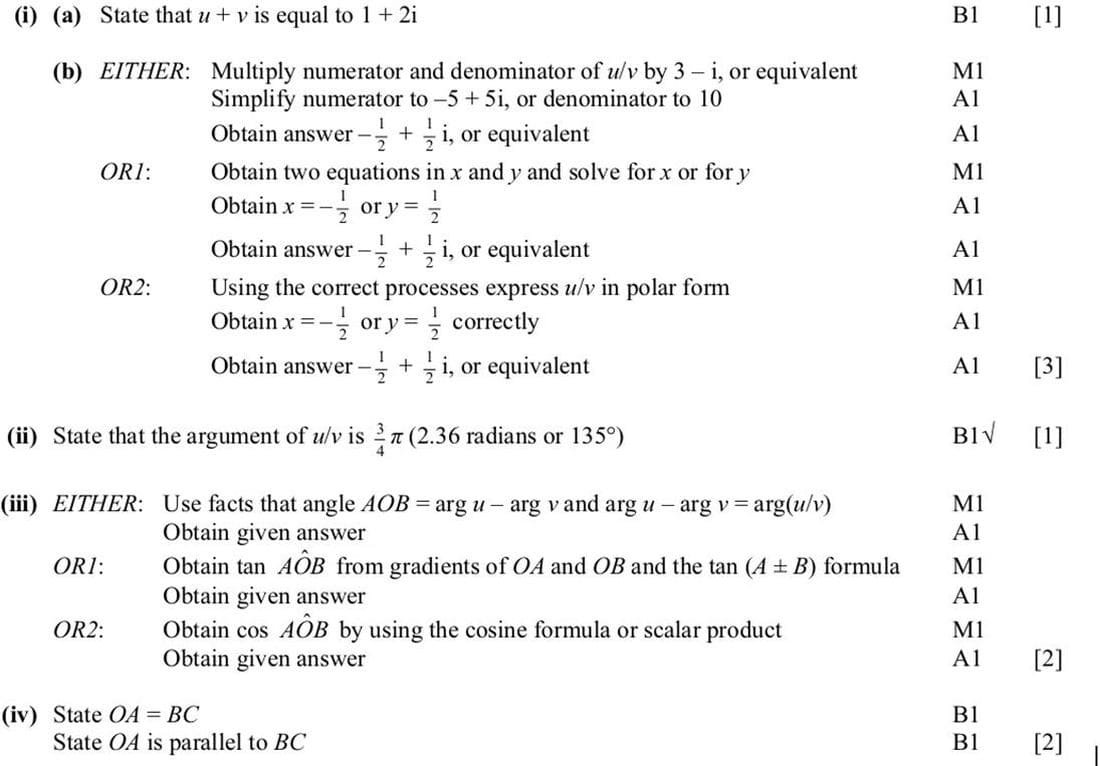
(a) \(u + v\),
(b) \(\frac{u}{v}\), showing all your working.
(ii) State the argument of \(\frac{u}{v}\).
In an Argand diagram with origin \(O\), the points \(A, B\) and \(C\) represent the complex numbers \(u, v\) and \(u + v\) respectively.
(iii) Prove that angle \(AOB = \frac{3}{4}\pi\).
(iv) State fully the geometrical relationship between the line segments \(OA\) and \(BC\).
Nov 2009 p31 q7
2012
The complex number \(-2 + i\) is denoted by \(u\).
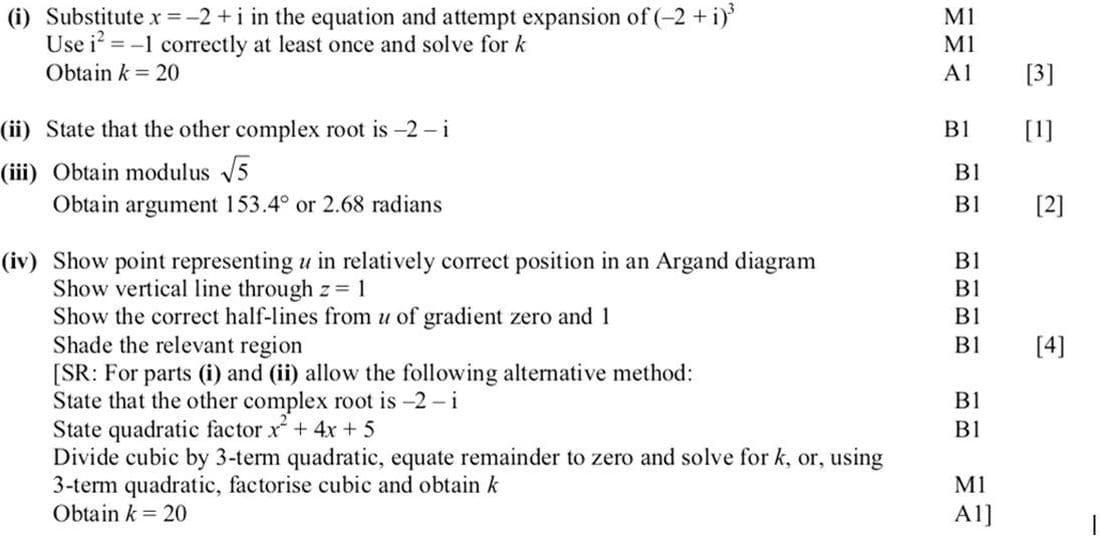
(i) Given that \(u\) is a root of the equation \(x^3 - 11x - k = 0\), where \(k\) is real, find the value of \(k\).
(ii) Write down the other complex root of this equation.
(iii) Find the modulus and argument of \(u\).
(iv) Sketch an Argand diagram showing the point representing \(u\). Shade the region whose points represent the complex numbers \(z\) satisfying both the inequalities \(|z| < |z - 2|\) and \(0 < \arg(z - u) < \frac{1}{4}\pi\).
June 2009 p3 q7
2013
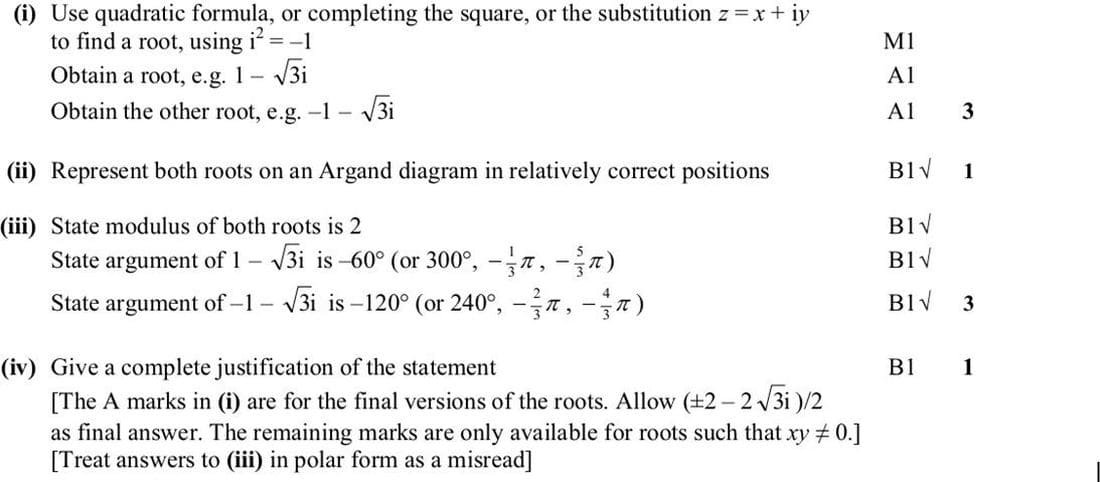
(i) Solve the equation \(z^2 + (2\sqrt{3})iz - 4 = 0\), giving your answers in the form \(x + iy\), where \(x\) and \(y\) are real.
(ii) Sketch an Argand diagram showing the points representing the roots.
(iii) Find the modulus and argument of each root.
(iv) Show that the origin and the points representing the roots are the vertices of an equilateral triangle.
Nov 2008 p3 q10
2014
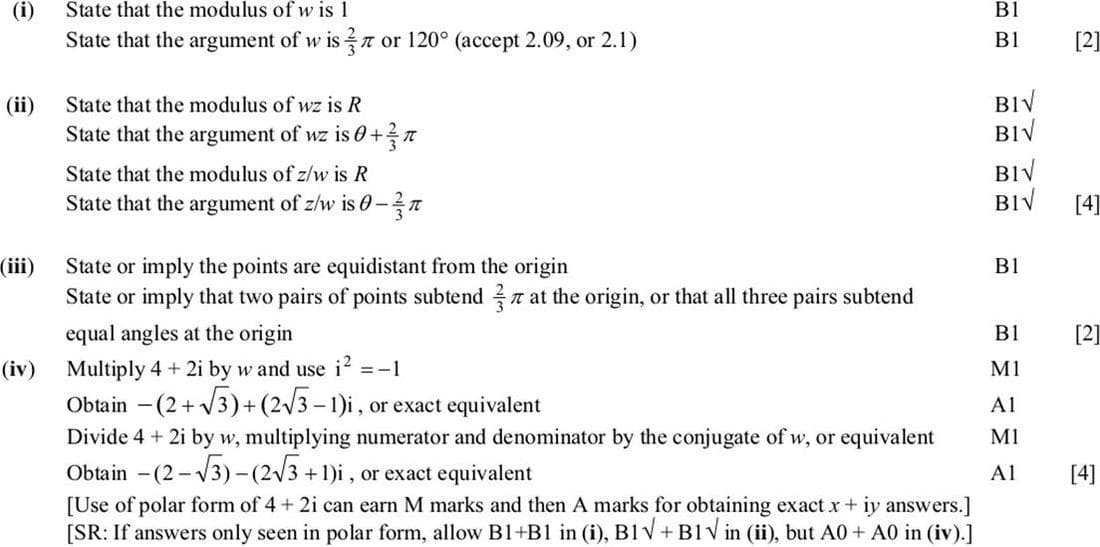
The complex number w is given by \(w = -\frac{1}{2} + i \frac{\sqrt{3}}{2}\).
- Find the modulus and argument of w. [2]
- The complex number z has modulus R and argument \(\theta\), where \(-\frac{1}{3}\pi < \theta < \frac{1}{3}\pi\). State the modulus and argument of wz and the modulus and argument of \(\frac{z}{w}\). [4]
- Hence explain why, in an Argand diagram, the points representing z, wz and \(\frac{z}{w}\) are the vertices of an equilateral triangle. [2]
- In an Argand diagram, the vertices of an equilateral triangle lie on a circle with centre at the origin. One of the vertices represents the complex number 4 + 2i. Find the complex numbers represented by the other two vertices. Give your answers in the form x + iy, where x and y are real and exact. [4]