Exam-Style Problems
⬅ Back to SubchapterJune 2009 p6 q1
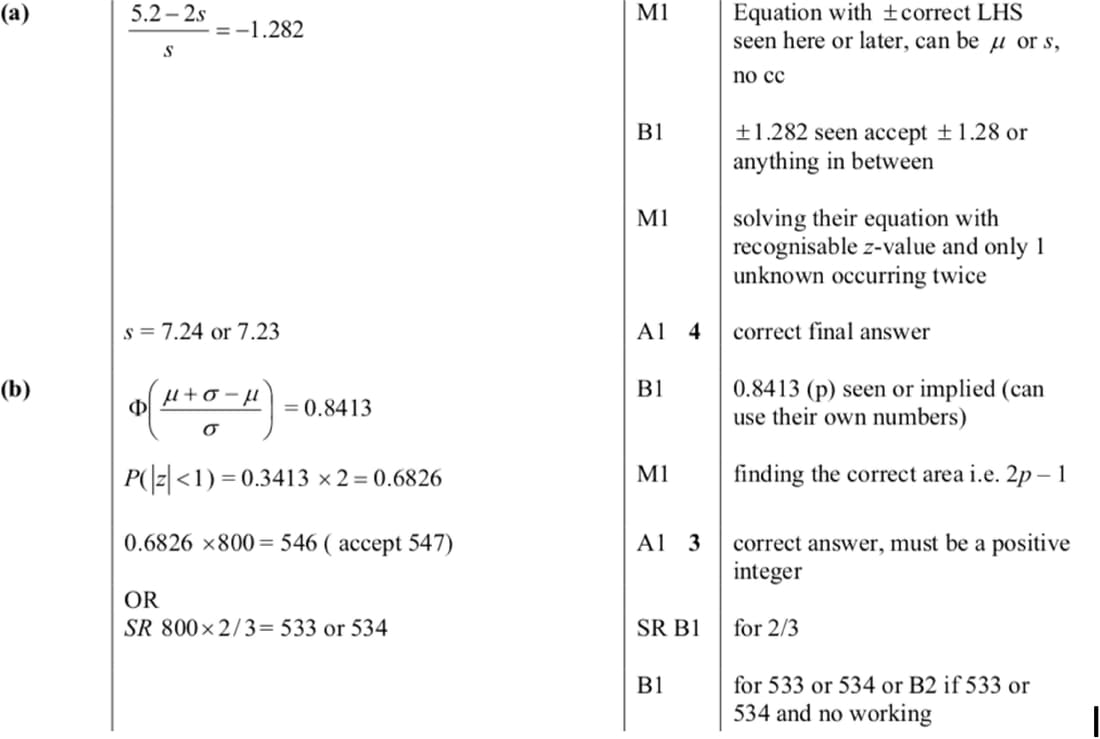
The volume of milk in millilitres in cartons is normally distributed with mean \(\mu\) and standard deviation 8. Measurements were taken of the volume in 900 of these cartons and it was found that 225 of them contained more than 1002 millilitres.
(i) Calculate the value of \(\mu\).
(ii) Three of these 900 cartons are chosen at random. Calculate the probability that exactly 2 of them contain more than 1002 millilitres.
Nov 2008 p6 q3
In another city the daily minimum temperature in °C in January is a random variable with distribution \(N(\mu, 40.0)\). In this city the probability that a randomly chosen day in January has a minimum temperature above 0°C is 0.8888. Find the value of \(\mu\).

June 2008 p6 q4
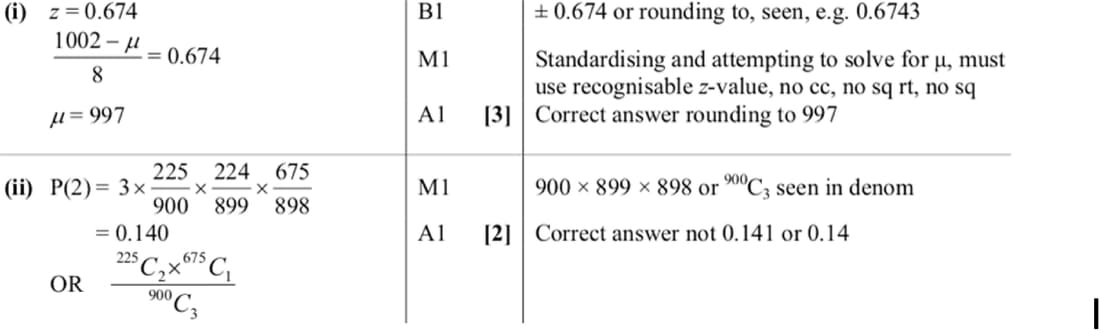
In a certain country the time taken for a common infection to clear up is normally distributed with mean \(\mu\) days and standard deviation 2.6 days. 25% of these infections clear up in less than 7 days.
(i) Find the value of \(\mu\).
In another country the standard deviation of the time taken for the infection to clear up is the same as in part (i), but the mean is 6.5 days. The time taken is normally distributed.
(ii) Find the probability that, in a randomly chosen case from this country, the infection takes longer than 6.2 days to clear up.
Nov 2007 p6 q4
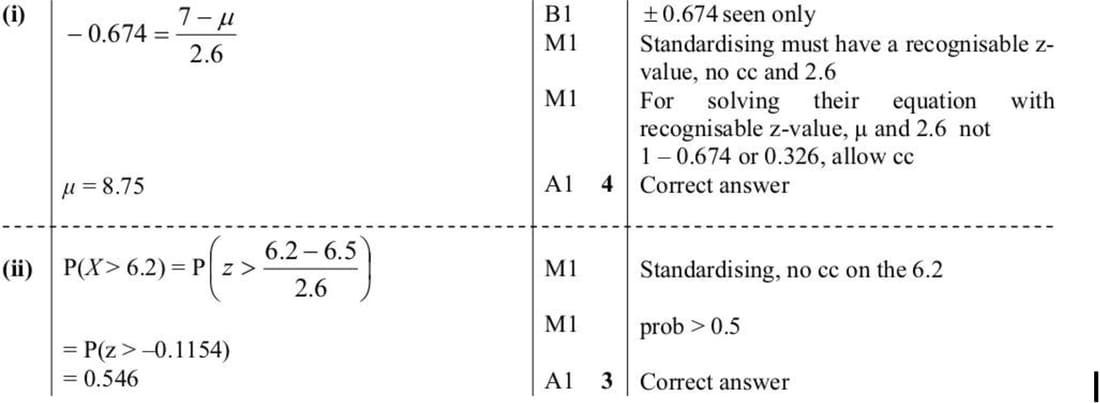
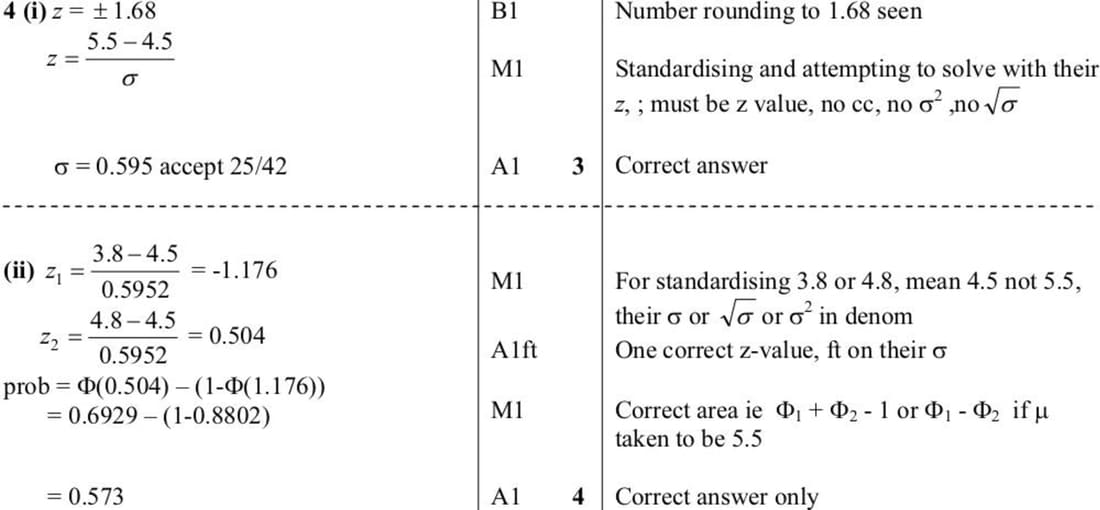
The random variable X has a normal distribution with mean 4.5. It is given that \(P(X > 5.5) = 0.0465\) (see diagram).
- Find the standard deviation of X.
- Find the probability that a random observation of X lies between 3.8 and 4.8.
June 2007 p6 q3
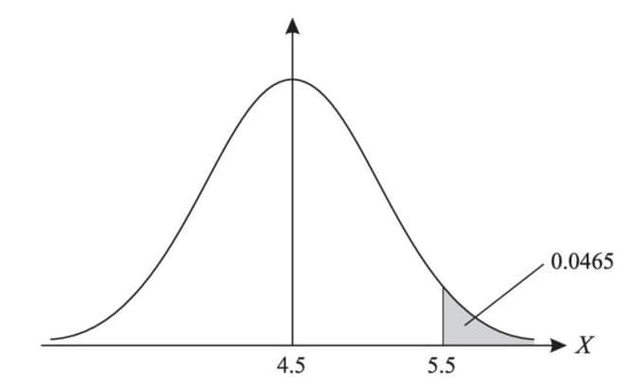
(a) The random variable \(X\) is normally distributed. The mean is twice the standard deviation. It is given that \(P(X > 5.2) = 0.9\). Find the standard deviation.
(b) A normal distribution has mean \(\mu\) and standard deviation \(\sigma\). If 800 observations are taken from this distribution, how many would you expect to be between \(\mu - \sigma\) and \(\mu + \sigma\)?