Exam-Style Problems
⬅ Back to SubchapterJune 2023 p32 q5
2005
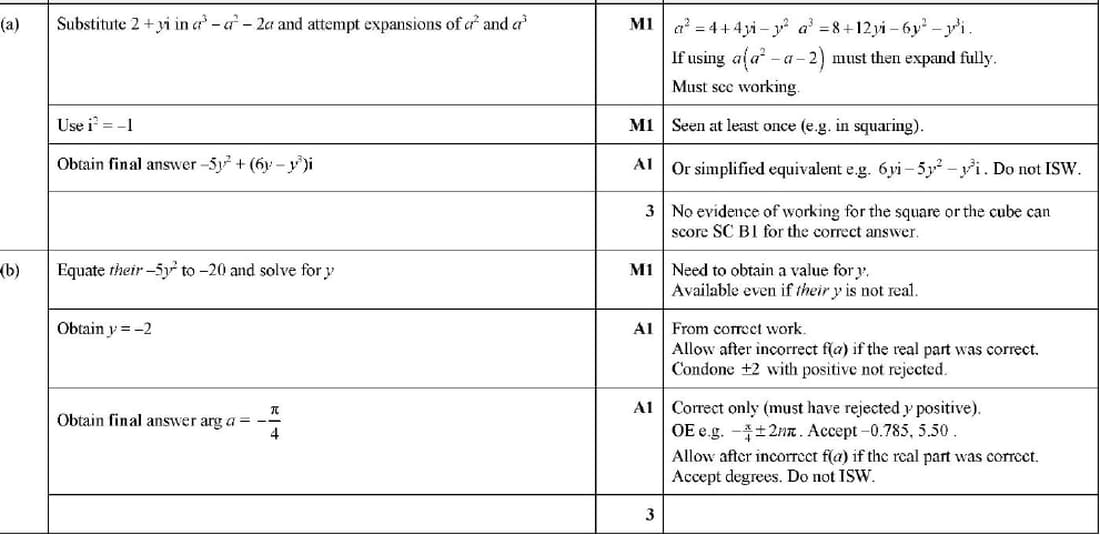
The complex number \(2 + yi\) is denoted by \(a\), where \(y\) is a real number and \(y < 0\). It is given that \(f(a) = a^3 - a^2 - 2a\).
(a) Find a simplified expression for \(f(a)\) in terms of \(y\).
(b) Given that \(\text{Re}(f(a)) = -20\), find \(\arg a\).
Nov 2010 p33 q3
2006
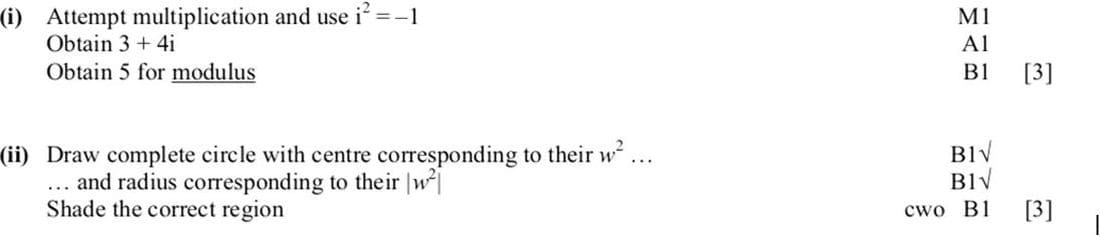
\(The complex number w is defined by w = 2 + i.\)
(i) Showing your working, express w2 in the form x + iy, where x and y are real. Find the modulus of w2.
(ii) Shade on an Argand diagram the region whose points represent the complex numbers z which satisfy \(|z - w^2| \leq |w^2|\).
Nov 2010 p31 q6
2007
The complex number z is given by
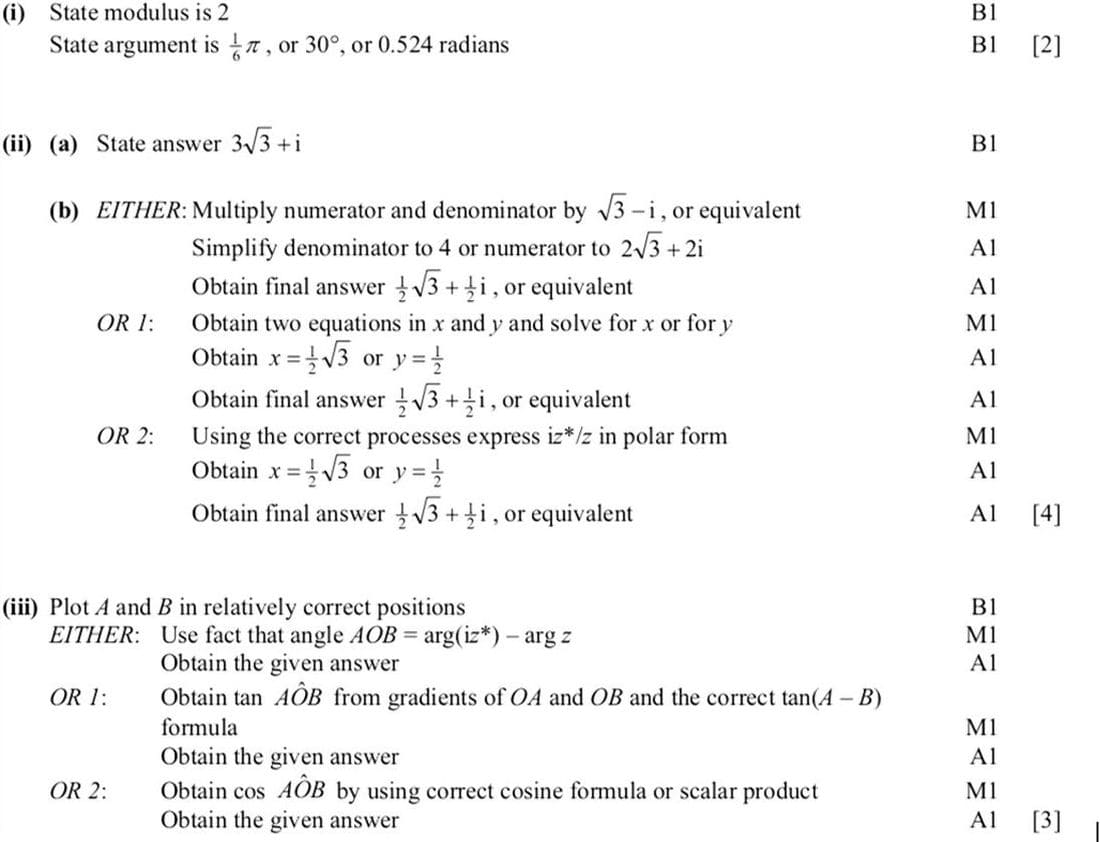
\(z = (3) + i\).
- Find the modulus and argument of z.
- The complex conjugate of z is denoted by \(z^*\). Showing your working, express in the form \(x + iy\), where x and y are real,
- \(2z + z^*\),
- \(\frac{iz^*}{z}\).
- On a sketch of an Argand diagram with origin O, show the points A and B representing the complex numbers z and \(iz^*\) respectively. Prove that angle \(AOB = \frac{1}{6}\pi\).
June 2010 p33 q8
2008
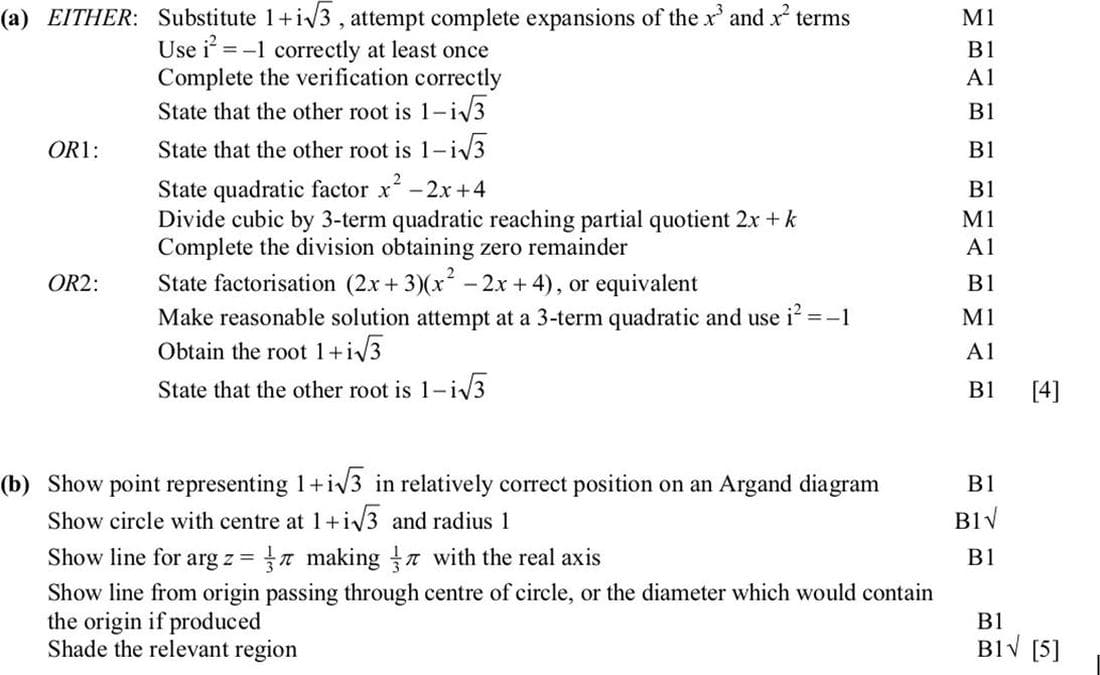
(a) The equation \(2x^3 - x^2 + 2x + 12 = 0\) has one real root and two complex roots. Showing your working, verify that \(1 + i\sqrt{3}\) is one of the complex roots. State the other complex root.
(b) On a sketch of an Argand diagram, show the point representing the complex number \(1 + i\sqrt{3}\). On the same diagram, shade the region whose points represent the complex numbers \(z\) which satisfy both the inequalities \(|z - 1 - i\sqrt{3}| \leq 1\) and \(\arg z \leq \frac{1}{3}\pi\).
June 2010 p32 q8
2009
The variable complex number \(z\) is given by
\(z = 1 + \\cos 2\theta + i \\sin 2\theta\),
where \(\theta\) takes all values in the interval \(-\frac{1}{2}\pi < \theta < \frac{1}{2}\pi\).
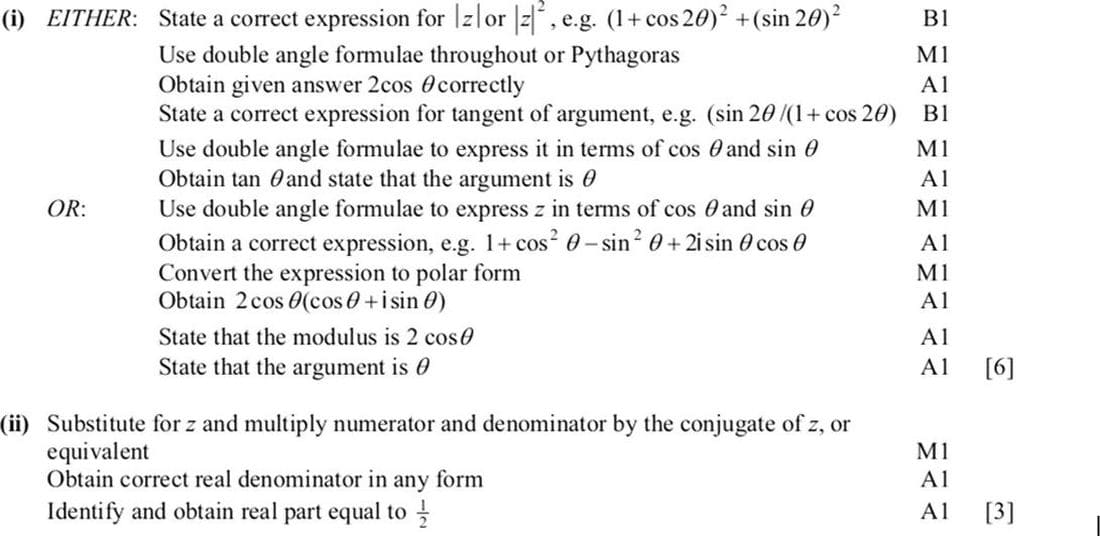
(i) Show that the modulus of \(z\) is \(2 \cos \theta\) and the argument of \(z\) is \(\theta\).
(ii) Prove that the real part of \(\frac{1}{z}\) is constant.