Exam-Style Problems
⬅ Back to SubchapterNov 2015 p31 q6
1422
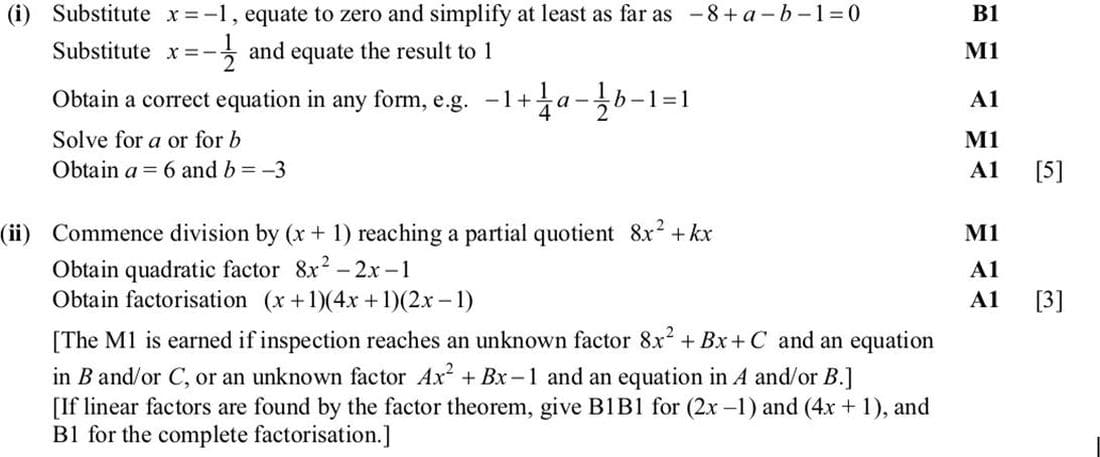
The polynomial \(8x^3 + ax^2 + bx - 1\), where \(a\) and \(b\) are constants, is denoted by \(p(x)\). It is given that \((x + 1)\) is a factor of \(p(x)\) and that when \(p(x)\) is divided by \((2x + 1)\) the remainder is 1.
(i) Find the values of \(a\) and \(b\).
(ii) When \(a\) and \(b\) have these values, factorise \(p(x)\) completely.
Nov 2023 p32 q3
1423
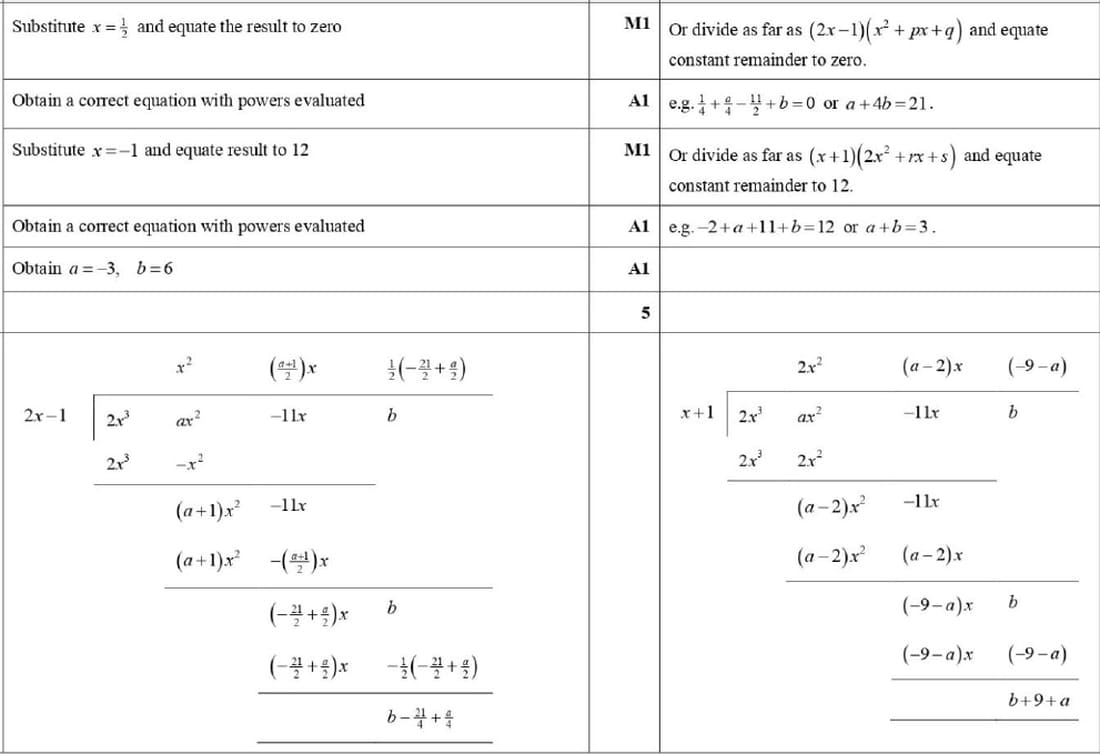
The polynomial \(2x^3 + ax^2 - 11x + b\) is denoted by \(p(x)\). It is given that \(p(x)\) is divisible by \((2x - 1)\) and that when \(p(x)\) is divided by \((x + 1)\) the remainder is 12.
Find the values of \(a\) and \(b\).
Nov 2014 p33 q3
1424
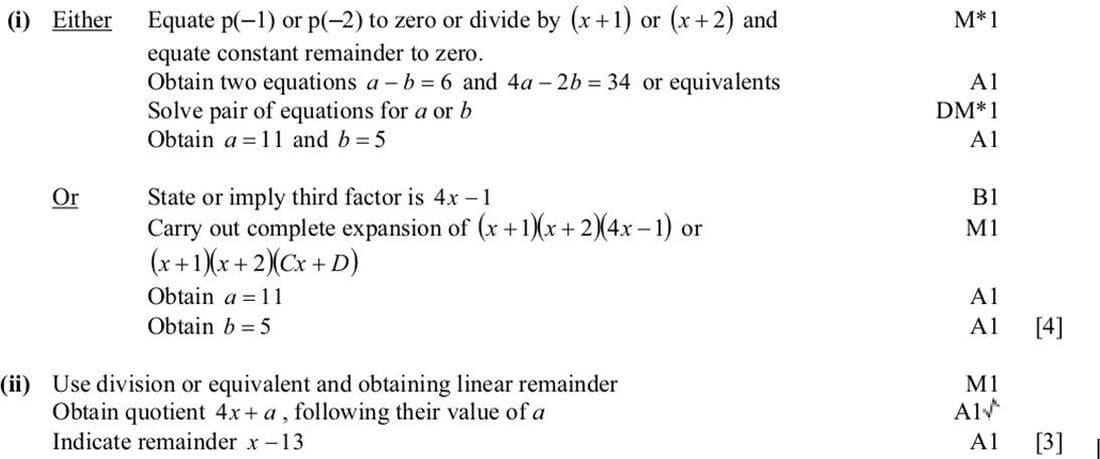
The polynomial \(4x^3 + ax^2 + bx - 2\), where \(a\) and \(b\) are constants, is denoted by \(p(x)\). It is given that \((x+1)\) and \((x+2)\) are factors of \(p(x)\).
(i) Find the values of \(a\) and \(b\).
(ii) When \(a\) and \(b\) have these values, find the remainder when \(p(x)\) is divided by \((x^2 + 1)\).
Nov 2014 p31 q3
1425
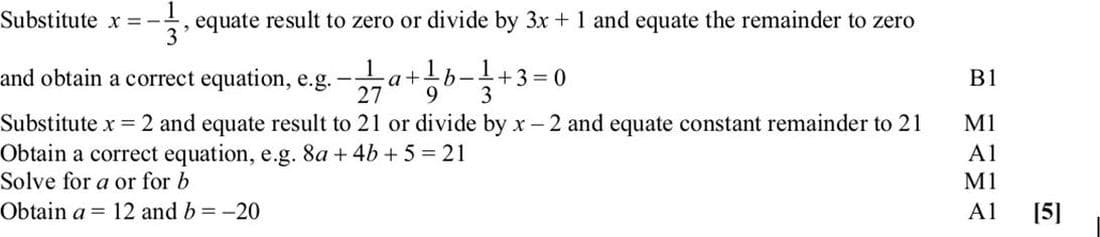
The polynomial \(ax^3 + bx^2 + x + 3\), where \(a\) and \(b\) are constants, is denoted by \(p(x)\). It is given that \((3x + 1)\) is a factor of \(p(x)\), and that when \(p(x)\) is divided by \((x - 2)\) the remainder is 21. Find the values of \(a\) and \(b\).
Nov 2013 p33 q3
1426
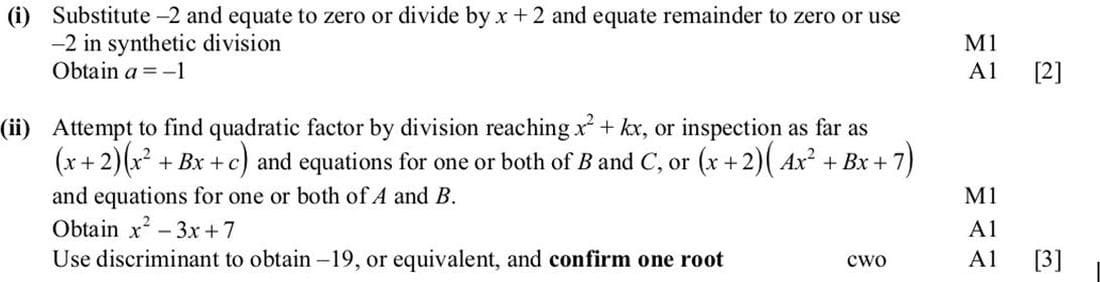
The polynomial \(f(x)\) is defined by
\(f(x) = x^3 + ax^2 - ax + 14\),
where \(a\) is a constant. It is given that \((x + 2)\) is a factor of \(f(x)\).
(i) Find the value of \(a\).
(ii) Show that, when \(a\) has this value, the equation \(f(x) = 0\) has only one real root.