Exam-Style Problems
⬅ Back to SubchapterJune 2016 p13 q3
1379
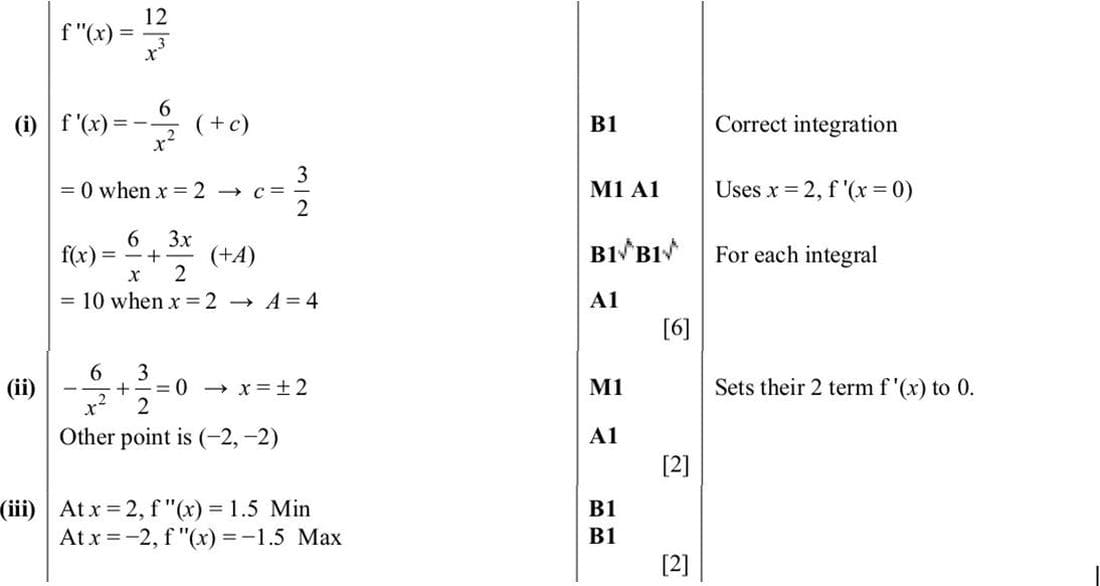
A curve is such that \(\frac{dy}{dx} = 6x^2 + \frac{k}{x^3}\) and passes through the point \(P(1, 9)\). The gradient of the curve at \(P\) is 2.
(i) Find the value of the constant \(k\).
(ii) Find the equation of the curve.
Nov 2021 p11 q9
1380
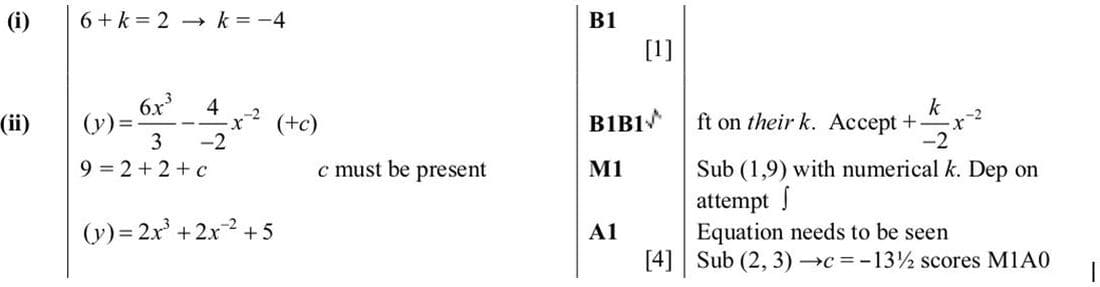
A curve has equation \(y = f(x)\), and it is given that \(f'(x) = 2x^2 - 7 - \frac{4}{x^2}\).
(a) Given that \(f(1) = -\frac{1}{3}\), find \(f(x)\).
(b) Find the coordinates of the stationary points on the curve.
(c) Find \(f''(x)\).
(d) Hence, or otherwise, determine the nature of each of the stationary points.
June 2016 p11 q4
1381
A curve is such that \(\frac{dy}{dx} = 2 - 8(3x + 4)^{-\frac{1}{2}}\).
The curve intersects the y-axis where \(y = \frac{4}{3}\).
Find the equation of the curve.

Nov 2015 p13 q9
1382
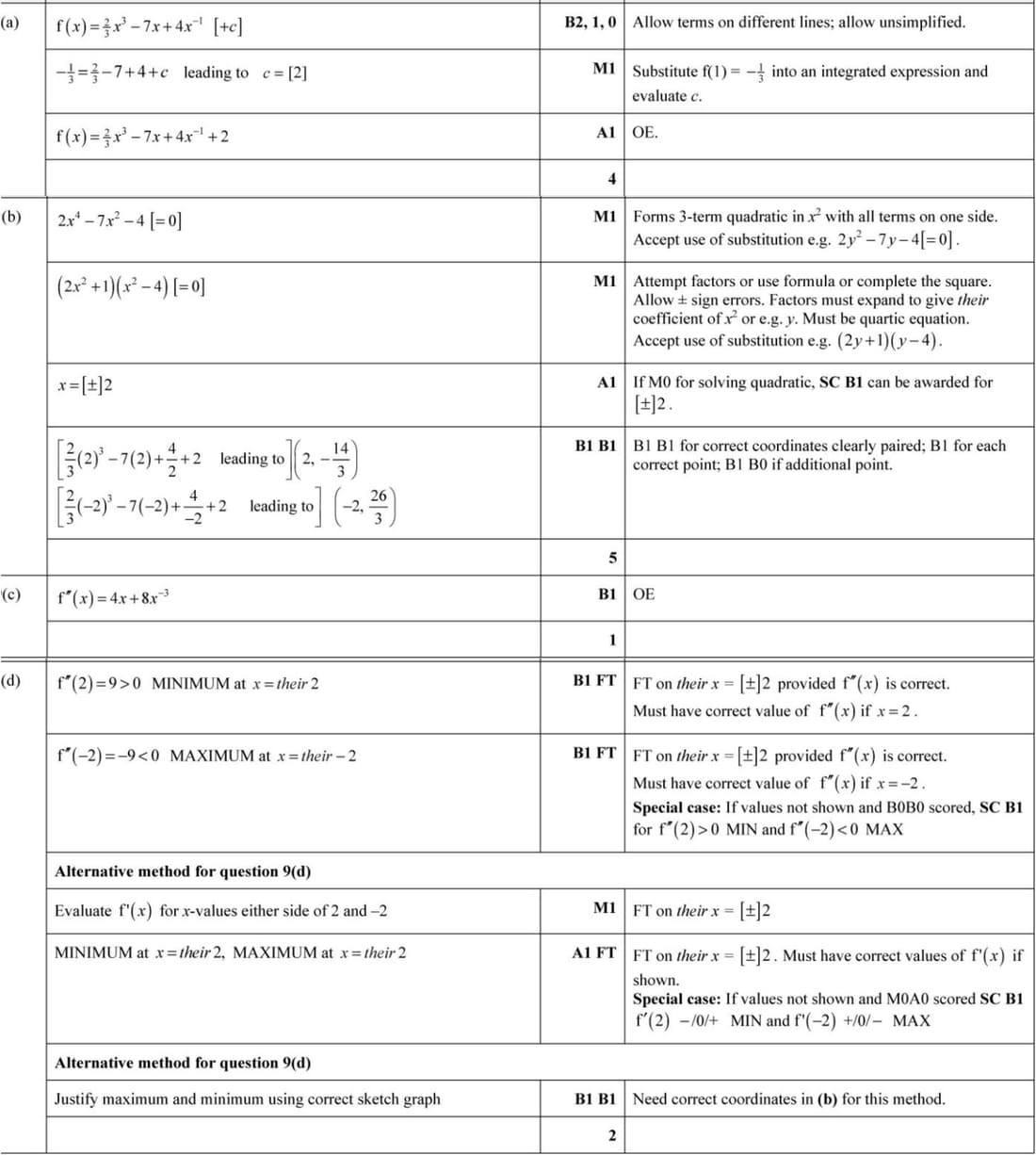
A curve passes through the point A (4, 6) and is such that \(\frac{dy}{dx} = 1 + 2x^{-\frac{1}{2}}\). A point P is moving along the curve in such a way that the x-coordinate of P is increasing at a constant rate of 3 units per minute.
(i) Find the rate at which the y-coordinate of P is increasing when P is at A.
(ii) Find the equation of the curve.
(iii) The tangent to the curve at A crosses the x-axis at B and the normal to the curve at A crosses the x-axis at C. Find the area of triangle ABC.
Nov 2015 p12 q9
1383
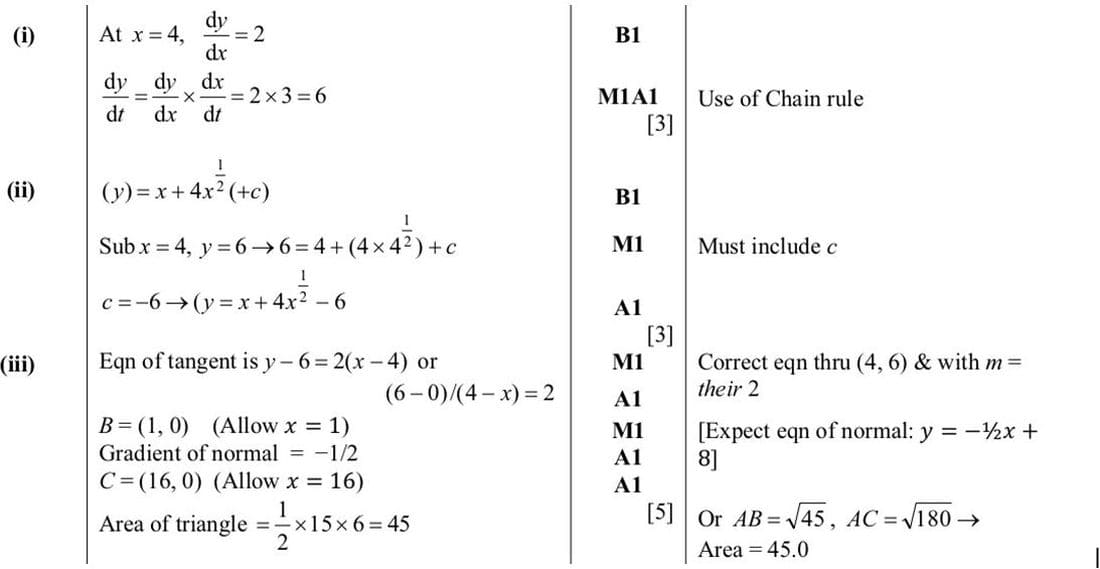
The curve \(y = f(x)\) has a stationary point at \((2, 10)\) and it is given that \(f''(x) = \frac{12}{x^3}\).
(i) Find \(f(x)\).
(ii) Find the coordinates of the other stationary point.
(iii) Find the nature of each of the stationary points.