Exam-Style Problems
⬅ Back to SubchapterJune 2017 p11 q10
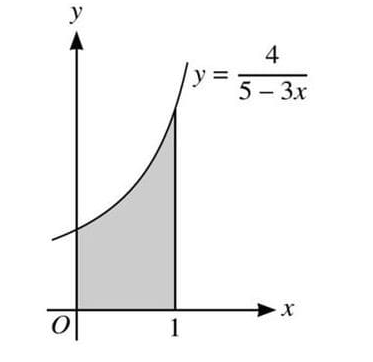
The diagram shows part of the curve \(y = \frac{4}{5 - 3x}\).
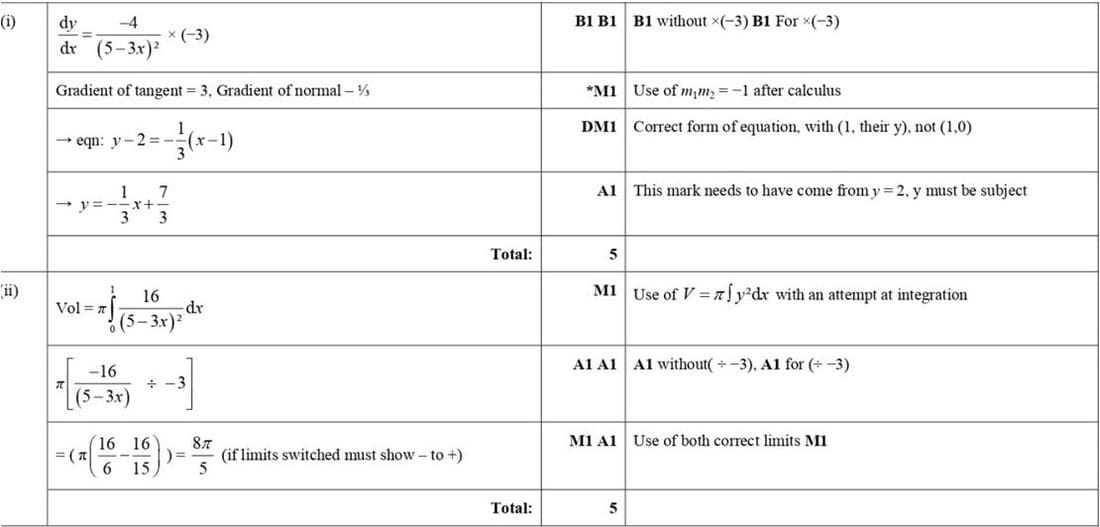
(i) Find the equation of the normal to the curve at the point where \(x = 1\) in the form \(y = mx + c\), where \(m\) and \(c\) are constants.
The shaded region is bounded by the curve, the coordinate axes and the line \(x = 1\).
(ii) Find, showing all necessary working, the volume obtained when this shaded region is rotated through 360° about the \(x\)-axis.
Problem 1332
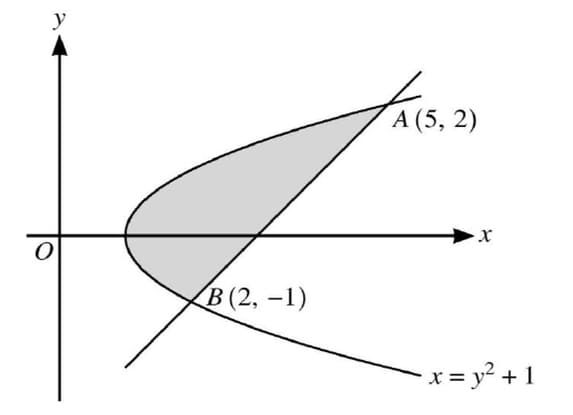
The diagram shows the curve with equation \(x = y^2 + 1\). The points \(A(5, 2)\) and \(B(2, -1)\) lie on the curve.
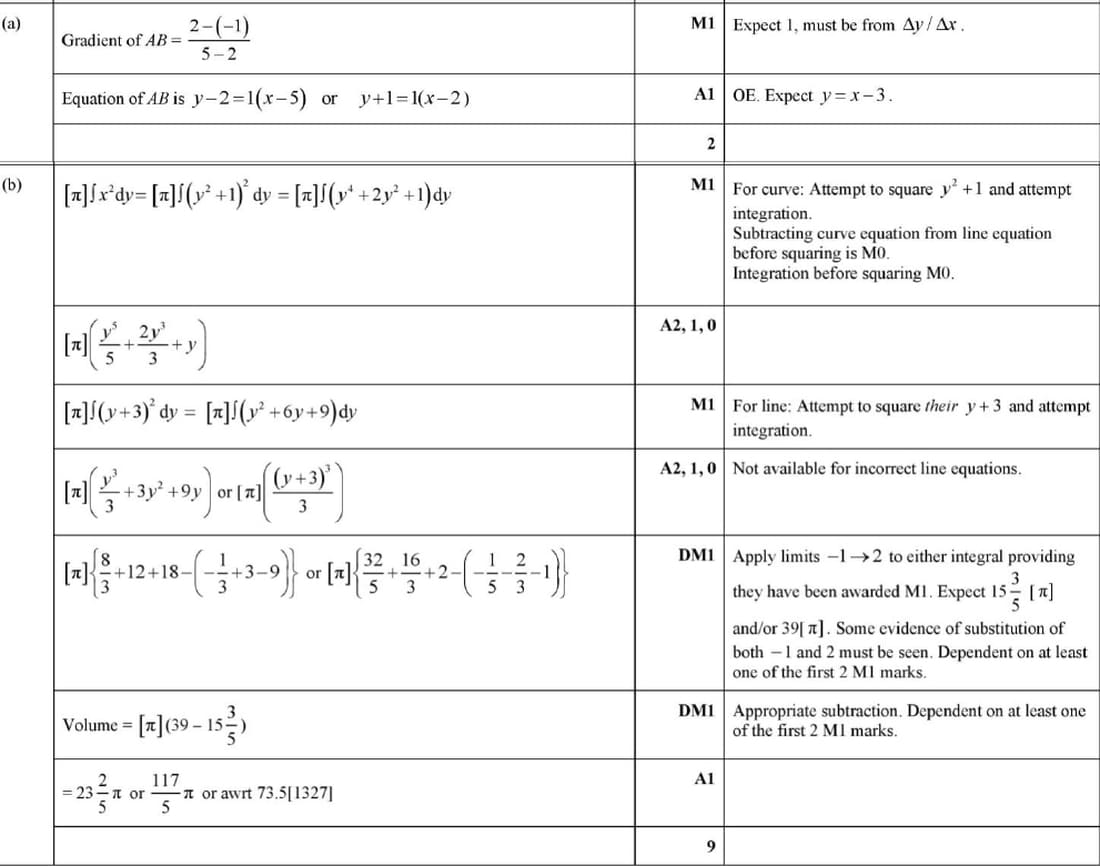
(a) Find an equation of the line \(AB\).
(b) Find the volume of revolution when the region between the curve and the line \(AB\) is rotated through 360° about the \(y\)-axis.
Nov 2016 p13 q11
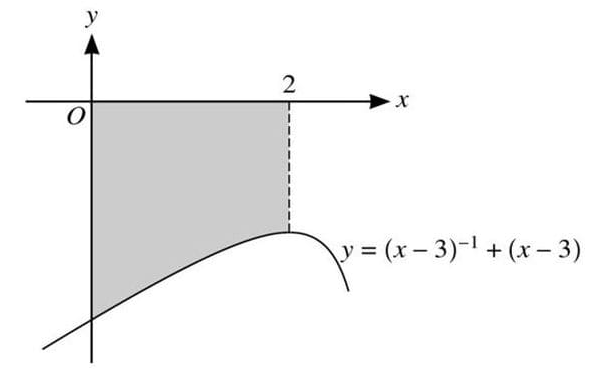
A curve has equation \(y = (kx - 3)^{-1} + (kx - 3)\), where \(k\) is a non-zero constant.
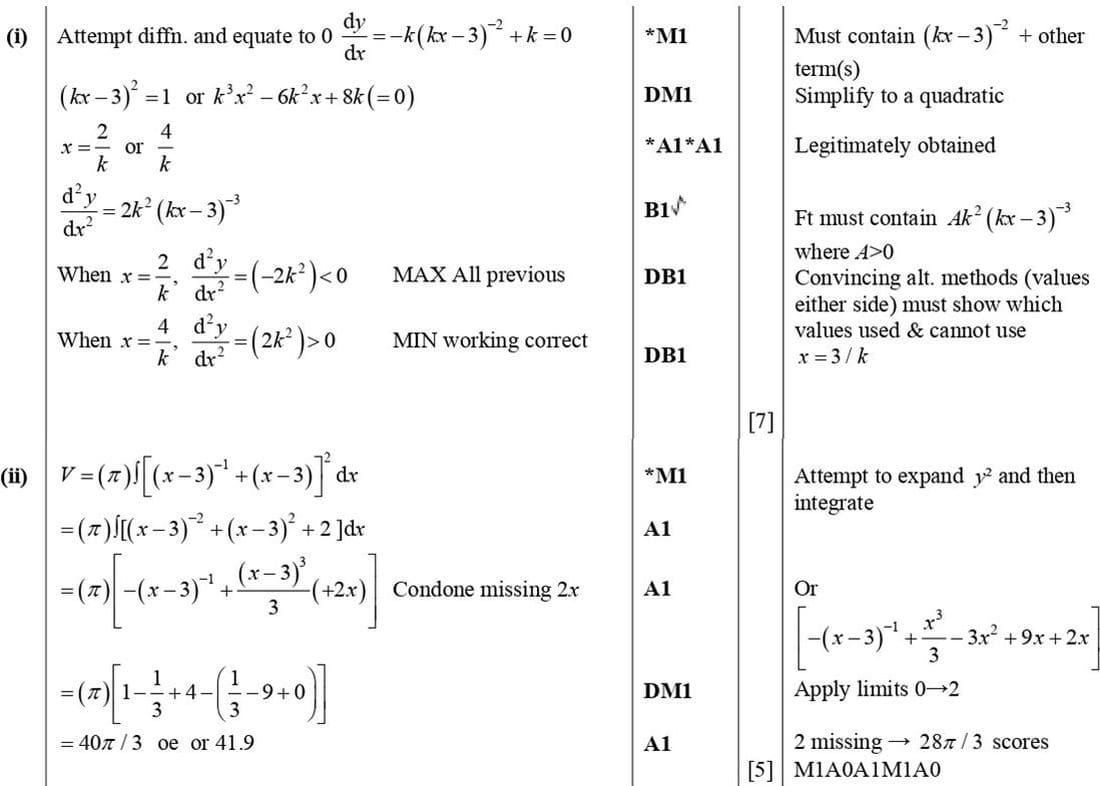
(i) Find the \(x\)-coordinates of the stationary points in terms of \(k\), and determine the nature of each stationary point, justifying your answers.
(ii) The diagram shows part of the curve for the case when \(k = 1\). Showing all necessary working, find the volume obtained when the region between the curve, the \(x\)-axis, the \(y\)-axis and the line \(x = 2\), shown shaded in the diagram, is rotated through 360° about the \(x\)-axis.
June 2016 p13 q2
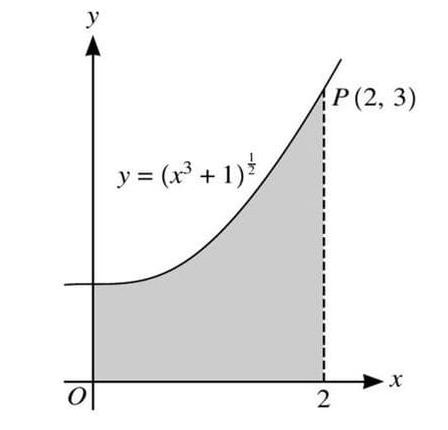
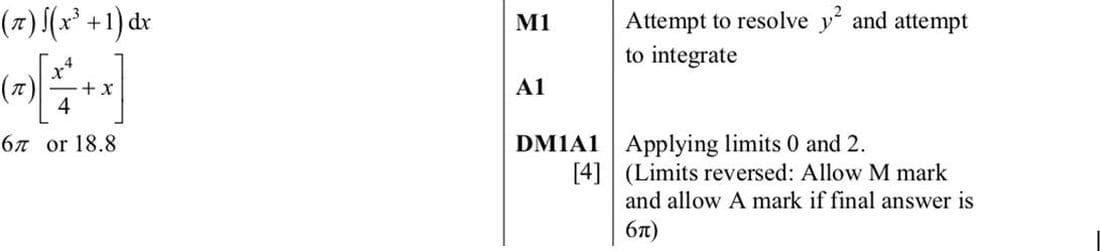
The diagram shows part of the curve \(y = (x^3 + 1)^{\frac{1}{2}}\) and the point \(P(2, 3)\) lying on the curve. Find, showing all necessary working, the volume obtained when the shaded region is rotated through 360° about the x-axis.
June 2016 p12 q10
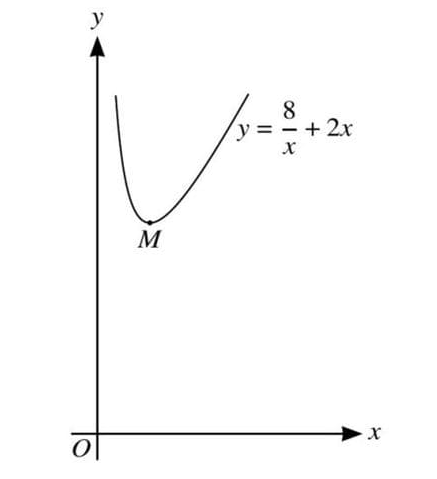
The diagram shows the part of the curve \(y = \frac{8}{x} + 2x\) for \(x > 0\), and the minimum point \(M\).
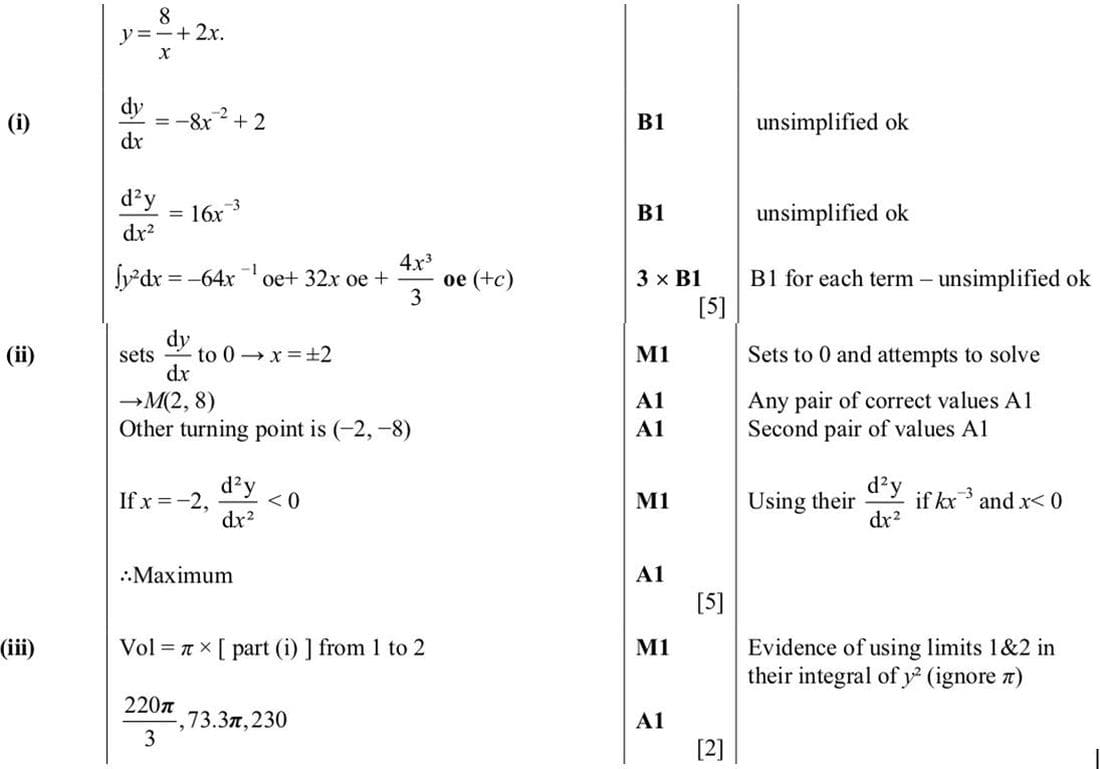
(i) Find expressions for \(\frac{dy}{dx}\), \(\frac{d^2y}{dx^2}\) and \(\int y^2 \, dx\). [5]
(ii) Find the coordinates of \(M\) and determine the coordinates and nature of the stationary point on the part of the curve for which \(x < 0\). [5]
(iii) Find the volume obtained when the region bounded by the curve, the \(x\)-axis and the lines \(x = 1\) and \(x = 2\) is rotated through 360° about the \(x\)-axis. [2]