Exam-Style Problems
⬅ Back to SubchapterJune 2017 p13 q10
1109
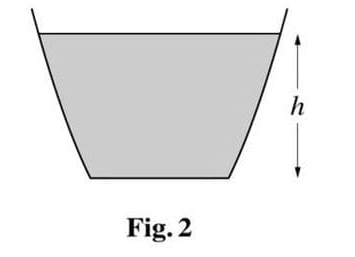
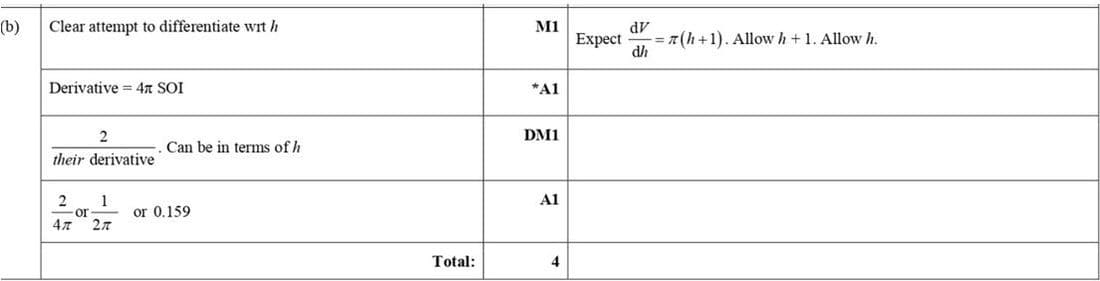
Fig. 2 shows a cross-section of a bowl containing water. When the height of the water level is \(h\) cm, the volume, \(V\) cm\(^3\), of water is given by \(V = \pi \left( \frac{1}{2}h^2 + h \right)\). Water is poured into the bowl at a constant rate of 2 cm\(^3\) s\(^{-1}\). Find the rate, in cm s\(^{-1}\), at which the height of the water level is increasing when the height of the water level is 3 cm.
Nov 2023 p11 q3
1110
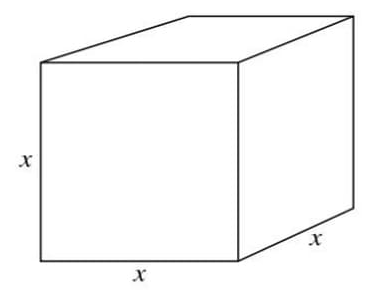
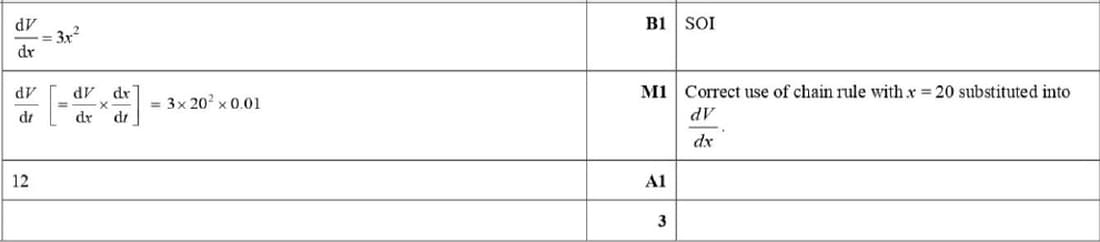
The diagram shows a cubical closed container made of a thin elastic material which is filled with water and frozen. During the freezing process the length, x cm, of each edge of the container increases at the constant rate of 0.01 cm per minute. The volume of the container at time t minutes is V cm3.
\(Find the rate of increase of V when x = 20.\)
June 2017 p12 q5
1111
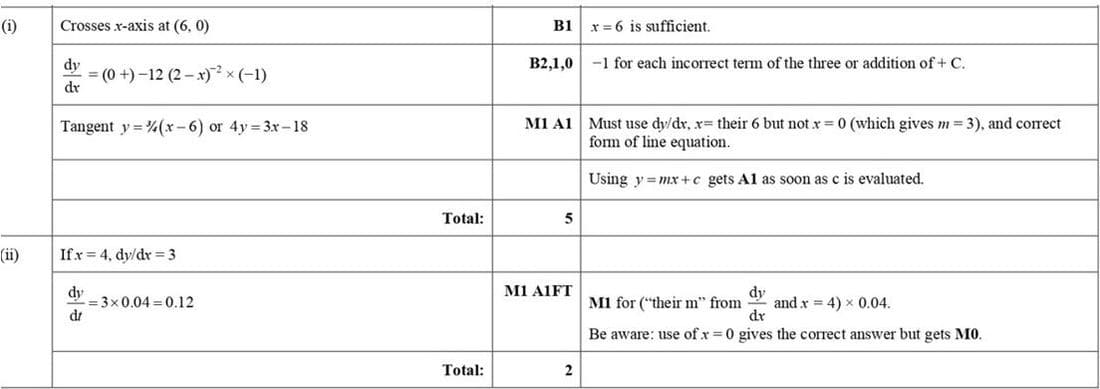
A curve has equation \(y = 3 + \frac{12}{2-x}\).
(i) Find the equation of the tangent to the curve at the point where the curve crosses the x-axis. [5]
(ii) A point moves along the curve in such a way that the x-coordinate is increasing at a constant rate of 0.04 units per second. Find the rate of change of the y-coordinate when \(x = 4\). [2]
Feb/Mar 2017 p12 q3
1112
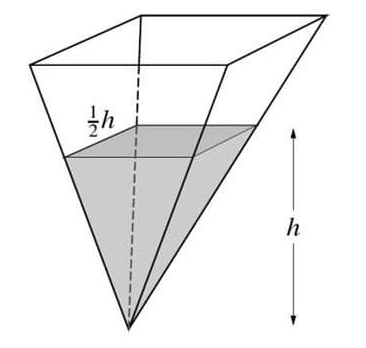
The diagram shows a water container in the form of an inverted pyramid, which is such that when the height of the water level is h cm the surface of the water is a square of side \(\frac{1}{2}h\) cm.
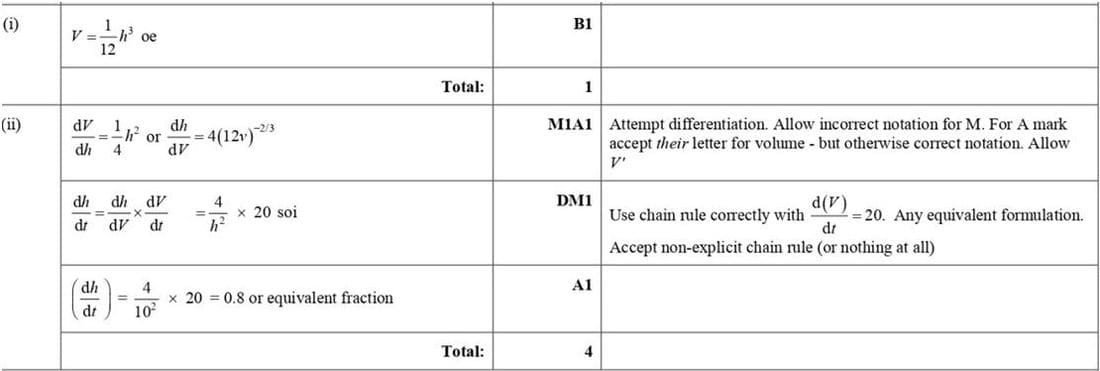
(i) Express the volume of water in the container in terms of h.
[The volume of a pyramid having a base area A and vertical height h is \(\frac{1}{3}Ah\).]
Water is steadily dripping into the container at a constant rate of 20 cm3 per minute.
(ii) Find the rate, in cm per minute, at which the water level is rising when the height of the water level is 10 cm.
Nov 2016 p12 q7
1113
The equation of a curve is \(y = 2 + \frac{3}{2x - 1}\).
(i) Obtain an expression for \(\frac{dy}{dx}\).
(ii) Explain why the curve has no stationary points.
At the point \(P\) on the curve, \(x = 2\).
(iii) Show that the normal to the curve at \(P\) passes through the origin.
(iv) A point moves along the curve in such a way that its \(x\)-coordinate is decreasing at a constant rate of 0.06 units per second. Find the rate of change of the \(y\)-coordinate as the point passes through \(P\).