Exam-Style Problems
⬅ Back to SubchapterNov 2017 p13 q1
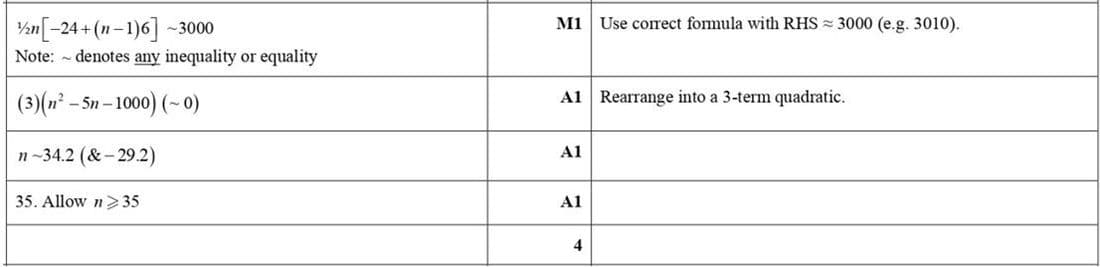
An arithmetic progression has first term \(-12\) and common difference \(6\). The sum of the first \(n\) terms exceeds \(3000\). Calculate the least possible value of \(n\).
Feb/Mar 2023 p12 q4
The circumference round the trunk of a large tree is measured and found to be 5.00 m. After one year the circumference is measured again and found to be 5.02 m.
Given that the circumferences at yearly intervals form an arithmetic progression, find the circumference 20 years after the first measurement.

Nov 2017 p12 q3
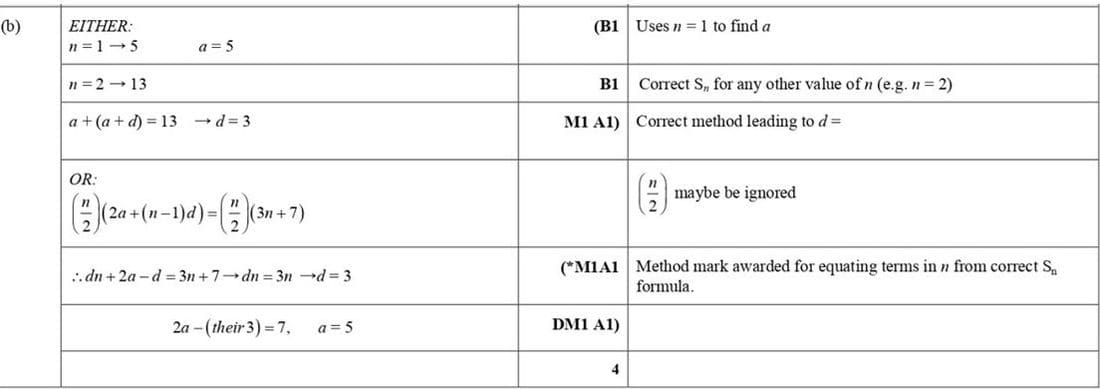
The sum of the first n terms of an arithmetic progression is \(\frac{1}{2}n(3n + 7)\). Find the 1st term and the common difference of the progression.
Nov 2017 p11 q3
The first two terms of an arithmetic progression are 15 and 19 respectively. The first two terms of a second arithmetic progression are 420 and 415 respectively. The two progressions have the same sum of the first n terms. Find the value of n.

June 2017 p12 q7
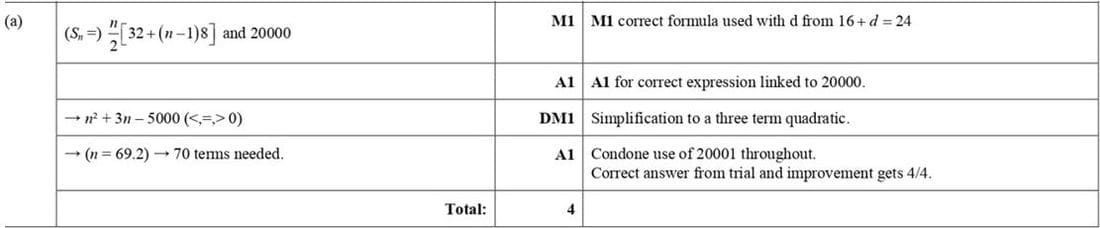
The first two terms of an arithmetic progression are 16 and 24. Find the least number of terms of the progression which must be taken for their sum to exceed 20,000.