Exam-Style Problems
⬅ Back to SubchapterProblem 439
(i) Show that the equation \(3 \cos^4 \theta + 4 \sin^2 \theta - 3 = 0\) can be expressed as \(3x^2 - 4x + 1 = 0\), where \(x = \cos^2 \theta\).
(ii) Hence solve the equation \(3 \cos^4 \theta + 4 \sin^2 \theta - 3 = 0\) for \(0^\circ \leq \theta \leq 180^\circ\).
Problem 440
(a) Verify the identity \((2x - 1)(4x^2 + 2x - 1) \equiv 8x^3 - 4x + 1\).
(b) Prove the identity \(\frac{\tan^2 \theta + 1}{\tan^2 \theta - 1} \equiv \frac{1}{1 - 2 \cos^2 \theta}\).
(c) Using the results of (a) and (b), solve the equation \(\frac{\tan^2 \theta + 1}{\tan^2 \theta - 1} = 4 \cos \theta\), for \(0^\circ \leq \theta \leq 180^\circ\).
Problem 441
(i) Given that \(4 \tan x + 3 \cos x + \frac{1}{\cos x} = 0\), show, without using a calculator, that \(\sin x = -\frac{2}{3}\).
(ii) Hence, showing all necessary working, solve the equation \(4 \tan(2x - 20^\circ) + 3 \cos(2x - 20^\circ) + \frac{1}{\cos(2x - 20^\circ)} = 0\) for \(0^\circ \leq x \leq 180^\circ\).
March 2019 p12 q7a
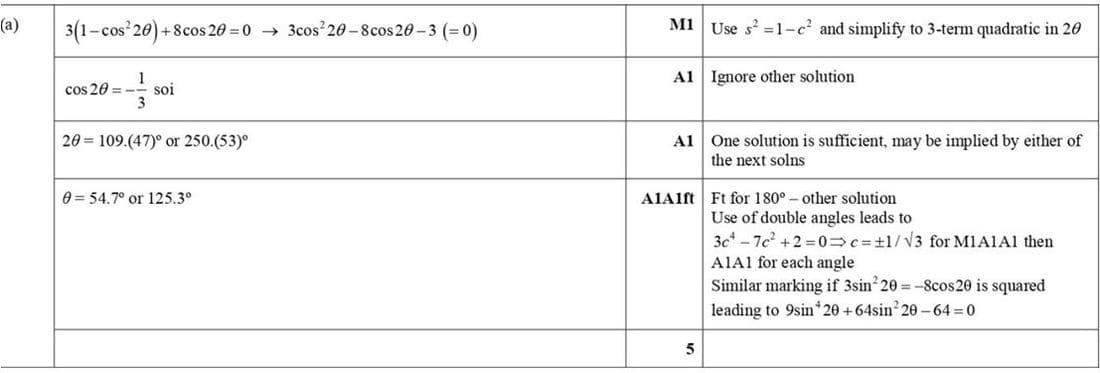
Solve the equation \(3 \sin^2 2\theta + 8 \cos 2\theta = 0\) for \(0^\circ \leq \theta \leq 180^\circ\).
Problem 443
(i) Show that \(\frac{\tan \theta + 1}{1 + \cos \theta} + \frac{\tan \theta - 1}{1 - \cos \theta} \equiv \frac{2(\tan \theta - \cos \theta)}{\sin^2 \theta}\).
(ii) Hence, showing all necessary working, solve the equation \(\frac{\tan \theta + 1}{1 + \cos \theta} + \frac{\tan \theta - 1}{1 - \cos \theta} = 0\) for \(0^\circ < \theta < 90^\circ\).