Exam-Style Problems
⬅ Back to SubchapterJune 2021 p12 q7
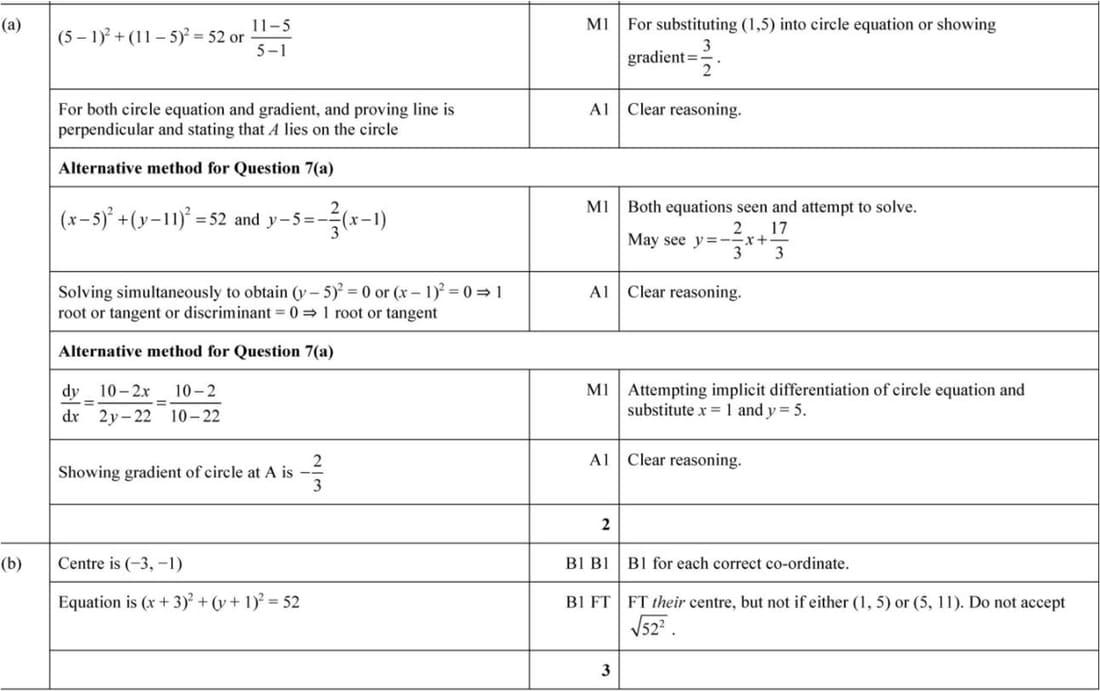
The point A has coordinates (1, 5) and the line l has gradient \(-\frac{2}{3}\) and passes through A. A circle has centre (5, 11) and radius \(\sqrt{52}\).
(a) Show that l is the tangent to the circle at A.
(b) Find the equation of the other circle of radius \(\sqrt{52}\) for which l is also the tangent at A.
Nov 2023 p12 q11
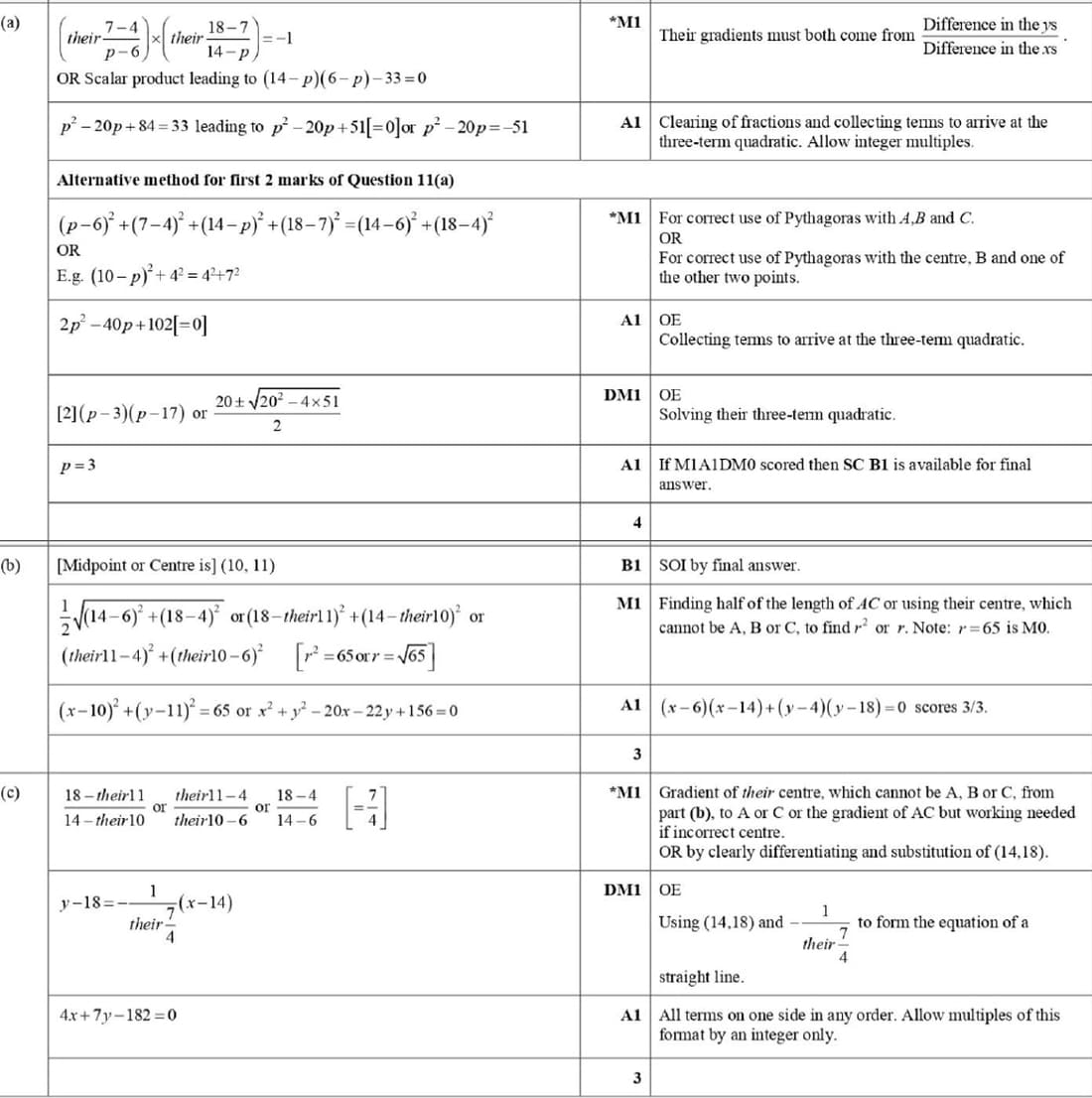
The coordinates of points A, B and C are (6, 4), (p, 7) and (14, 18) respectively, where p is a constant. The line AB is perpendicular to the line BC.
(a) Given that p < 10, find the value of p.
A circle passes through the points A, B and C.
(b) Find the equation of the circle.
(c) Find the equation of the tangent to the circle at C, giving the answer in the form dx + ey + f = 0, where d, e and f are integers.
June 2021 p11 q10
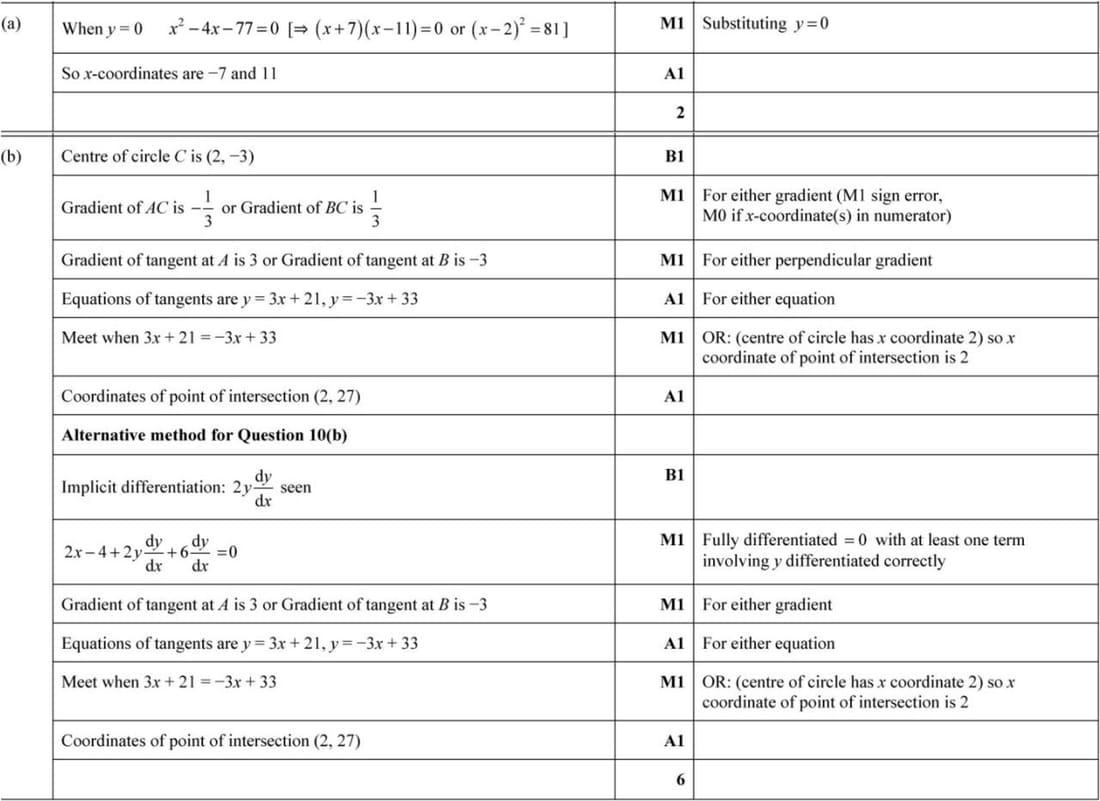
The equation of a circle is \(x^2 + y^2 - 4x + 6y - 77 = 0\).
(a) Find the \(x\)-coordinates of the points \(A\) and \(B\) where the circle intersects the \(x\)-axis.
(b) Find the point of intersection of the tangents to the circle at \(A\) and \(B\).
Feb/Mar 2021 p12 q8
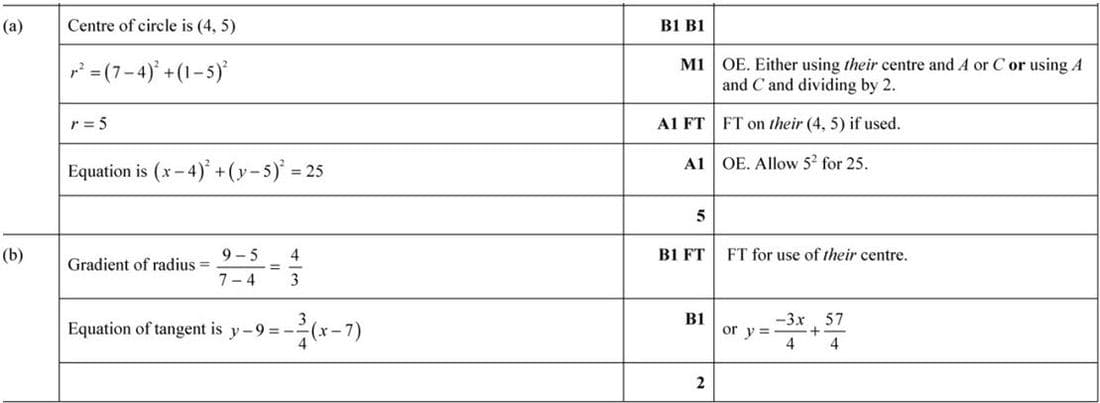
The points \(A(7, 1)\), \(B(7, 9)\), and \(C(1, 9)\) are on the circumference of a circle.
(a) Find an equation of the circle.
(b) Find an equation of the tangent to the circle at \(B\).
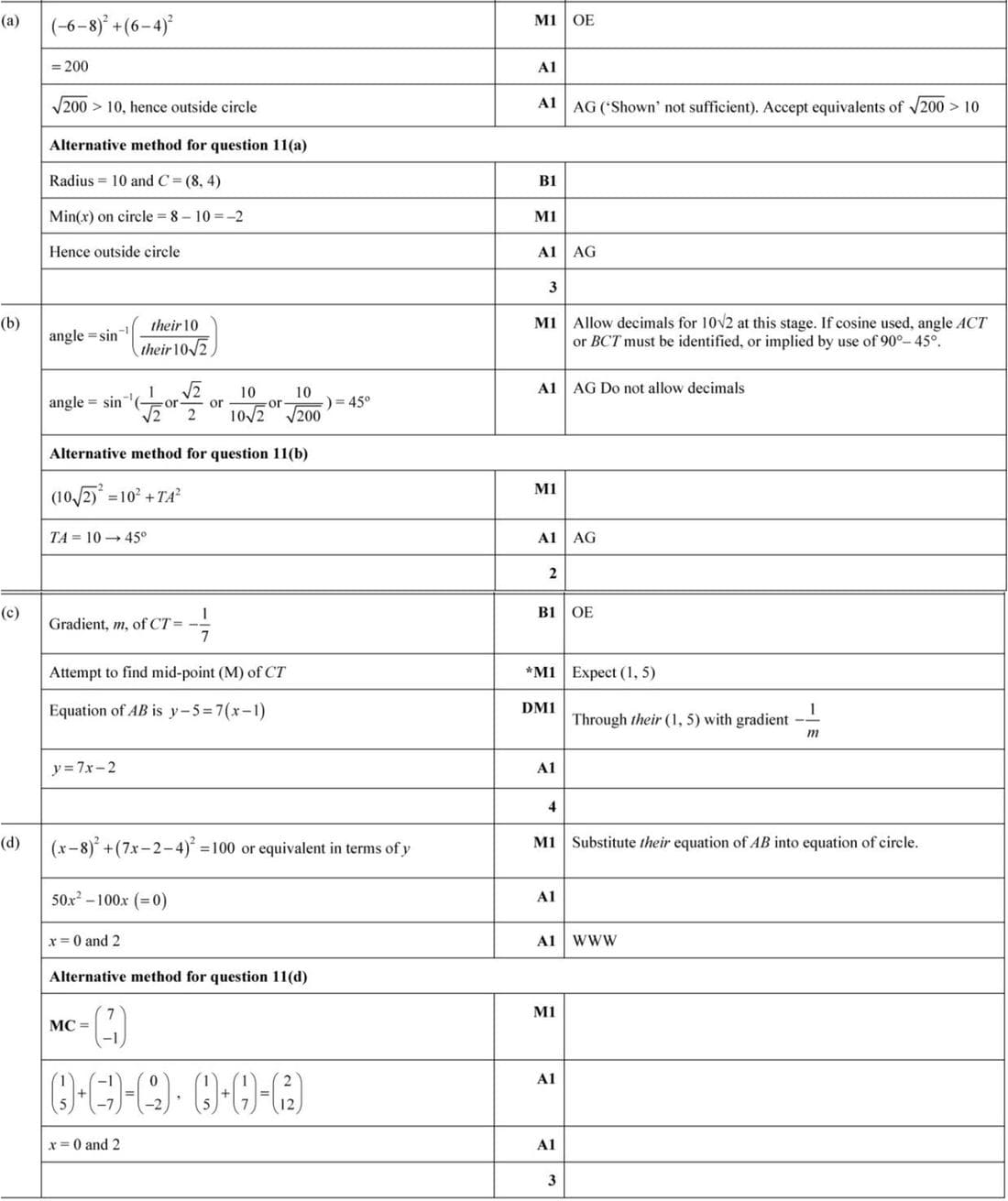
Nov 2020 p13 q11
A circle with centre C has equation \((x - 8)^2 + (y - 4)^2 = 100\).
(a) Show that the point \(T(-6, 6)\) is outside the circle.
Two tangents from \(T\) to the circle are drawn.
(b) Show that the angle between one of the tangents and \(CT\) is exactly \(45^\circ\).
The two tangents touch the circle at \(A\) and \(B\).
(c) Find the equation of the line \(AB\), giving your answer in the form \(y = mx + c\).
(d) Find the \(x\)-coordinates of \(A\) and \(B\).