Exam-Style Problems
⬅ Back to SubchapterFeb/Mar 2020 p12 q2
The graph of \(y = f(x)\) is transformed to the graph of \(y = 1 + f\left(\frac{1}{2}x\right)\).
Describe fully the two single transformations which have been combined to give the resulting transformation.

Nov 2023 p11 q4
The transformation R denotes a reflection in the x-axis and the transformation T denotes a translation of \(\begin{pmatrix} 3 \\ -1 \end{pmatrix}\).
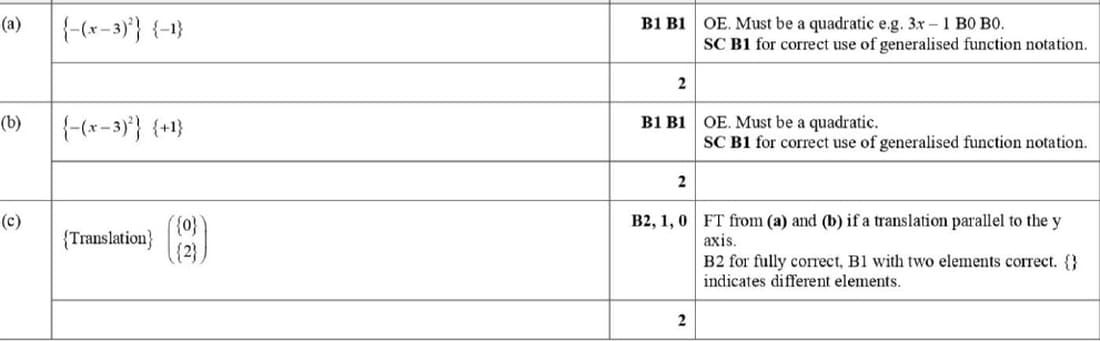
(a) Find the equation, \(y = g(x)\), of the curve with equation \(y = x^2\) after it has been transformed by the sequence of transformations R followed by T.
(b) Find the equation, \(y = h(x)\), of the curve with equation \(y = x^2\) after it has been transformed by the sequence of transformations T followed by R.
(c) State fully the transformation that maps the curve \(y = g(x)\) onto the curve \(y = h(x)\).
June 2023 p13 q1
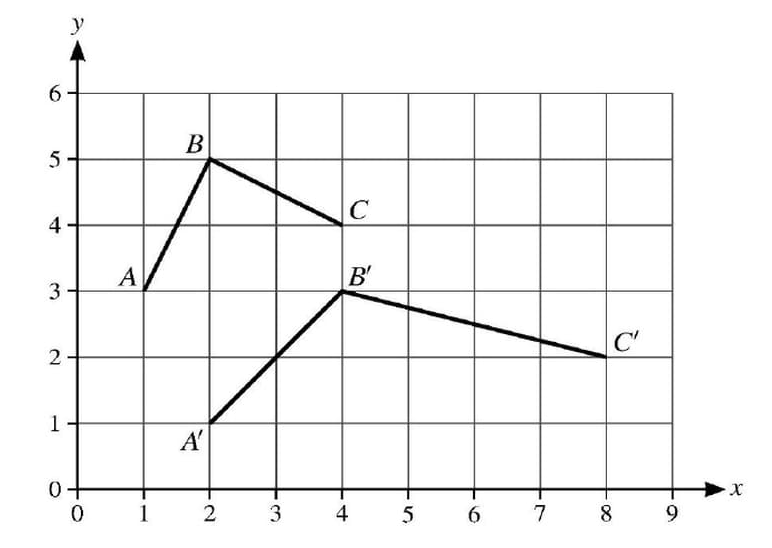
The diagram shows the graph of \(y = f(x)\), which consists of the two straight lines \(AB\) and \(BC\). The lines \(A'B'\) and \(B'C'\) form the graph of \(y = g(x)\), which is the result of applying a sequence of two transformations, in either order, to \(y = f(x)\).
State fully the two transformations.

June 2023 p11 q3
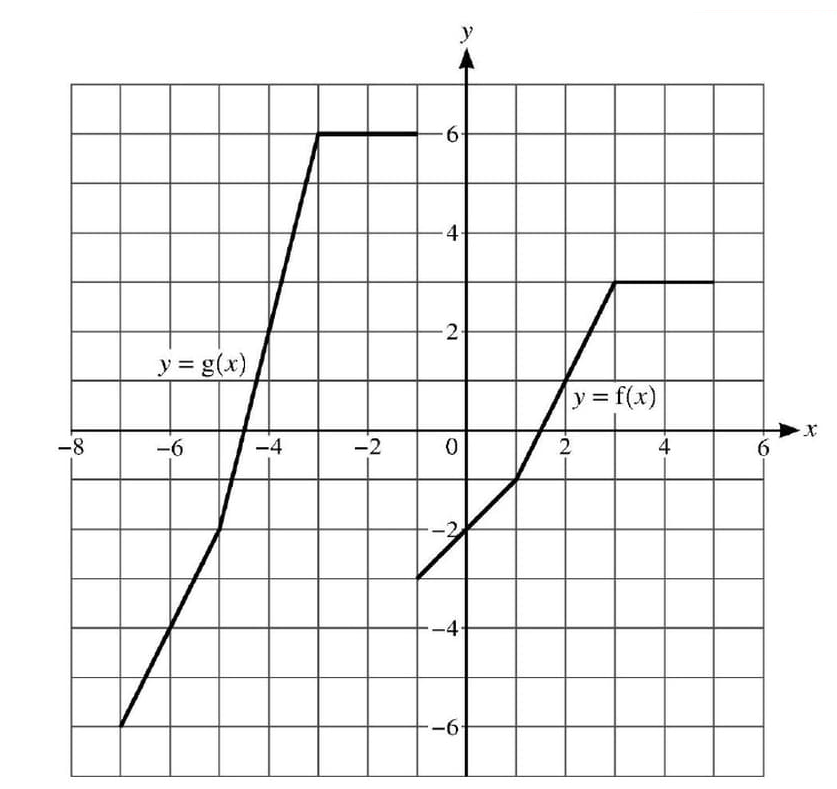
The diagram shows graphs with equations \(y = f(x)\) and \(y = g(x)\).
Describe fully a sequence of two transformations which transforms the graph of \(y = f(x)\) to \(y = g(x)\).

Feb/Mar 2023 p12 q2
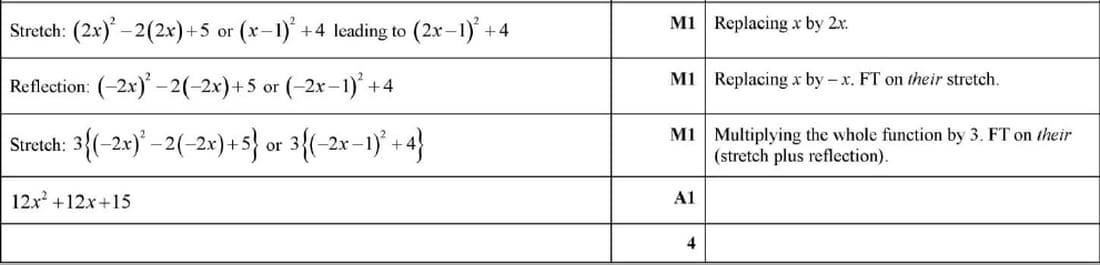
A function f is defined by \(f(x) = x^2 - 2x + 5\) for \(x \in \mathbb{R}\). A sequence of transformations is applied in the following order to the graph of \(y = f(x)\) to give the graph of \(y = g(x)\).
1. Stretch parallel to the x-axis with scale factor \(\frac{1}{2}\)
2. Reflection in the y-axis
3. Stretch parallel to the y-axis with scale factor 3
Find \(g(x)\), giving your answer in the form \(ax^2 + bx + c\), where \(a, b\) and \(c\) are constants.