Exam-Style Problems
⬅ Back to SubchapterJune 2023 p13 q7
755
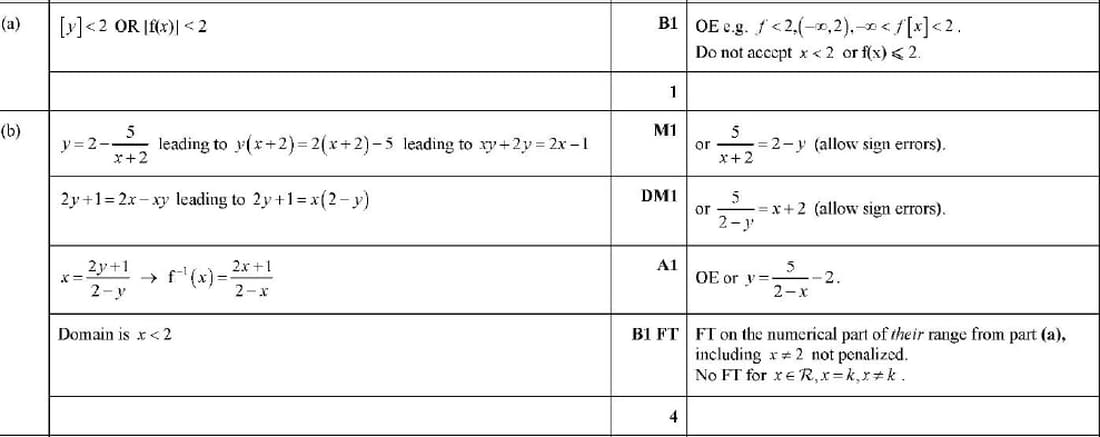
The function \(f\) is defined by \(f(x) = 2 - \frac{5}{x+2}\) for \(x > -2\).
(a) State the range of \(f\).
(b) Obtain an expression for \(f^{-1}(x)\) and state the domain of \(f^{-1}\).
Nov 2019 p13 q2
756
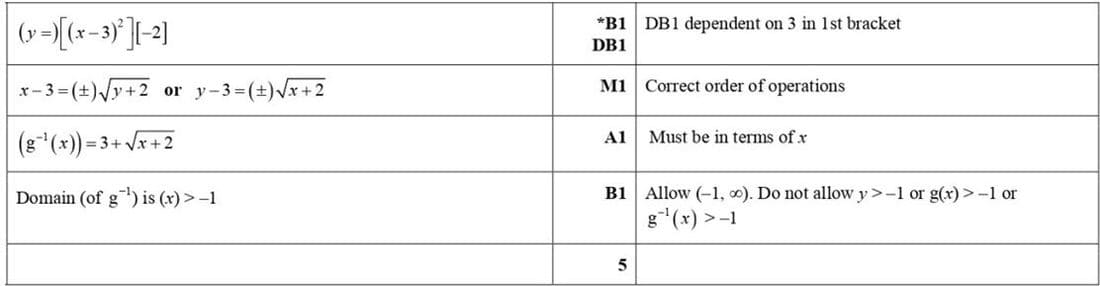
The function \(g\) is defined by \(g(x) = x^2 - 6x + 7\) for \(x > 4\). By first completing the square, find an expression for \(g^{-1}(x)\) and state the domain of \(g^{-1}\).
June 2017 p13 q9
757
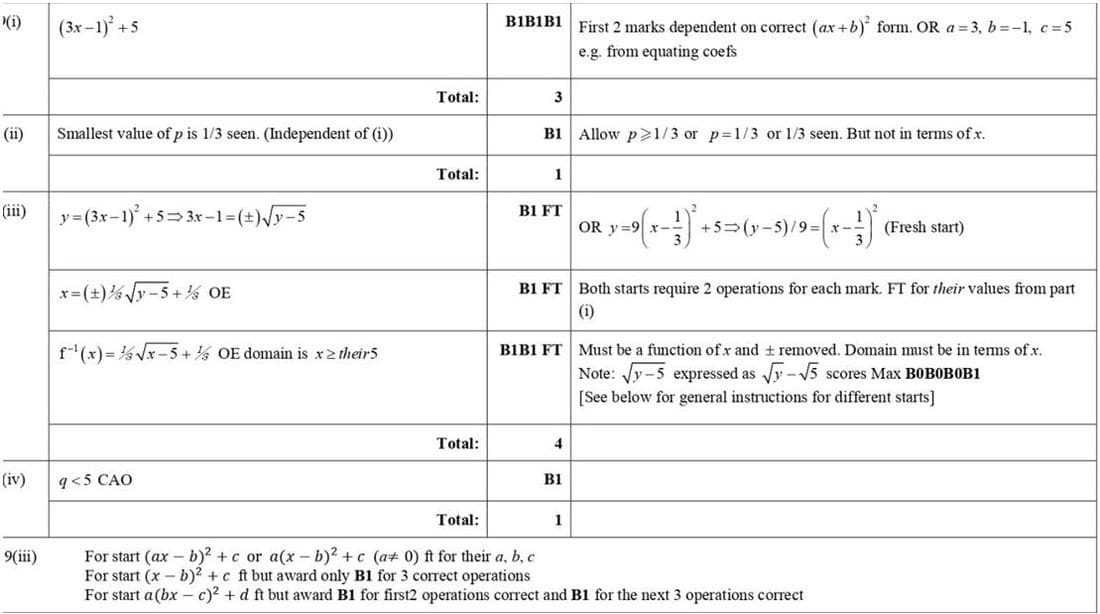
(i) Express \(9x^2 - 6x + 6\) in the form \((ax + b)^2 + c\), where \(a, b\) and \(c\) are constants.
The function \(f\) is defined by \(f(x) = 9x^2 - 6x + 6\) for \(x \geq p\), where \(p\) is a constant.
(ii) State the smallest value of \(p\) for which \(f\) is a one-one function.
(iii) For this value of \(p\), obtain an expression for \(f^{-1}(x)\), and state the domain of \(f^{-1}\).
(iv) State the set of values of \(q\) for which the equation \(f(x) = q\) has no solution.
Nov 2015 p11 q9
758
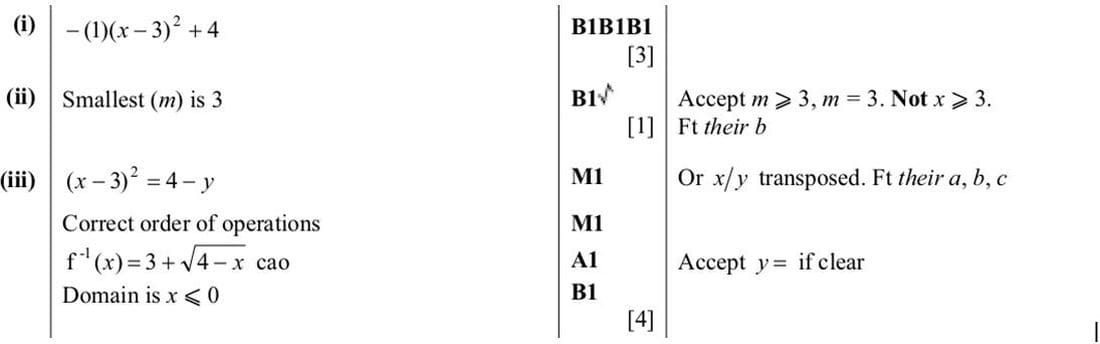
(i) Express \(-x^2 + 6x - 5\) in the form \(a(x + b)^2 + c\), where \(a, b\) and \(c\) are constants.
The function \(f : x \mapsto -x^2 + 6x - 5\) is defined for \(x \geq m\), where \(m\) is a constant.
(ii) State the smallest value of \(m\) for which \(f\) is one-one.
(iii) For the case where \(m = 5\), find an expression for \(f^{-1}(x)\) and state the domain of \(f^{-1}\).
June 2014 p13 q5
759
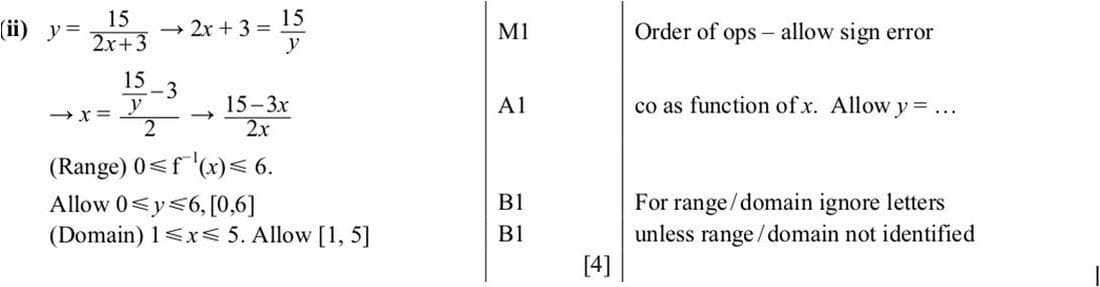
A function \(f\) is such that \(f(x) = \frac{15}{2x+3}\) for \(0 \leq x \leq 6\).
Find an expression for \(f^{-1}(x)\), and state the domain and range of \(f^{-1}\).