Exam-Style Problems
⬅ Back to SubchapterFM June 2021 p13 q04
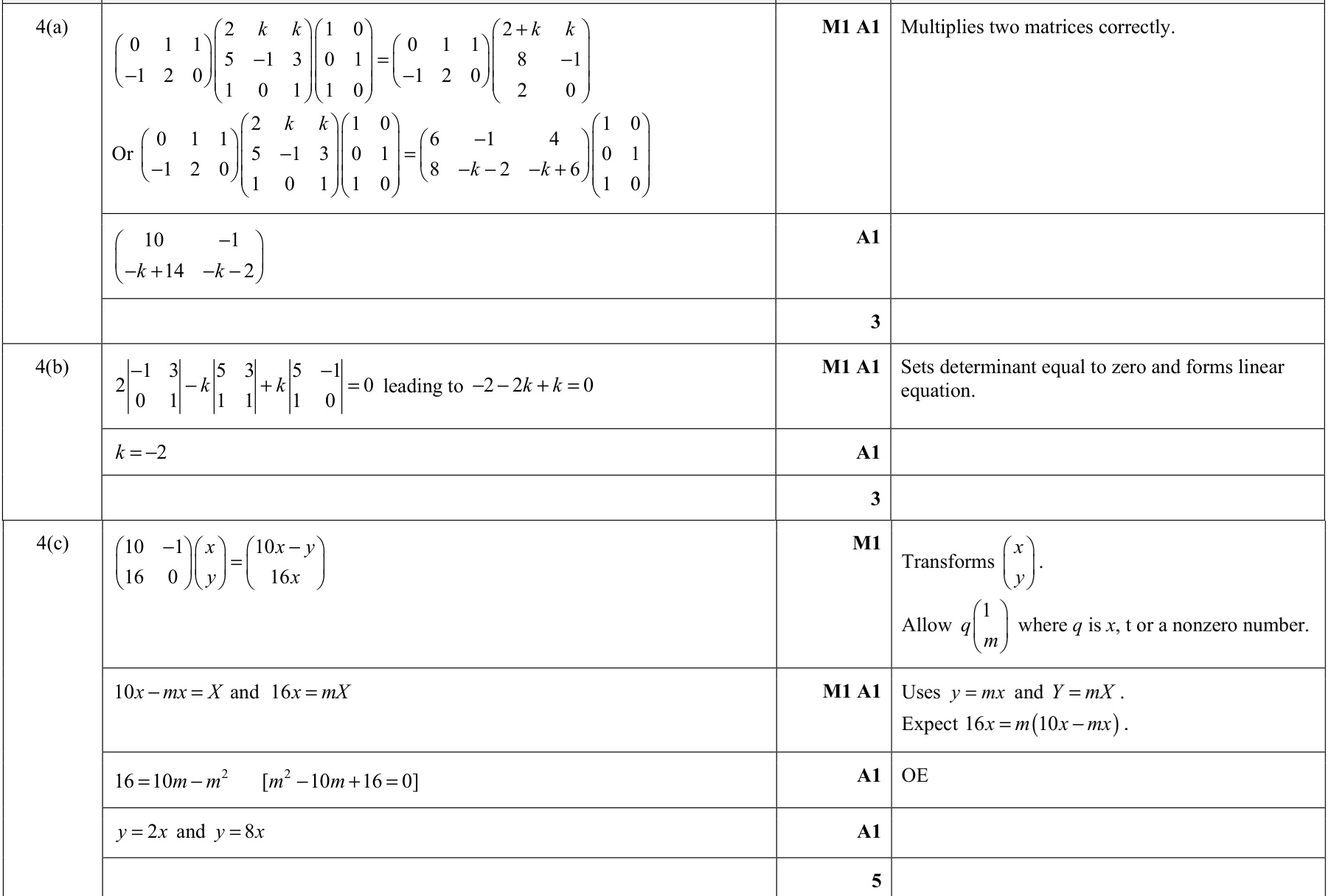
The matrices A, B and C are given by
\(A = \begin{pmatrix} 2 & k & k \\ 5 & -1 & 3 \\ 1 & 0 & 1 \end{pmatrix}, \quad B = \begin{pmatrix} 1 & 0 \\ 0 & 1 \\ 1 & 0 \end{pmatrix} \quad \text{and} \quad C = \begin{pmatrix} 0 & 1 & 1 \\ -1 & 2 & 0 \end{pmatrix},\)
where \(k\) is a real constant.
- Find \(CAB\).
- Given that \(A\) is singular, find the value of \(k\).
- Using the value of \(k\) from part (b), find the equations of the invariant lines, through the origin, of the transformation in the \(x-y\) plane represented by \(CAB\).
FM June 2021 p13 q05
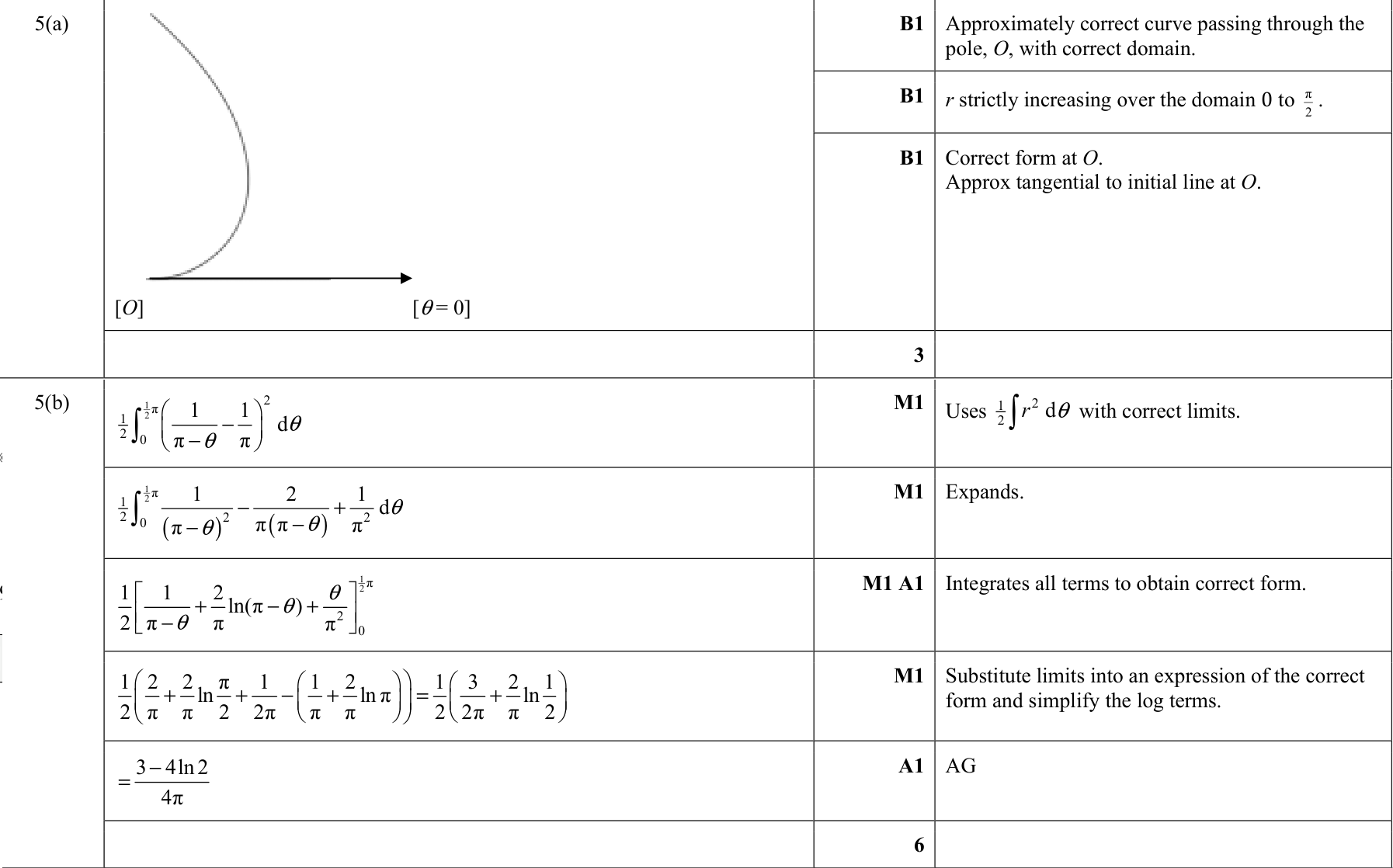
The curve C has polar equation \(r = \frac{1}{\pi - \theta} - \frac{1}{\pi}\), where \(0 \leq \theta \leq \frac{1}{2}\pi\).
(a) Sketch C.
(b) Show that the area of the region bounded by the half-line \(\theta = \frac{1}{2}\pi\) and C is \(\frac{3 - 4 \ln 2}{4\pi}\).
FM June 2021 p13 q06
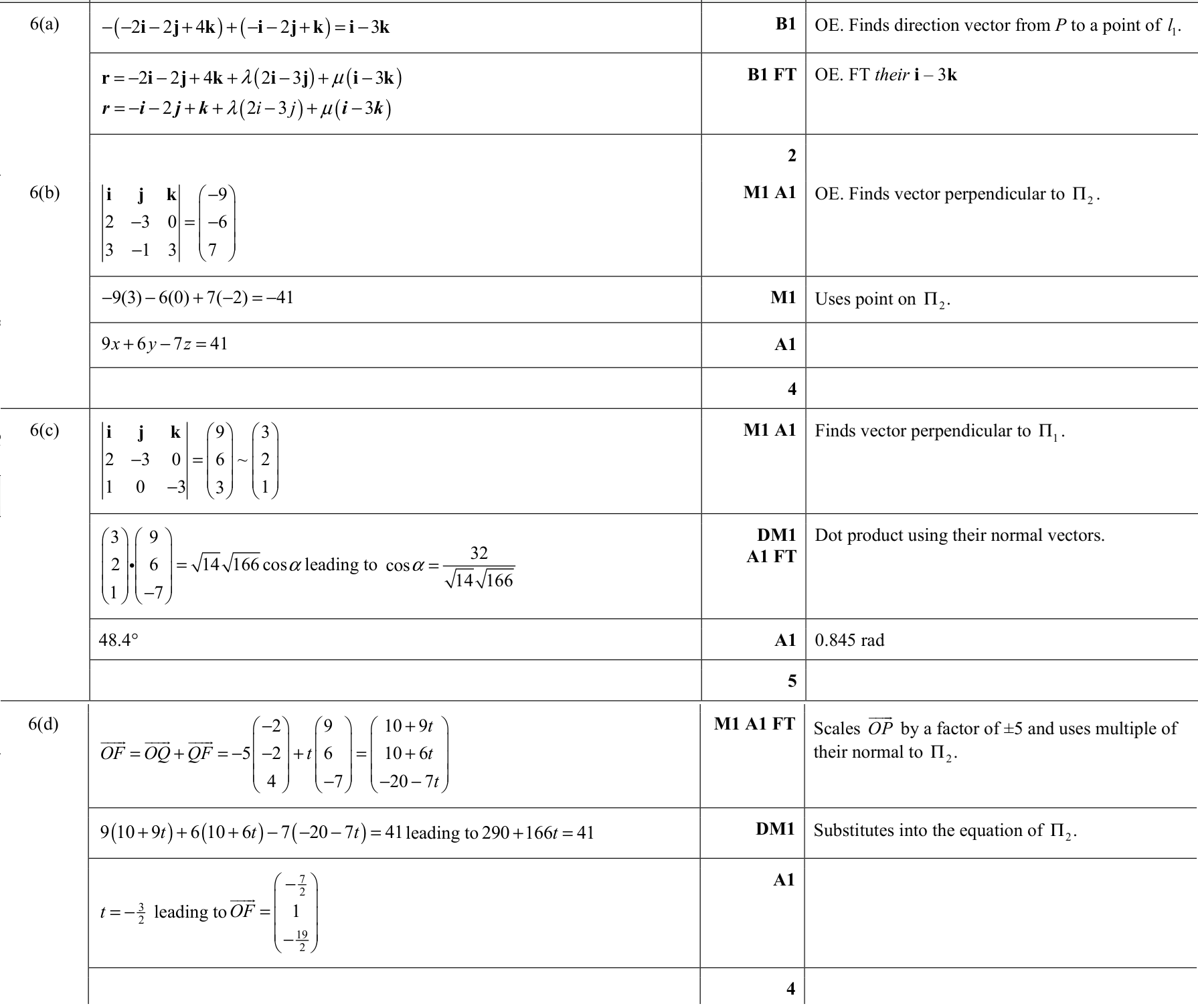
The lines \(l_1\) and \(l_2\) have equations \(\mathbf{r} = -\mathbf{i} - 2\mathbf{j} + \mathbf{k} + s(2\mathbf{i} - 3\mathbf{j})\) and \(\mathbf{r} = 3\mathbf{i} - 2\mathbf{k} + t(3\mathbf{i} - \mathbf{j} + 3\mathbf{k})\) respectively.
The plane \(\Pi_1\) contains \(l_1\) and the point \(P\) with position vector \(-2\mathbf{i} - 2\mathbf{j} + 4\mathbf{k}\).
- (a) Find an equation of \(\Pi_1\), giving your answer in the form \(\mathbf{r} = \mathbf{a} + \lambda \mathbf{b} + \mu \mathbf{c}\).
- (b) The plane \(\Pi_2\) contains \(l_2\) and is parallel to \(l_1\). Find an equation of \(\Pi_2\), giving your answer in the form \(ax + by + cz = d\).
- (c) Find the acute angle between \(\Pi_1\) and \(\Pi_2\).
- (d) The point \(Q\) is such that \(\overrightarrow{OQ} = -5\overrightarrow{OP}\). Find the position vector of the foot of the perpendicular from the point \(Q\) to \(\Pi_2\).
FM June 2021 p13 q07
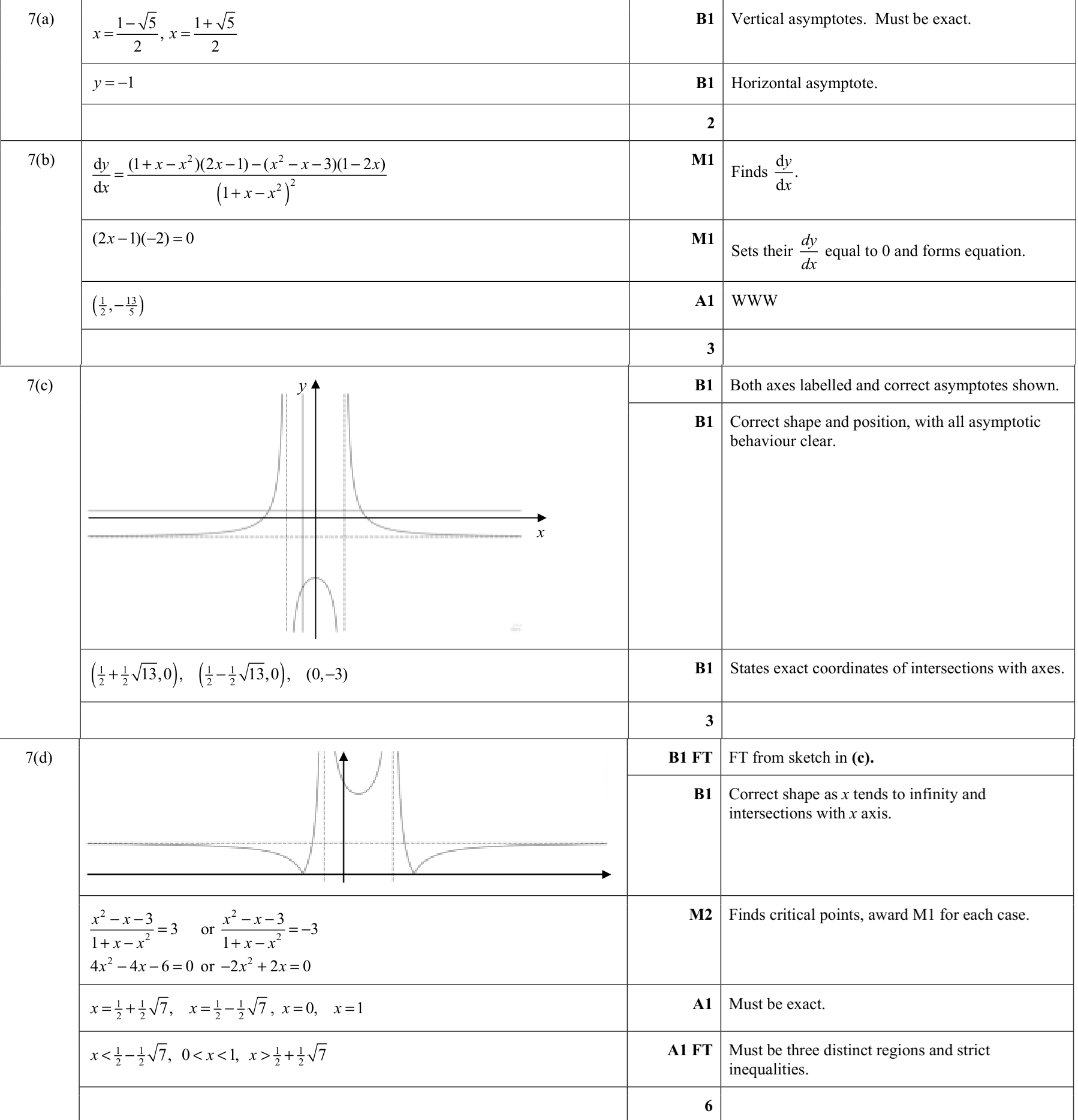
The curve \(C\) has equation \(y = \frac{x^2 - x - 3}{1 + x - x^2}\).
- (a) Find the equations of the asymptotes of \(C\).
- (b) Find the coordinates of any stationary points on \(C\).
- (c) Sketch \(C\), stating the coordinates of the intersections with the axes.
- (d) Sketch the curve with equation \(y = \left| \frac{x^2 - x - 3}{1 + x - x^2} \right|\) and find in exact form the set of values of \(x\) for which \(\left| \frac{x^2 - x - 3}{1 + x - x^2} \right| < 3\).
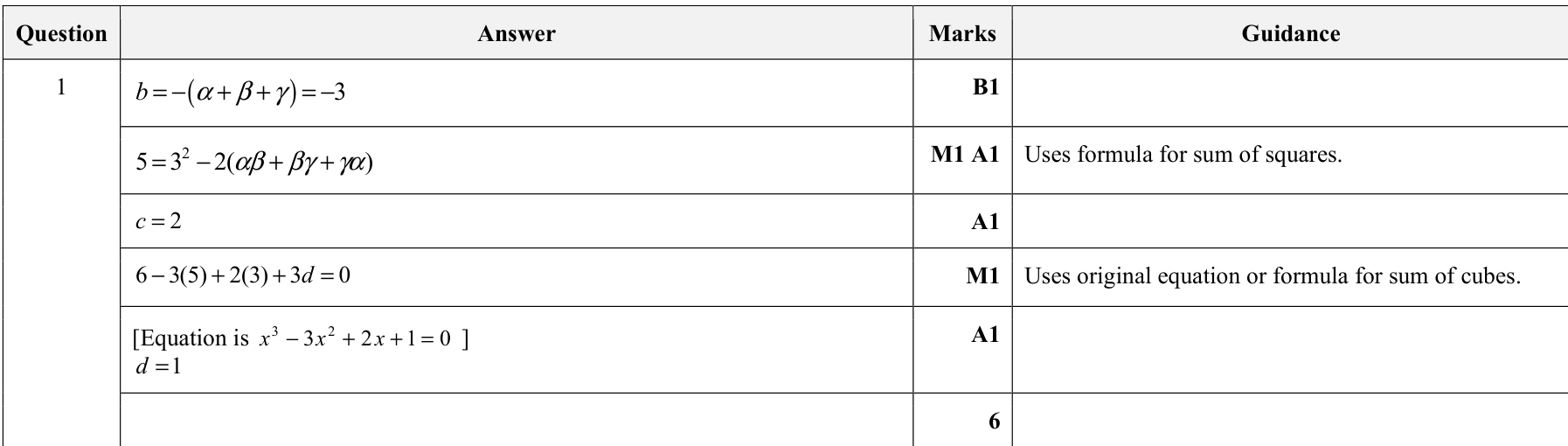
FM November 2021 p11 q01
It is given that
\(\alpha + \beta + \gamma = 3, \quad \alpha^2 + \beta^2 + \gamma^2 = 5, \quad \alpha^3 + \beta^3 + \gamma^3 = 6.\)
The cubic equation \(x^3 + bx^2 + cx + d = 0\) has roots \(\alpha, \beta, \gamma\).
Find the values of \(b, c\) and \(d\).