Exam-Style Problems
⬅ Back to Subchapter
Browsing as Guest. Progress, bookmarks and attempts are disabled.
Log in to track your work.
June 2025 p12 q9
4106
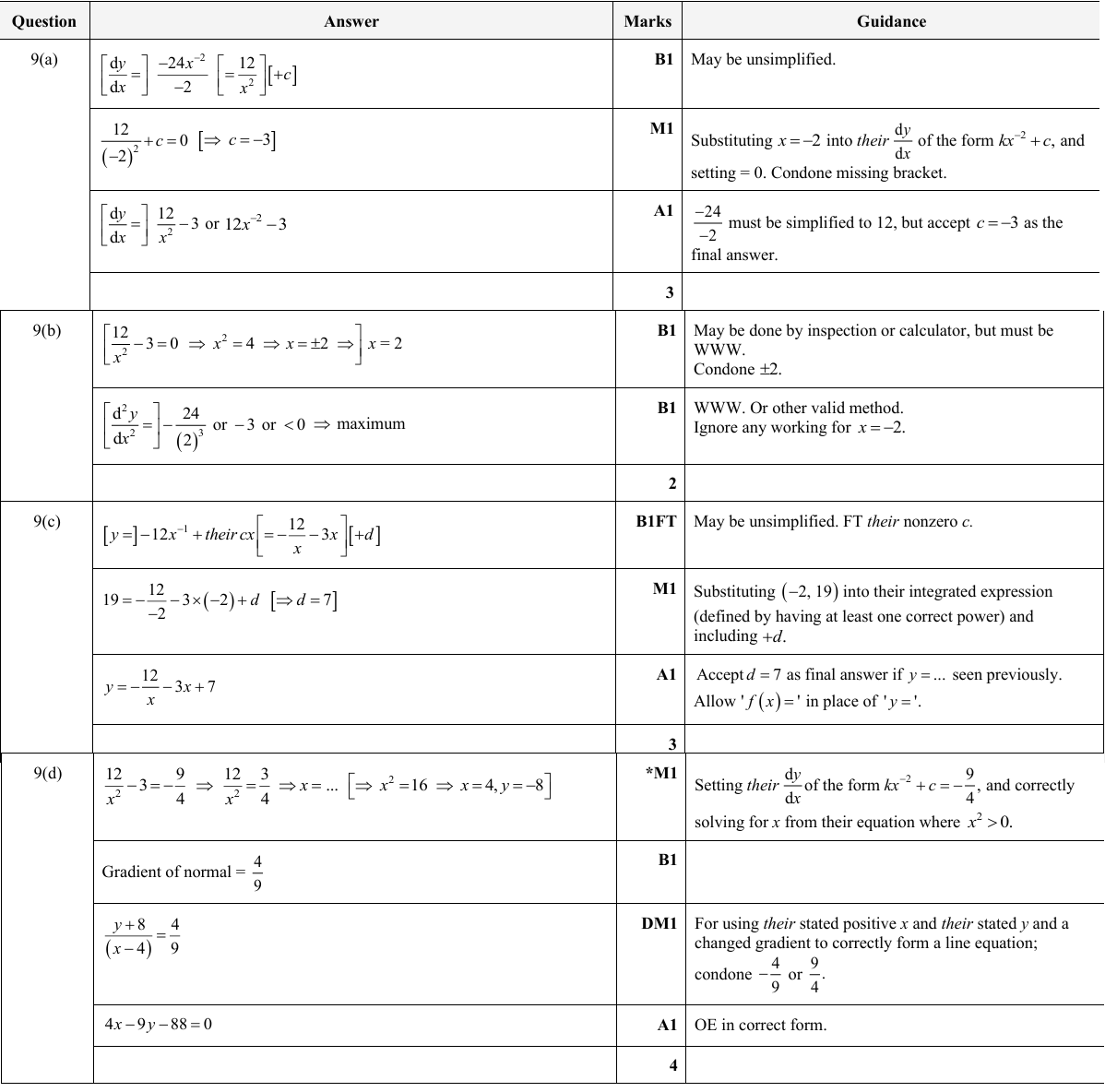
The equation of a curve is such that \(\frac{d^2y}{dx^2} = -\frac{24}{x^3}\). It is given that the curve has a stationary point at \((-2, 19)\).
(a) Find an expression for \(\frac{dy}{dx}\).
(b) Find the \(x\)-coordinate of the other stationary point of the curve, and determine the nature of this stationary point.
(c) Find the equation of the curve.
(d) Find the equation of the normal to the curve at the point where \(\frac{dy}{dx} = -\frac{9}{4}\) and \(x\) is positive. Express your answer in the form \(px + qy + r = 0\), where \(p, q\) and \(r\) are integers.
Log in to record attempts.