Exam-Style Problems
⬅ Back to SubchapterNov 2013 p42 q6
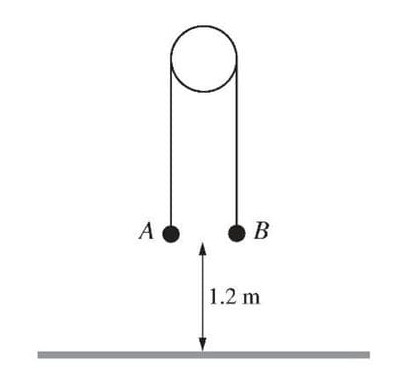
Particles A of mass 0.4 kg and B of mass 1.6 kg are attached to the ends of a light inextensible string which passes over a fixed smooth pulley. A is held at rest and B hangs freely, with both straight parts of the string vertical and both particles at a height of 1.2 m above the floor (see diagram). A is released and both particles start to move.
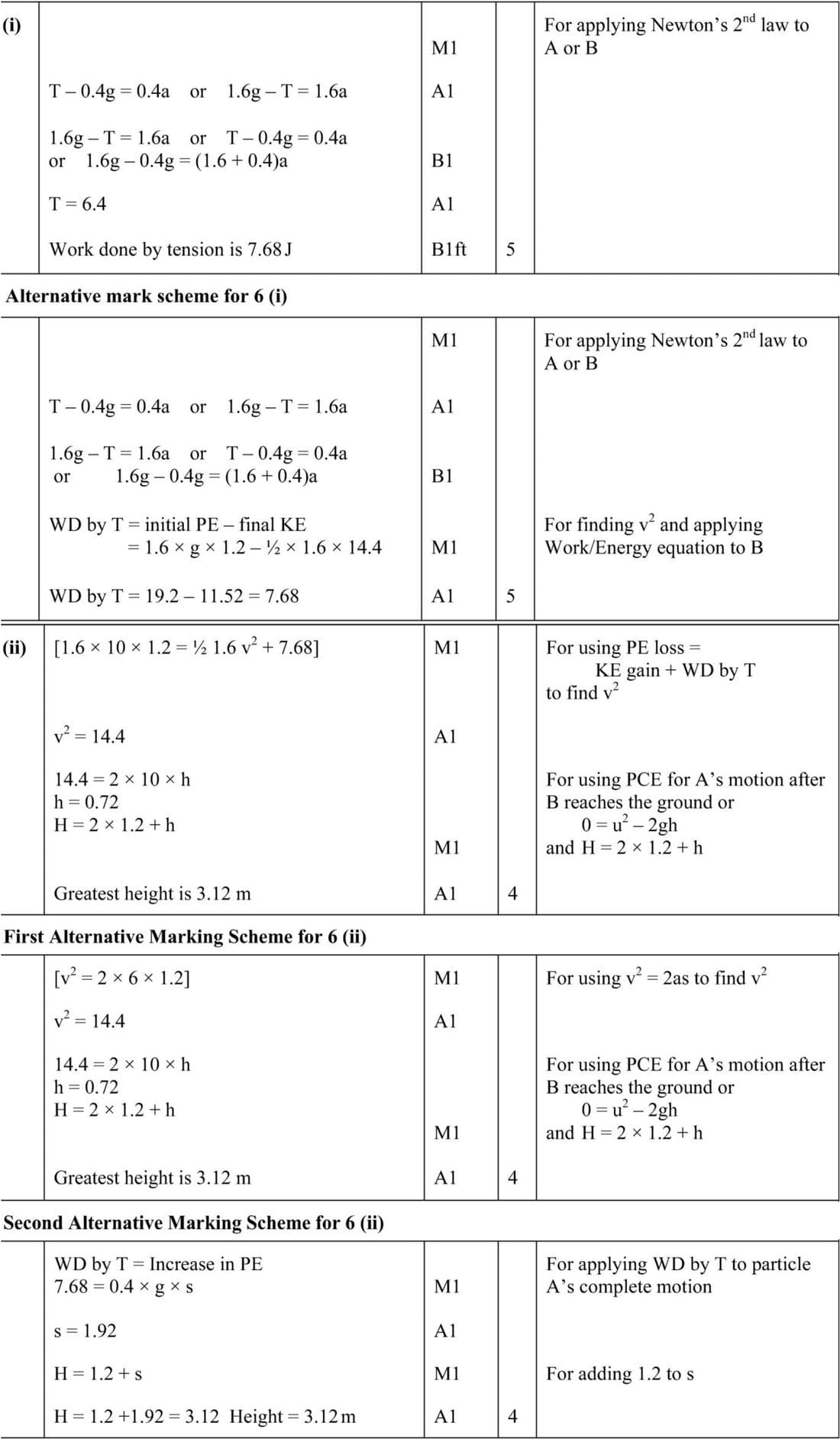
- Find the work done on B by the tension in the string, as B moves to the floor.
- When particle B reaches the floor it remains at rest. Particle A continues to move upwards. Find the greatest height above the floor reached by particle A.
Nov 2023 p42 q1
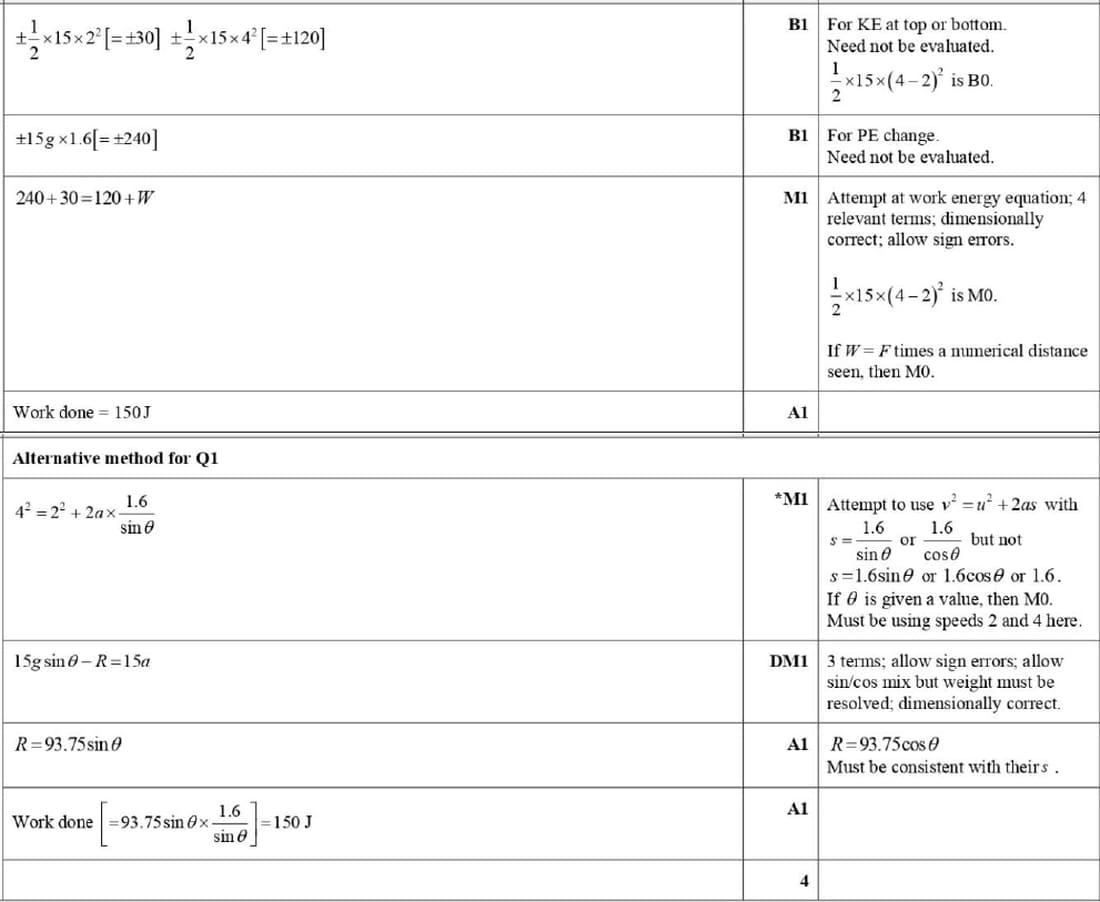
A block of mass 15 kg slides down a line of greatest slope of an inclined plane. The top of the plane is at a vertical height of 1.6 m above the level of the bottom of the plane. The speed of the block at the top of the plane is 2 m/s-1 and the speed of the block at the bottom of the plane is 4 m/s-1.
Find the work done against the resistance to motion of the block.
Nov 2013 p42 q2
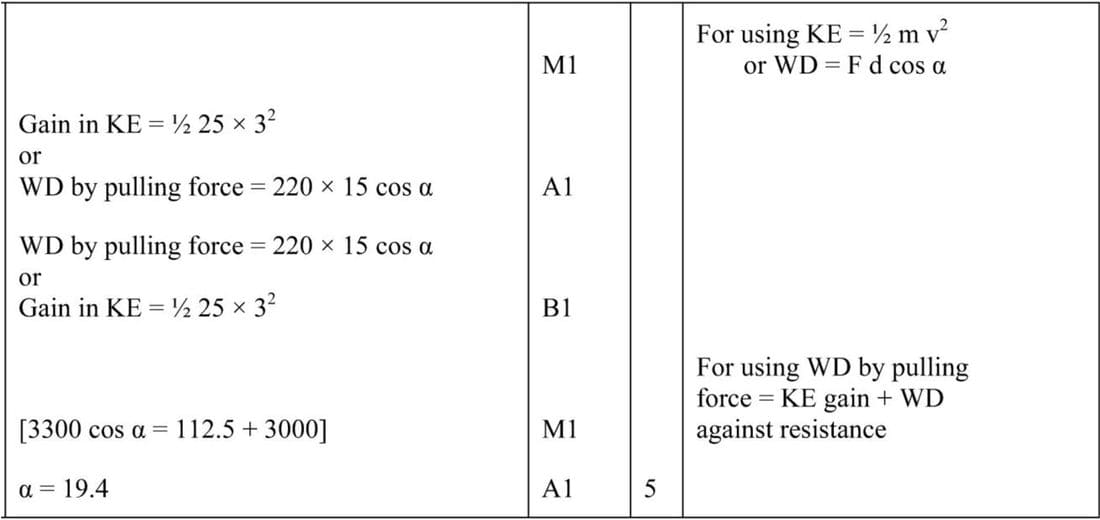
A box of mass 25 kg is pulled in a straight line along a horizontal floor. The box starts from rest at a point A and has a speed of 3 m/s when it reaches a point B. The distance AB is 15 m. The pulling force has magnitude 220 N and acts at an angle of \(\alpha^\circ\) above the horizontal. The work done against the resistance to motion acting on the box, as the box moves from A to B, is 3000 J. Find the value of \(\alpha\).
Nov 2013 p41 q5
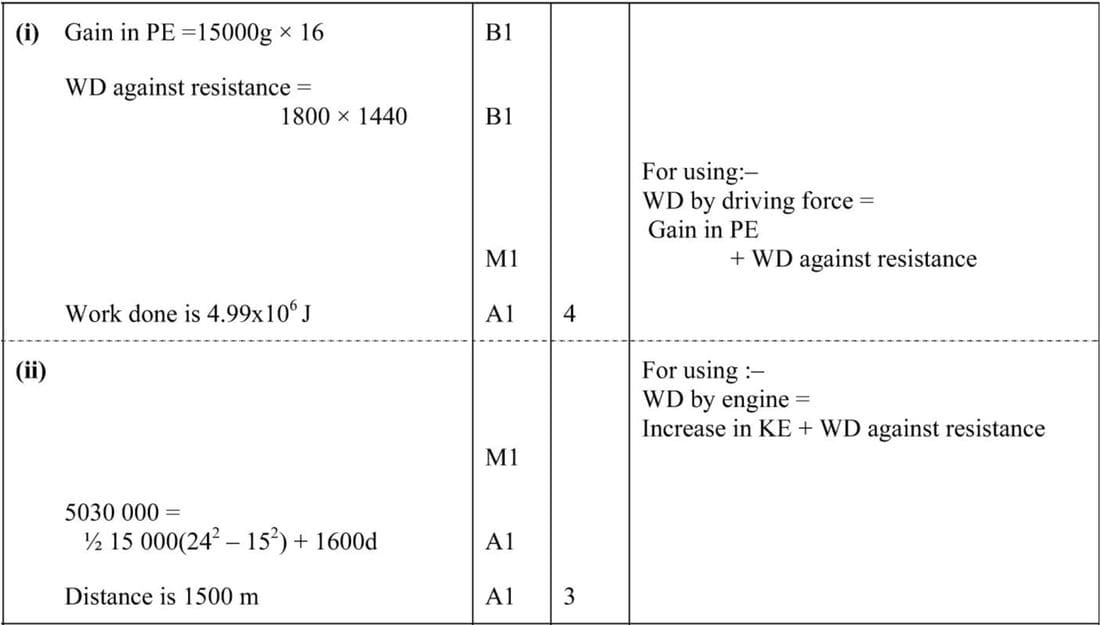
A lorry of mass 15,000 kg climbs from the bottom to the top of a straight hill, of length 1440 m, at a constant speed of 15 m s-1. The top of the hill is 16 m above the level of the bottom of the hill. The resistance to motion is constant and equal to 1800 N.
(i) Find the work done by the driving force.
On reaching the top of the hill the lorry continues on a straight horizontal road and passes through a point P with speed 24 m s-1. The resistance to motion is constant and is now equal to 1600 N. The work done by the lorry’s engine from the top of the hill to the point P is 5030 kJ.
(ii) Find the distance from the top of the hill to the point P.
Nov 2013 p41 q2
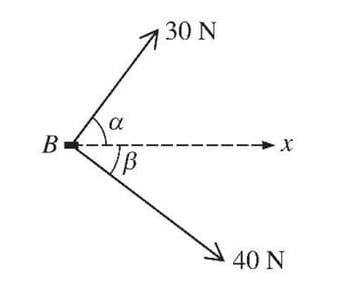
A block B lies on a rough horizontal plane. Horizontal forces of magnitudes 30 N and 40 N, making angles of \(\alpha\) and \(\beta\) respectively with the x-direction, act on B as shown in the diagram, and B is moving in the x-direction with constant speed. It is given that \(\cos \alpha = 0.6\) and \(\cos \beta = 0.8\).
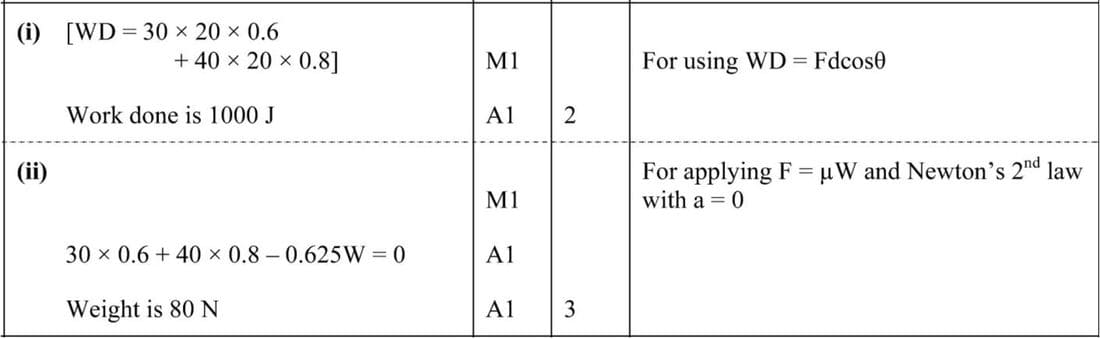
(i) Find the total work done by the forces shown in the diagram when B has moved a distance of 20 m.
(ii) Given that the coefficient of friction between the block and the plane is \(\frac{5}{8}\), find the weight of the block.