Exam-Style Problems
⬅ Back to SubchapterJune 2021 p42 q5
3503
A car of mass 1250 kg is pulling a caravan of mass 800 kg along a straight road. The resistances to the motion of the car and caravan are 440 N and 280 N respectively. The car and caravan are connected by a light rigid tow-bar.
(a) The car and caravan move along a horizontal part of the road at a constant speed of 30 m s-1.
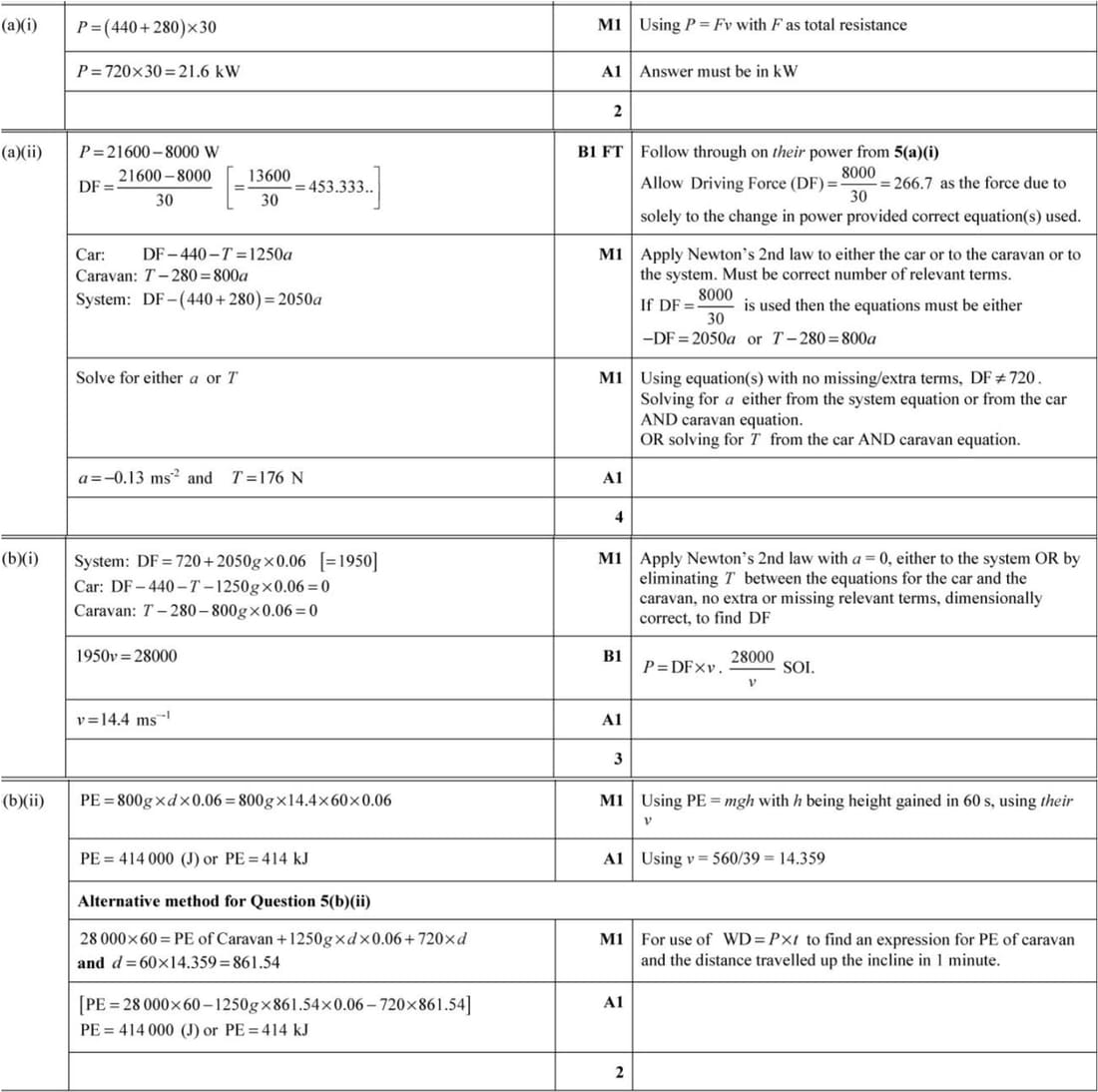
- Calculate, in kW, the power developed by the engine of the car.
- Given that this power is suddenly decreased by 8 kW, find the instantaneous deceleration of the car and caravan and the tension in the tow-bar.
(b) The car and caravan now travel along a part of the road inclined at sin-1 0.06 to the horizontal. The car and caravan travel up the incline at constant speed with the engine of the car working at 28 kW.
- Find this constant speed.
- Find the increase in the potential energy of the caravan in one minute.
Nov 2023 p41 q1
3504
A particle of mass 1.6 kg is projected with a speed of 20 m/s up a line of greatest slope of a smooth plane inclined at \(\alpha\) to the horizontal, where \(\tan \alpha = \frac{3}{4}\).
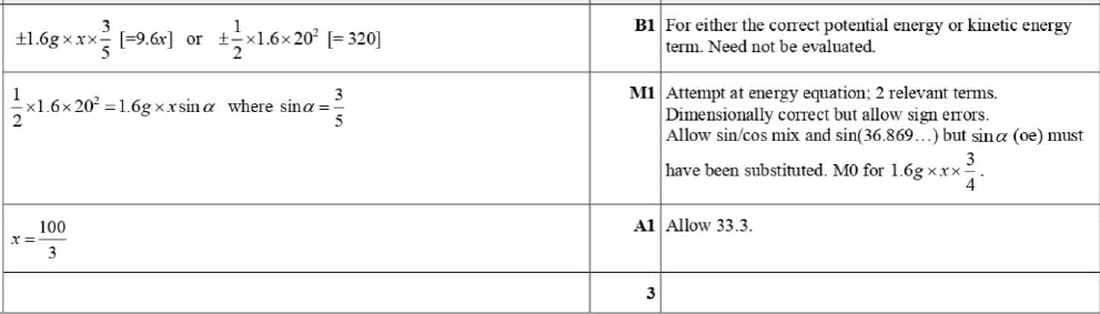
Use an energy method to find the distance the particle moves up the plane before coming to instantaneous rest.
June 2021 p42 q1
3505
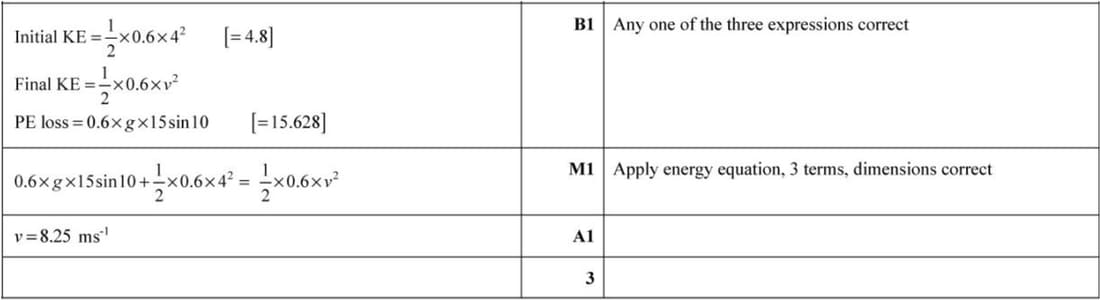
A particle of mass 0.6 kg is projected with a speed of 4 m s-1 down a line of greatest slope of a smooth plane inclined at 10° to the horizontal.
Use an energy method to find the speed of the particle after it has moved 15 m down the plane.
June 2021 p41 q7
3506
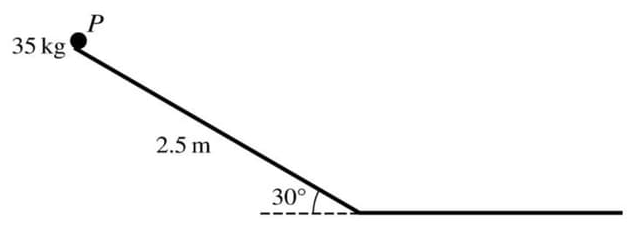
A slide in a playground descends at a constant angle of 30° for 2.5 m. It then has a horizontal section in the same vertical plane as the sloping section. A child of mass 35 kg, modelled as a particle P, starts from rest at the top of the slide and slides straight down the sloping section. She then continues along the horizontal section until she comes to rest (see diagram). There is no instantaneous change in speed when the child goes from the sloping section to the horizontal section.
The child experiences a resistance force on the horizontal section of the slide, and the work done against the resistance force on the horizontal section of the slide is 250 J per metre.
(a) It is given that the sloping section of the slide is smooth.
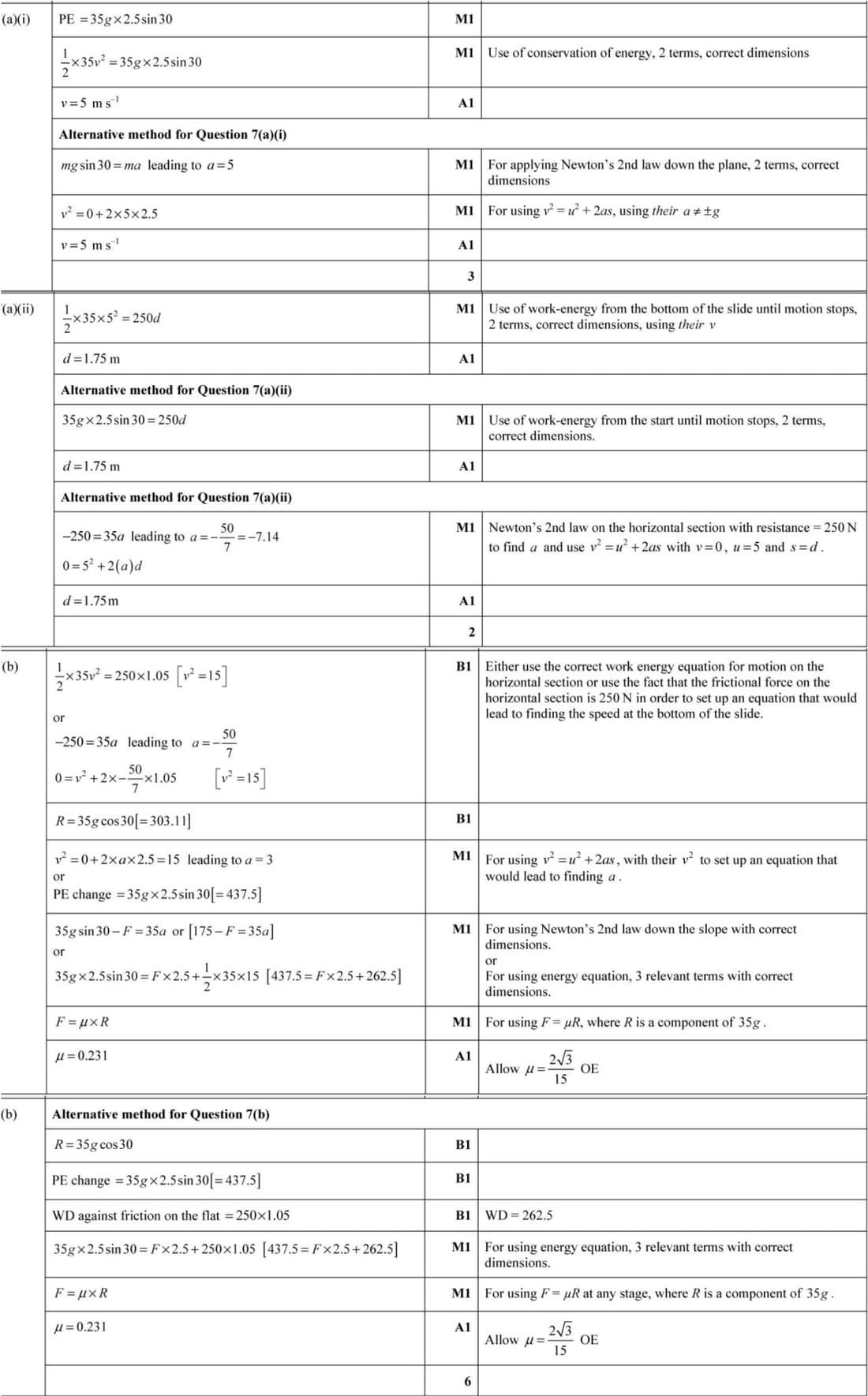
- Find the speed of the child when she reaches the bottom of the sloping section.
- Find the distance that the child travels along the horizontal section of the slide before she comes to rest.
(b) It is given instead that the sloping section of the slide is rough and that the child comes to rest on the slide 1.05 m after she reaches the horizontal section.
Find the coefficient of friction between the child and the sloping section of the slide.
Feb/Mar 2021 p42 q7
3507
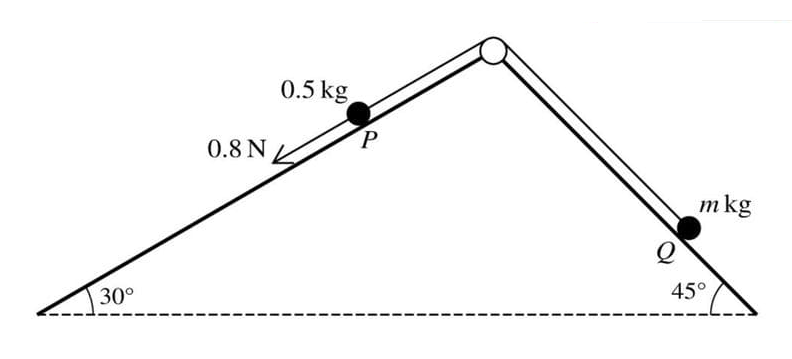
Two particles P and Q of masses 0.5 kg and m kg respectively are attached to the ends of a light inextensible string. The string passes over a fixed smooth pulley which is attached to the top of two inclined planes. The particles are initially at rest with P on a smooth plane inclined at 30° to the horizontal and Q on a plane inclined at 45° to the horizontal. The string is taut and the particles can move on lines of greatest slope of the two planes. A force of magnitude 0.8 N is applied to P acting down the plane, causing P to move down the plane (see diagram).
\((a) It is given that m = 0.3, and that the plane on which Q rests is smooth.\)
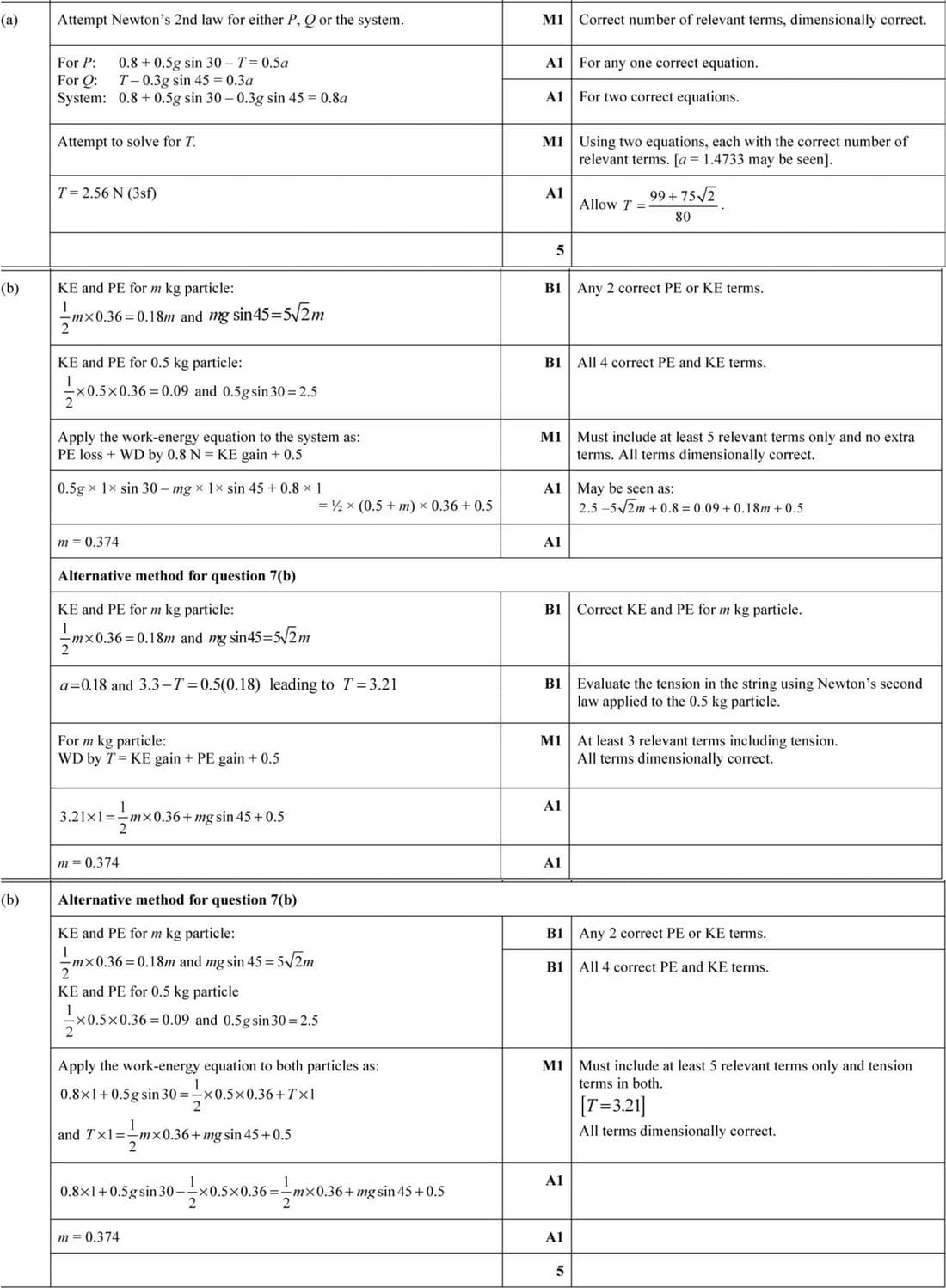
Find the tension in the string.
(b) It is given instead that the plane on which Q rests is rough, and that after each particle has moved a distance of 1 m, their speed is 0.6 m s-1. The work done against friction in this part of the motion is 0.5 J.
Use an energy method to find the value of m.