Exam-Style Problems
⬅ Back to SubchapterJune 2021 p41 q3
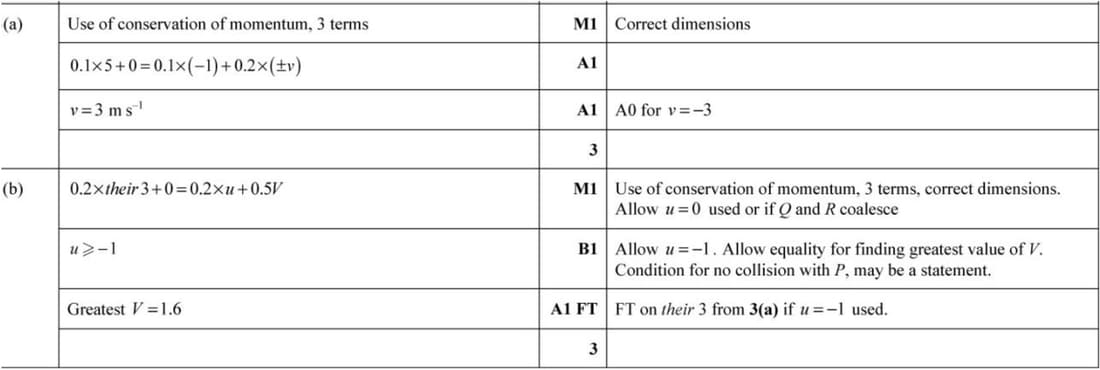
Three particles P, Q and R, of masses 0.1 kg, 0.2 kg and 0.5 kg respectively, are at rest in a straight line on a smooth horizontal plane. Particle P is projected towards Q at a speed of 5 m s-1. After P and Q collide, P rebounds with speed 1 m s-1.
- Find the speed of Q immediately after the collision with P.
- Q now collides with R. Immediately after the collision with Q, R begins to move with speed V m s-1.
- Given that there is no subsequent collision between P and Q, find the greatest possible value of V.
Nov 2023 p41 q4
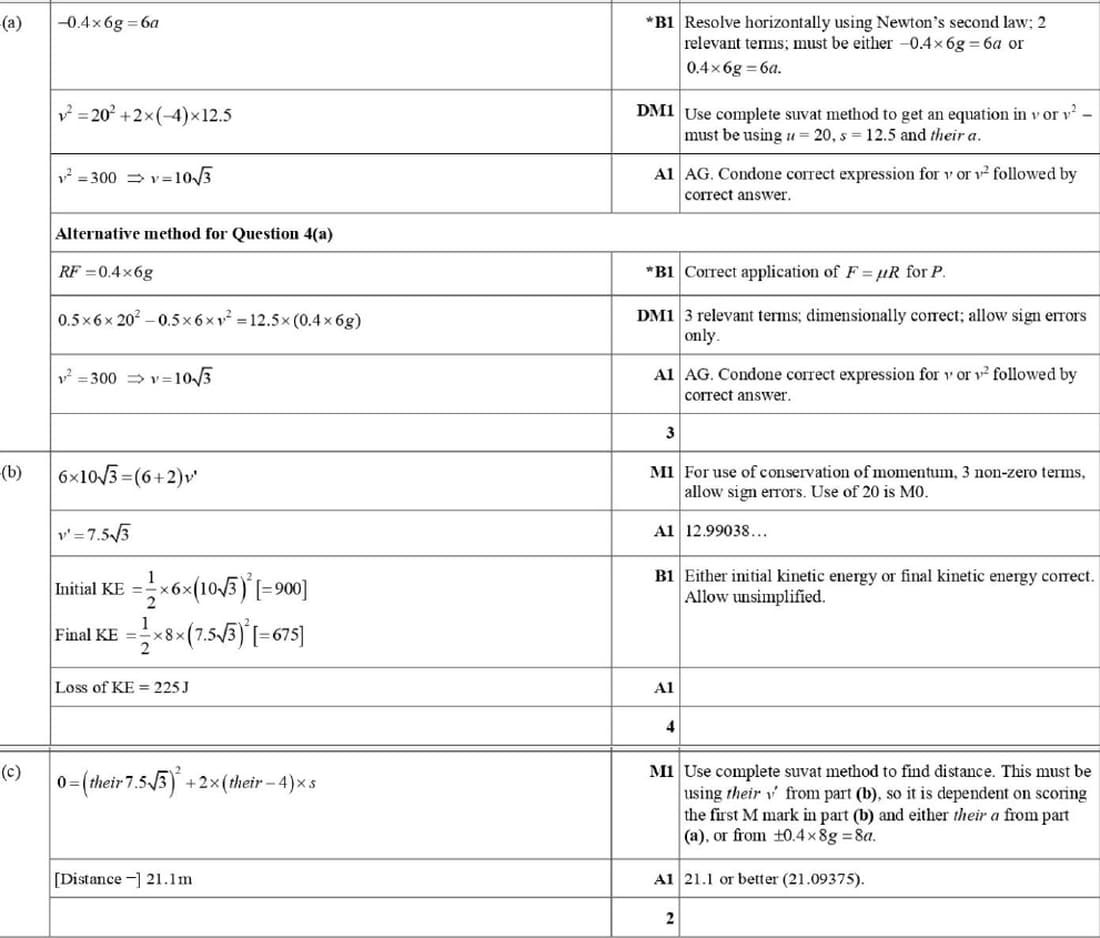
Two particles P and Q, of masses 6 kg and 2 kg respectively, lie at rest 12.5 m apart on a rough horizontal plane. The coefficient of friction between each particle and the plane is 0.4. Particle P is projected towards Q with speed 20 m/s-1.
(a) Show that the speed of P immediately before the collision with Q is 10\(\sqrt{3}\) m/s-1.
In the collision P and Q coalesce to form particle R.
(b) Find the loss of kinetic energy due to the collision.
The coefficient of friction between R and the plane is 0.4.
(c) Find the distance travelled by particle R before coming to rest.
Feb/Mar 2021 p42 q1
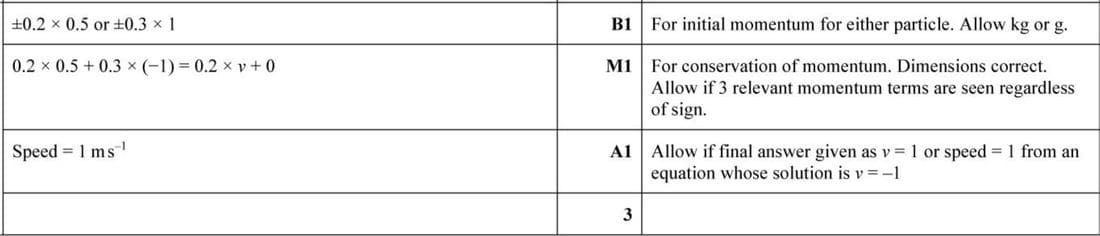
Two particles P and Q of masses 0.2 kg and 0.3 kg respectively are free to move in a horizontal straight line on a smooth horizontal plane. P is projected towards Q with speed 0.5 m s-1. At the same instant Q is projected towards P with speed 1 m s-1. Q comes to rest in the resulting collision.
Find the speed of P after the collision.
Nov 2020 p43 q4
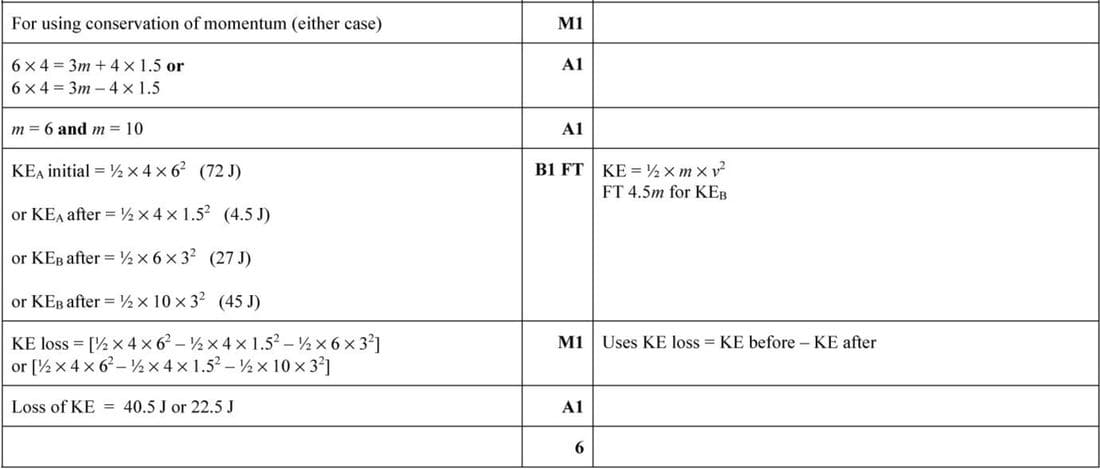
Two small smooth spheres A and B, of equal radii and of masses 4 kg and m kg respectively, lie on a smooth horizontal plane. Initially, sphere B is at rest and A is moving towards B with speed 6 m s-1. After the collision A moves with speed 1.5 m s-1 and B moves with speed 3 m s-1.
Find the two possible values of the loss of kinetic energy due to the collision.
Nov 2020 p42 q1
Two particles P and Q, of masses 0.2 kg and 0.5 kg respectively, are at rest on a smooth horizontal plane. P is projected towards Q with speed 2 m s-1.
(a) Write down the momentum of P.
(b) After the collision P continues to move in the same direction with speed 0.3 m s-1. Find the speed of Q after the collision.
