Exam-Style Problems
⬅ Back to SubchapterJune 2020 p42 q6
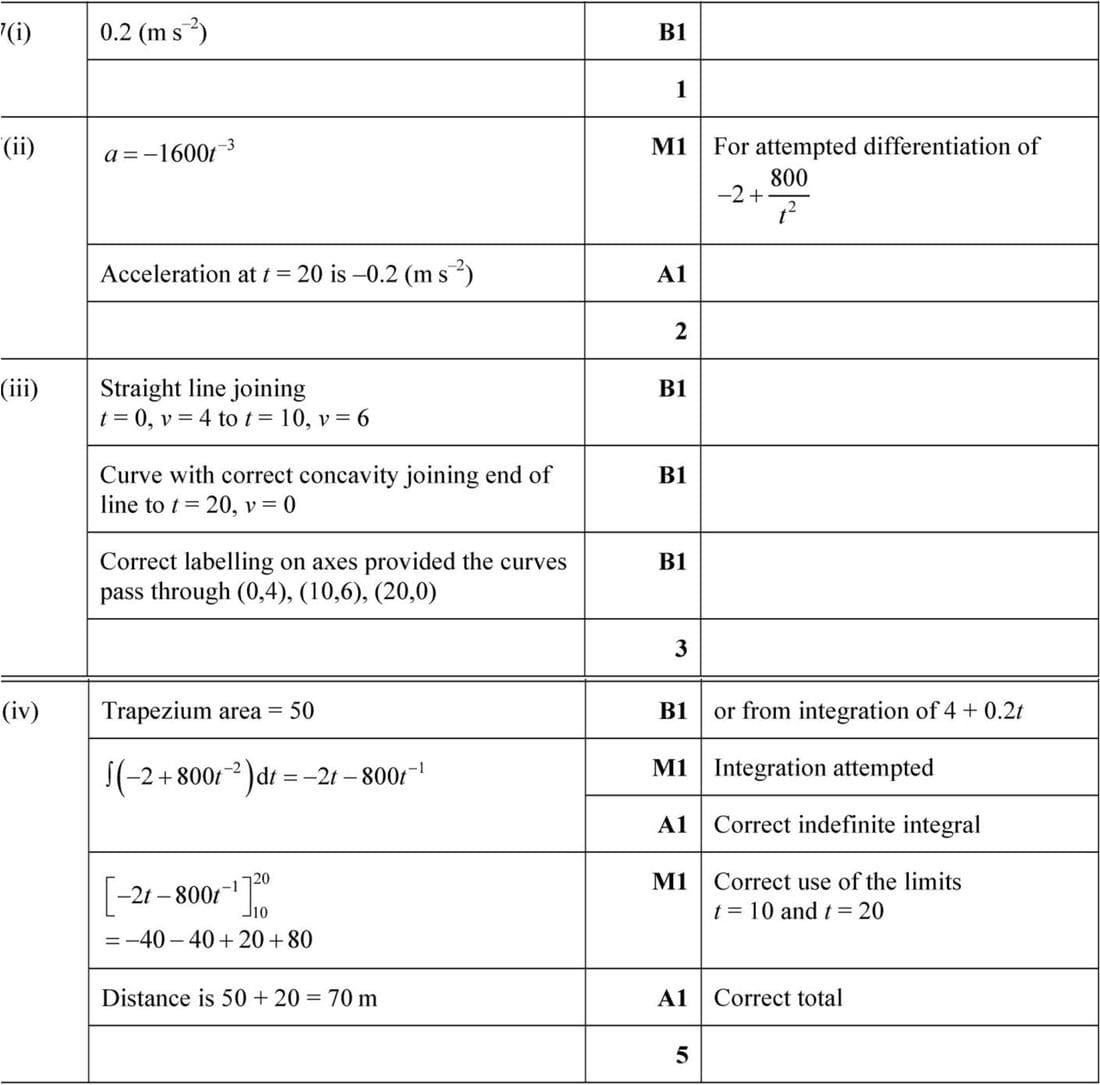
A particle P moves in a straight line. The velocity v m s-1 at time t s is given by
\(v = 2t + 1\) for \(0 \leq t \leq 5\),
\(v = 36 - t^2\) for \(5 \leq t \leq 7\),
\(v = 2t - 27\) for \(7 \leq t \leq 13.5\).
(a) Sketch the velocity-time graph for \(0 \leq t \leq 13.5\).
(b) Find the acceleration at the instant when \(t = 6\).
(c) Find the total distance travelled by P in the interval \(0 \leq t \leq 13.5\).

Nov 2018 p41 q7
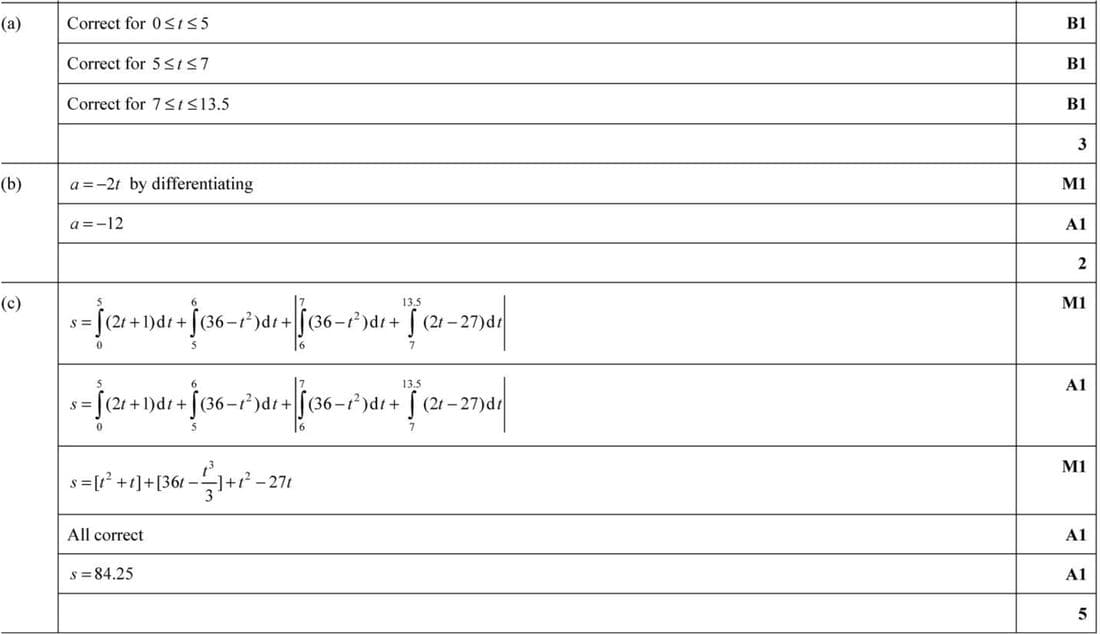
A particle moves in a straight line starting from rest from a point O. The acceleration of the particle at time t s after leaving O is a m/s2, where
\(a = 5.4 - 1.62t\).
- Find the positive value of t at which the velocity of the particle is zero, giving your answer as an exact fraction.
- Find the velocity of the particle at \(t = 10\) and sketch the velocity-time graph for the first ten seconds of the motion.
- Find the total distance travelled during the first ten seconds of the motion.
June 2018 p43 q7
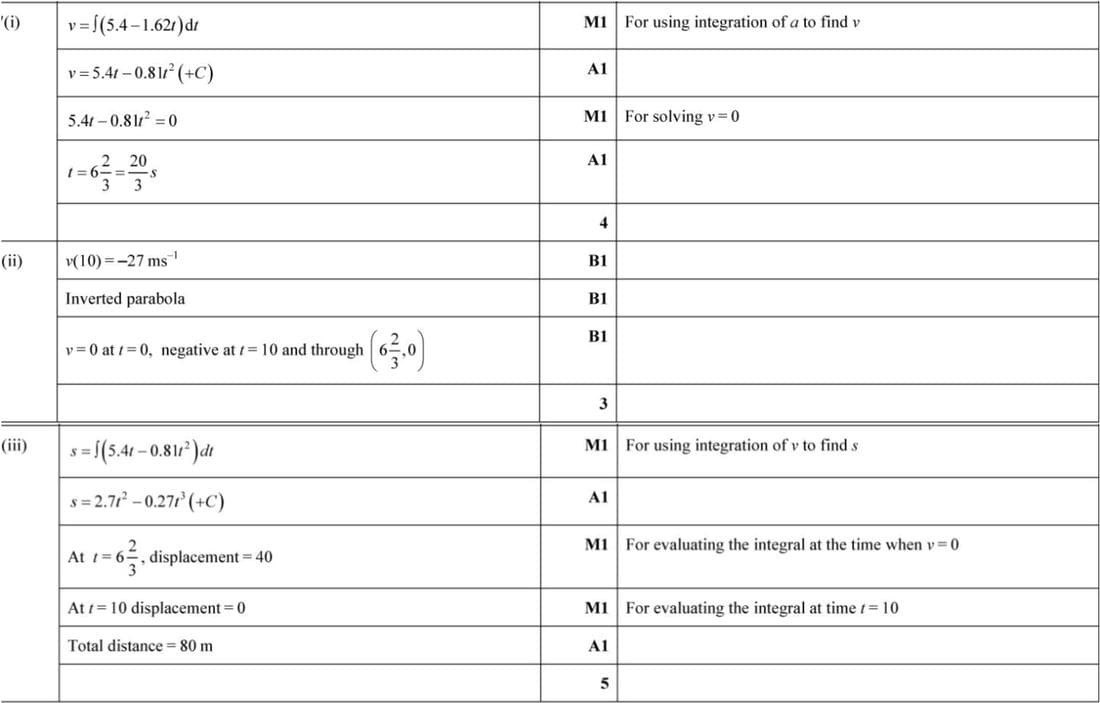
A particle P moves in a straight line starting from a point O. The velocity v m s-1 of P at time t s is given by
\(v = 12t - 4t^2\) for \(0 \leq t \leq 2\),
\(v = 16 - 4t\) for \(2 \leq t \leq 4\).
- Find the maximum velocity of P during the first 2 s.
- Determine, with justification, whether there is any instantaneous change in the acceleration of P when \(t = 2\).
- Sketch the velocity-time graph for \(0 \leq t \leq 4\).
- Find the distance travelled by P in the interval \(0 \leq t \leq 4\).
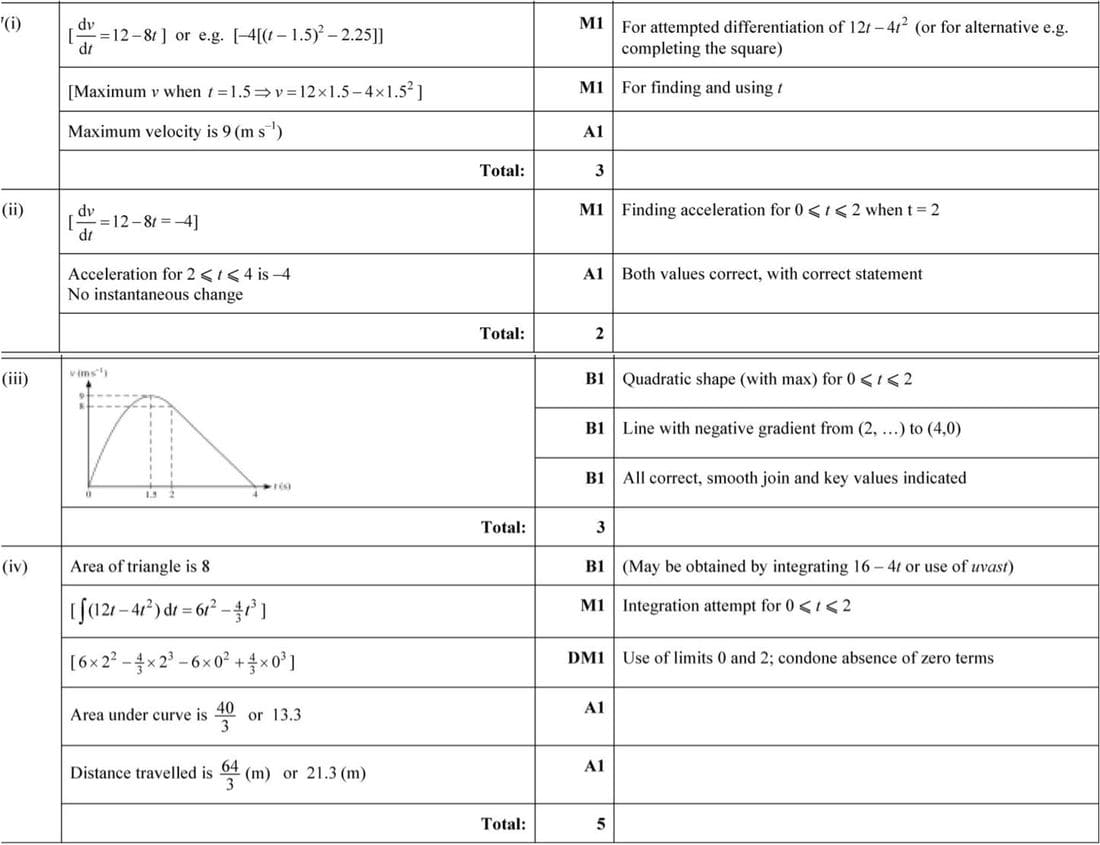
Feb/Mar 2018 p42 q7
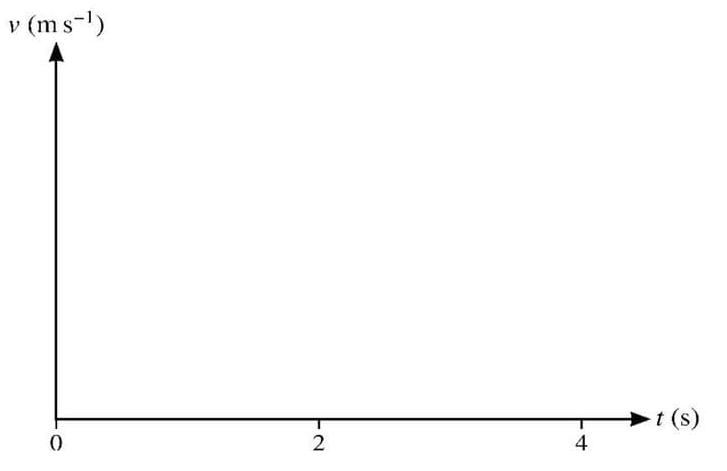
A particle P moves in a straight line. The velocity v m s-1 at time t s is given by
\(v = 4 + 0.2t\) for \(0 \leq t \leq 10\),
\(v = -2 + \frac{800}{t^2}\) for \(10 \leq t \leq 20\).
- Find the acceleration of P during the first 10 s.
- Find the acceleration of P when \(t = 20\).
- Sketch the velocity-time graph for \(0 \leq t \leq 20\).
- Find the total distance travelled by P in the interval \(0 \leq t \leq 20\).