Exam-Style Problems
⬅ Back to SubchapterNov 2004 p4 q5
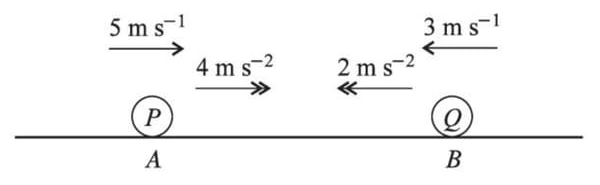
Particles P and Q start from points A and B respectively, at the same instant, and move towards each other in a horizontal straight line. The initial speeds of P and Q are 5 m s-1 and 3 m s-1 respectively. The accelerations of P and Q are constant and equal to 4 m s-2 and 2 m s-2 respectively (see diagram).
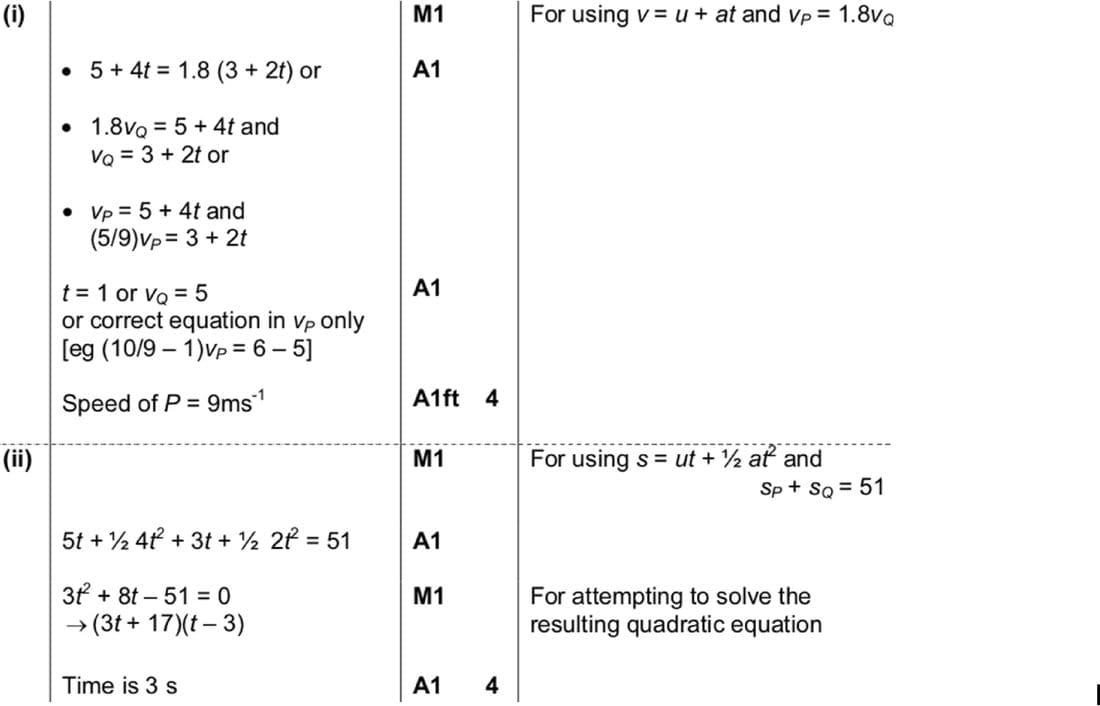
- Find the speed of P at the instant when the speed of P is 1.8 times the speed of Q.
- Given that AB = 51 m, find the time taken from the start until P and Q meet.
June 2021 p41 q4
Two cyclists, Isabella and Maria, are having a race. They both travel along a straight road with constant acceleration, starting from rest at point A.
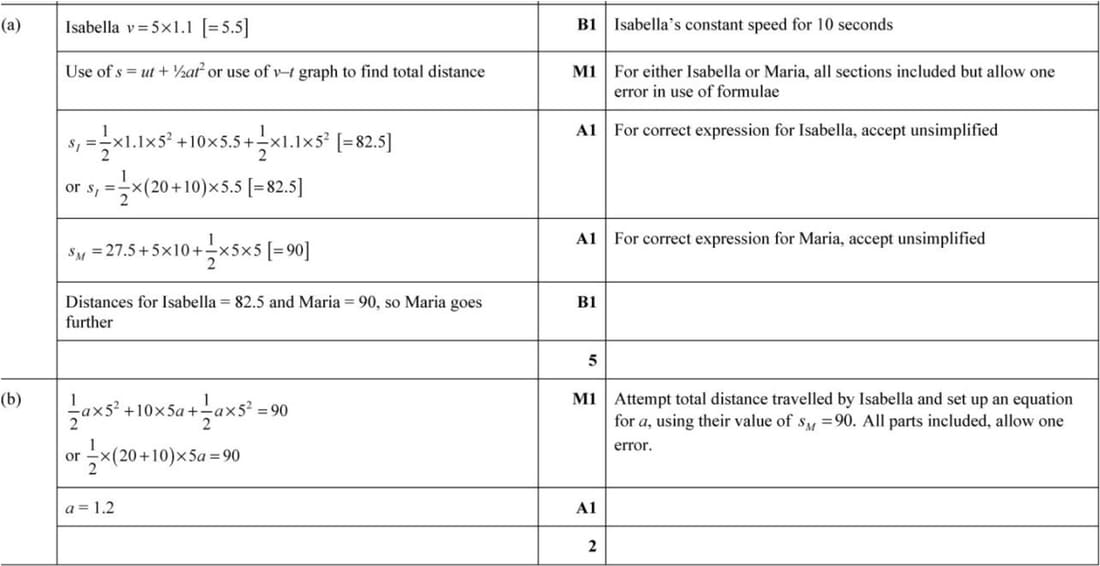
Isabella accelerates for 5 s at a constant rate \(a \text{ m s}^{-2}\). She then travels at the constant speed she has reached for 10 s, before decelerating to rest at a constant rate over a period of 5 s.
Maria accelerates at a constant rate, reaching a speed of 5 \(\text{ m s}^{-1}\) in a distance of 27.5 m. She then maintains this speed for a period of 10 s, before decelerating to rest at a constant rate over a period of 5 s.
(a) Given that \(a = 1.1\), find which cyclist travels further.
(b) Find the value of \(a\) for which the two cyclists travel the same distance.
Nov 2003 p4 q7
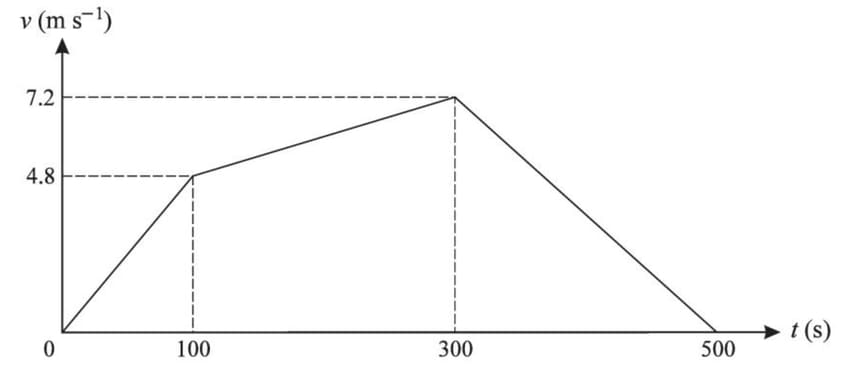
A tractor A starts from rest and travels along a straight road for 500 seconds. The velocity-time graph for the journey is shown above. This graph consists of three straight line segments. Find
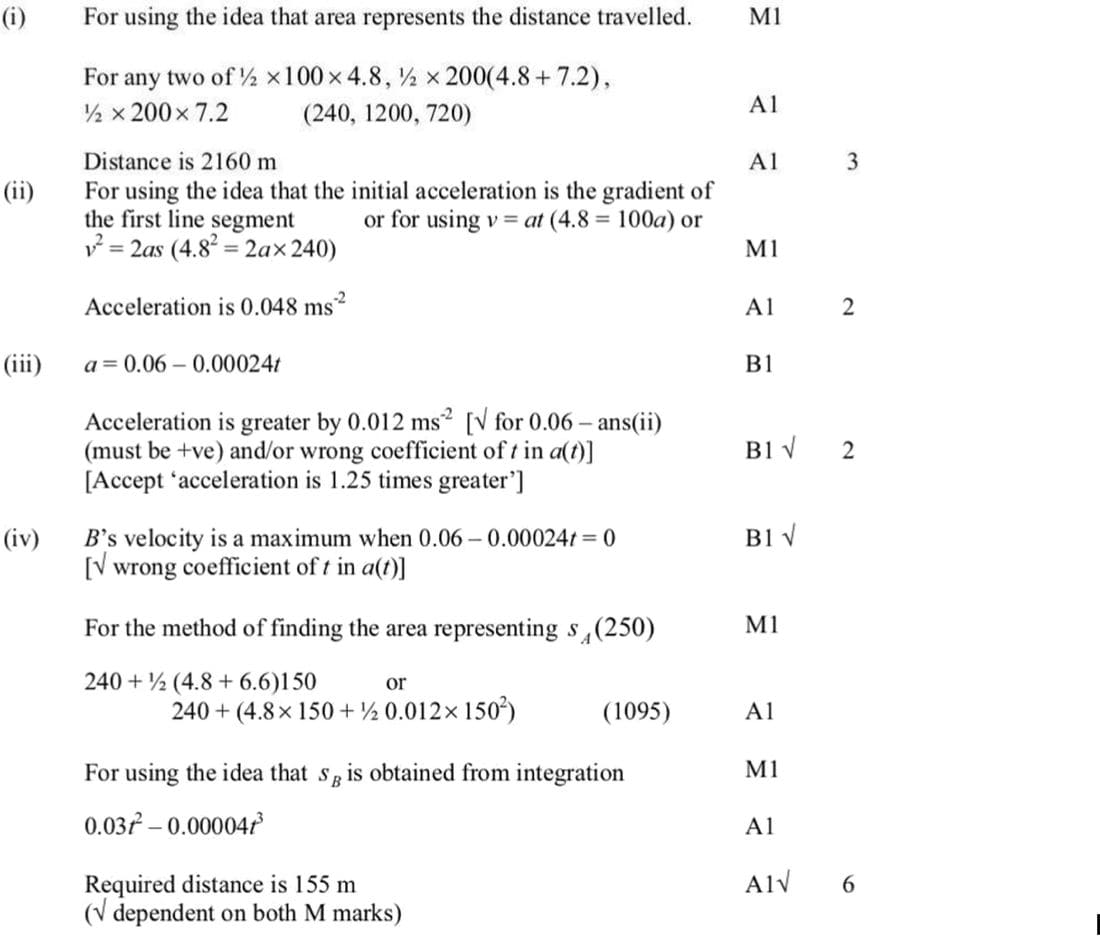
- the distance travelled by A,
- the initial acceleration of A.
Another tractor B starts from rest at the same instant as A, and travels along the same road for 500 seconds. Its velocity t seconds after starting is \((0.06t - 0.00012t^2)\) m s-1. Find
- how much greater B’s initial acceleration is than A’s,
- how much further B has travelled than A, at the instant when B’s velocity reaches its maximum.
Nov 2019 p41 q7
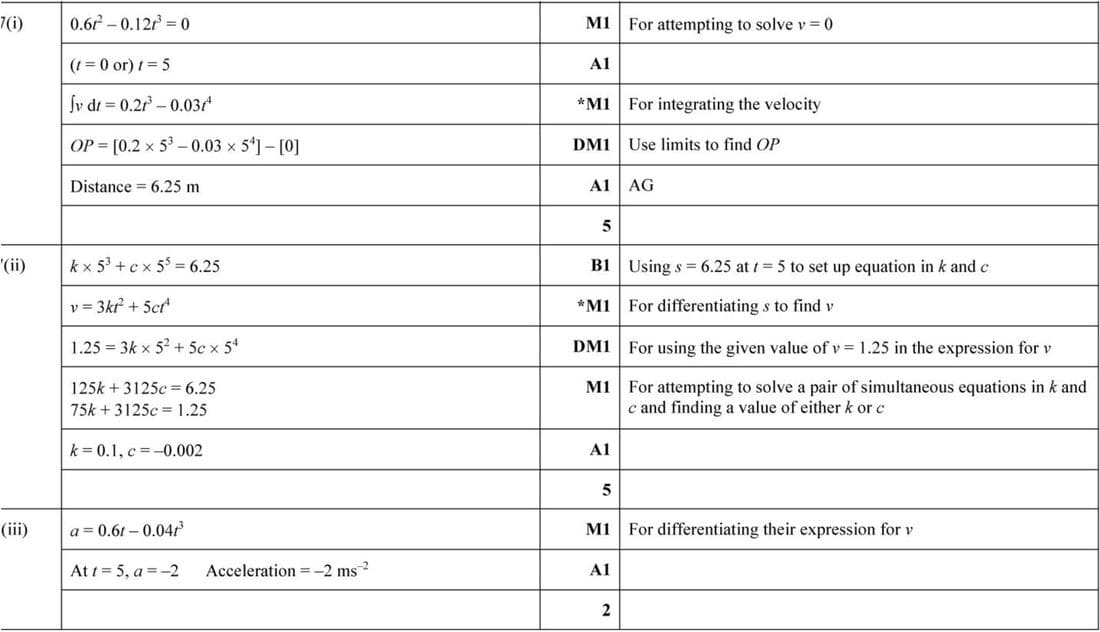
A particle moves in a straight line, starting from rest at a point O, and comes to instantaneous rest at a point P. The velocity of the particle at time t s after leaving O is v m s-1, where
\(v = 0.6t^2 - 0.12t^3\).
- Show that the distance OP is 6.25 m.
On another occasion, the particle also moves in the same straight line. On this occasion, the displacement of the particle at time t s after leaving O is s m, where
\(s = kt^3 + ct^5\).
\(It is given that the particle passes point P with velocity 1.25 m s-1 at time t = 5.\)
- Find the values of the constants k and c.
- Find the acceleration of the particle at time t = 5.
June 2019 p42 q7
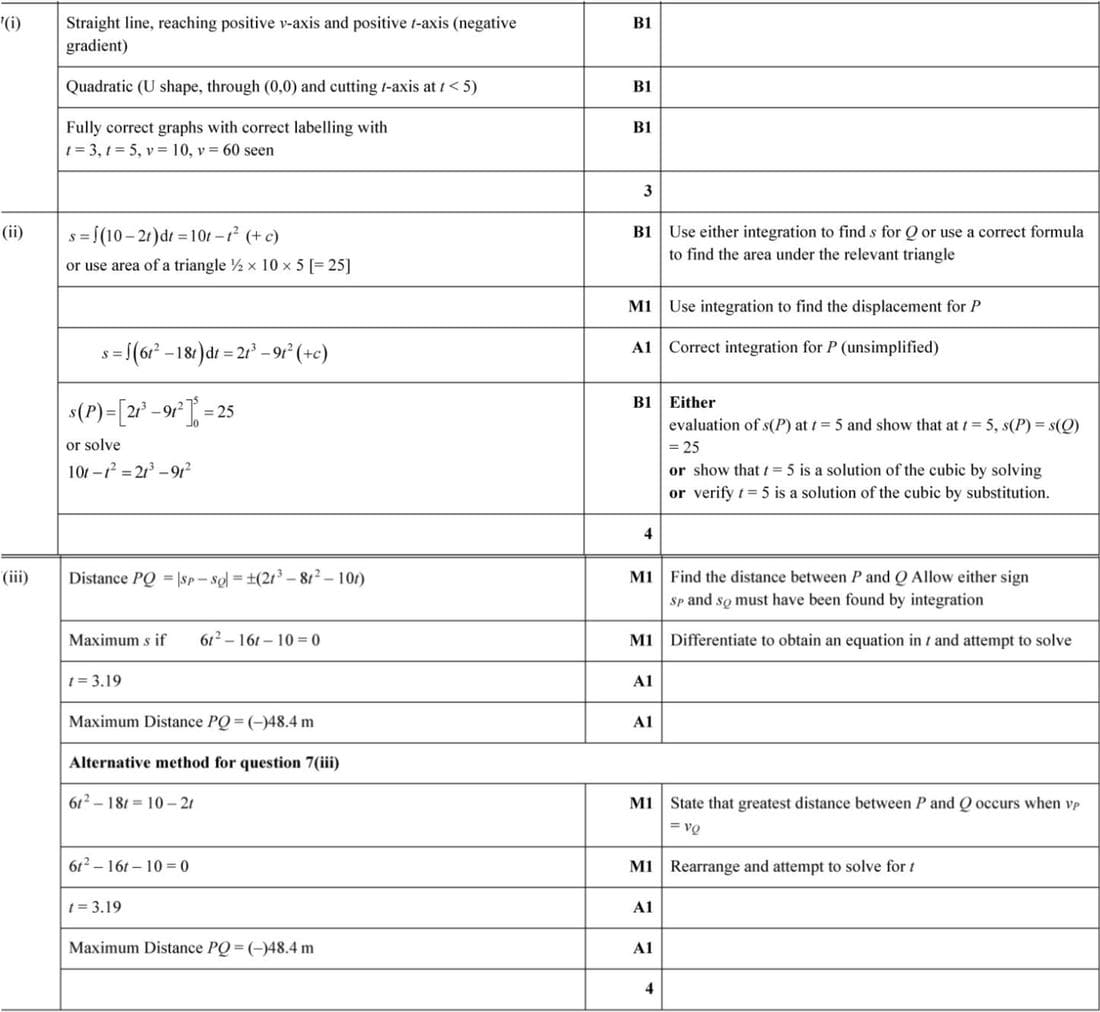
Particles P and Q leave a fixed point A at the same time and travel in the same straight line. The velocity of P after t seconds is \(6t(t-3)\) m s-1 and the velocity of Q after t seconds is \((10 - 2t)\) m s-1.
- Sketch, on the same axes, velocity-time graphs for P and Q for \(0 \leq t \leq 5\).
- Verify that P and Q meet after 5 seconds.
- Find the greatest distance between P and Q for \(0 \leq t \leq 5\).