Exam-Style Problems
⬅ Back to SubchapterNov 2010 p43 q3
3894
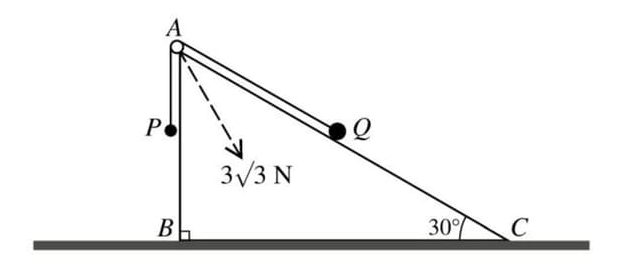
A small smooth pulley is fixed at the highest point A of a cross-section ABC of a triangular prism. Angle \(\angle ABC = 90^\circ\) and angle \(\angle BCA = 30^\circ\). The prism is fixed with the face containing BC in contact with a horizontal surface. Particles P and Q are attached to opposite ends of a light inextensible string, which passes over the pulley. The particles are in equilibrium with P hanging vertically below the pulley and Q in contact with AC. The resultant force exerted on the pulley by the string is \(3\sqrt{3} \text{ N}\) (see diagram).
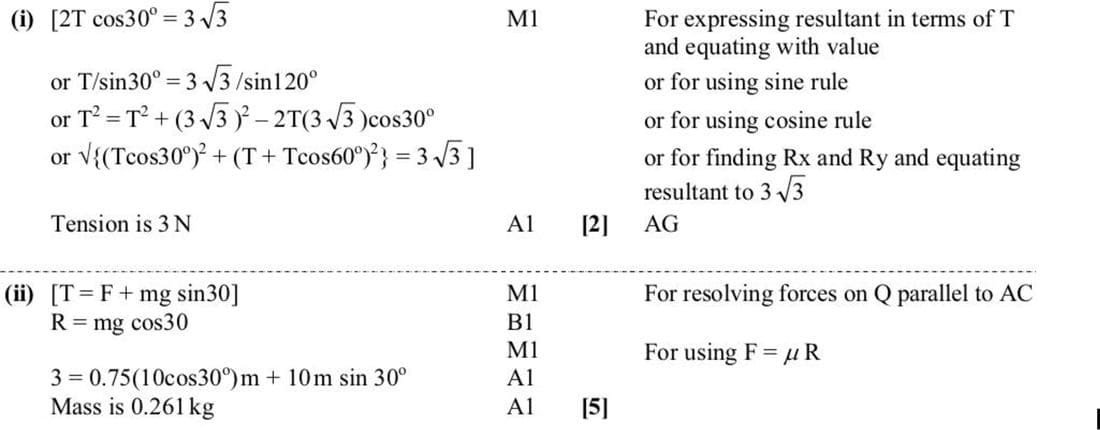
(i) Show that the tension in the string is 3 N.
The coefficient of friction between Q and the prism is 0.75.
(ii) Given that Q is in limiting equilibrium and on the point of moving upwards, find its mass.
June 2006 p4 q5
3895
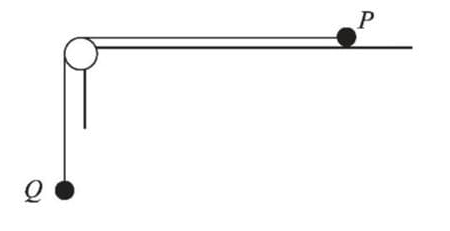
Particles P and Q are attached to opposite ends of a light inextensible string. P is at rest on a rough horizontal table. The string passes over a small smooth pulley which is fixed at the edge of the table. Q hangs vertically below the pulley (see diagram). The force exerted on the string by the pulley has magnitude \(4\sqrt{2}\) N. The coefficient of friction between P and the table is 0.8.
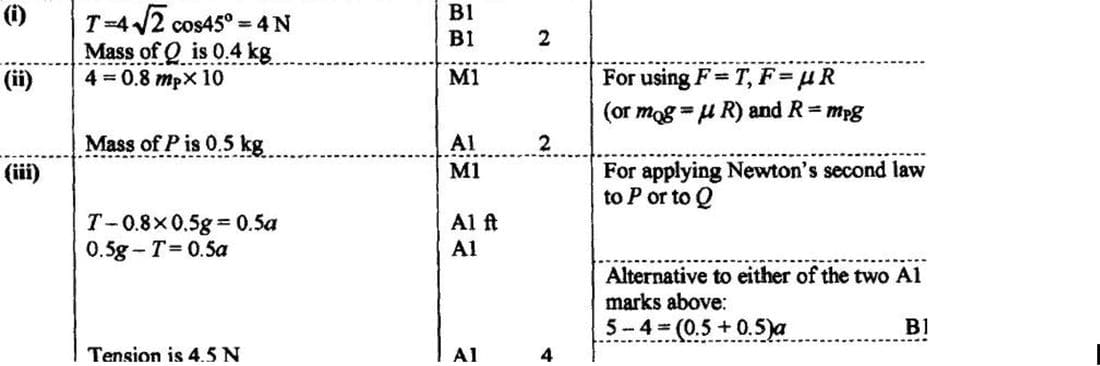
- Show that the tension in the string is 4 N and state the mass of Q.
- Given that P is on the point of slipping, find its mass.
- A particle of mass 0.1 kg is now attached to Q and the system starts to move. Find the tension in the string while the particles are in motion.
Nov 2021 p43 q6
3896
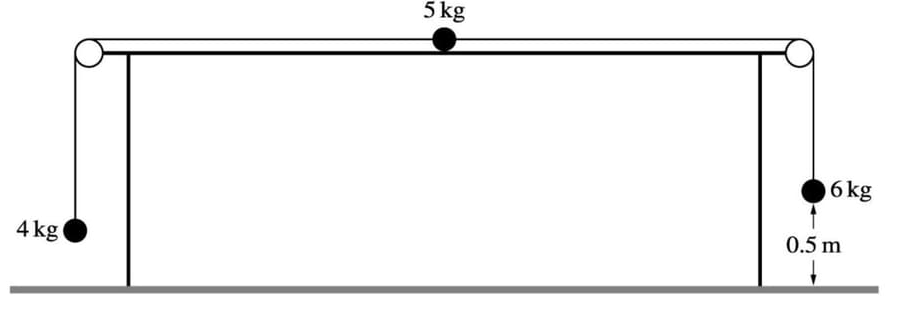
The diagram shows a particle of mass 5 kg on a rough horizontal table, and two light inextensible strings attached to it passing over smooth pulleys fixed at the edges of the table. Particles of masses 4 kg and 6 kg hang freely at the ends of the strings. The particle of mass 6 kg is 0.5 m above the ground. The system is in limiting equilibrium.
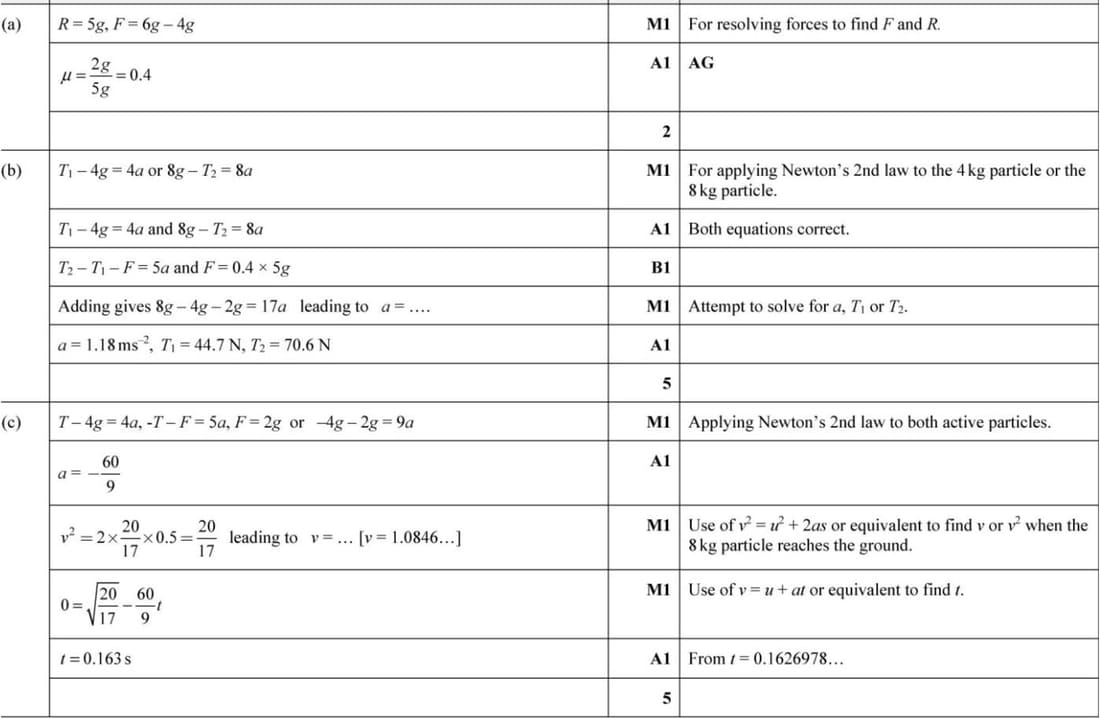
(a) Show that the coefficient of friction between the 5 kg particle and the table is 0.4.
The 6 kg particle is now replaced by a particle of mass 8 kg and the system is released from rest.
(b) Find the acceleration of the 4 kg particle and the tensions in the strings.
(c) In the subsequent motion the 8 kg particle hits the ground and does not rebound. Find the time that elapses after the 8 kg particle hits the ground before the other two particles come to instantaneous rest. (You may assume this occurs before either particle reaches a pulley.)
Nov 2016 p43 q3
3897
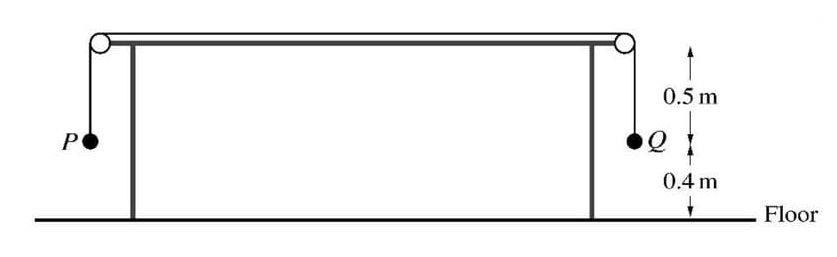
Particles P and Q, of masses 7 kg and 3 kg respectively, are attached to the two ends of a light inextensible string. The string passes over two small smooth pulleys attached to the two ends of a horizontal table. The two particles hang vertically below the two pulleys. The two particles are both initially at rest, 0.5 m below the level of the table, and 0.4 m above the horizontal floor (see diagram).
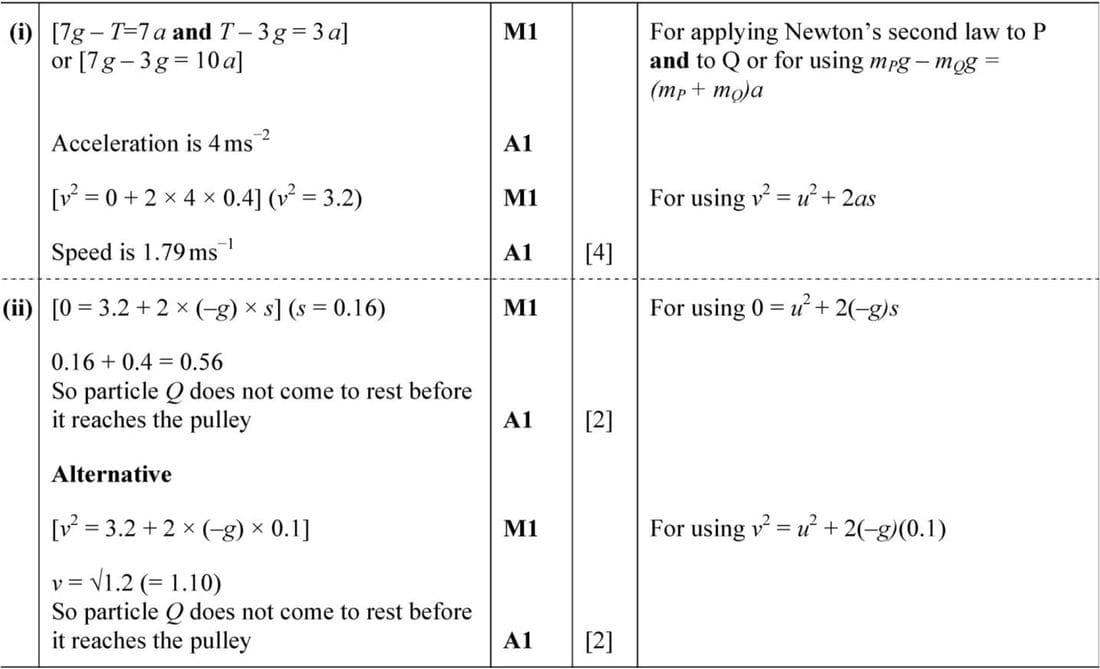
(i) Find the acceleration of the particles and the speed of P immediately before it reaches the floor.
(ii) Determine whether Q comes to instantaneous rest before it reaches the pulley directly above it.
Nov 2014 p41 q5
3898
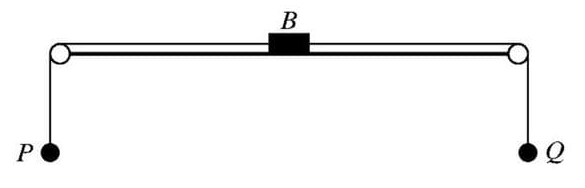
A small block B of mass 0.25 kg is attached to the mid-point of a light inextensible string. Particles P and Q, of masses 0.2 kg and 0.3 kg respectively, are attached to the ends of the string. The string passes over two smooth pulleys fixed at opposite sides of a rough table, with B resting in limiting equilibrium on the table between the pulleys and particles P and Q and block B are in the same vertical plane (see diagram).
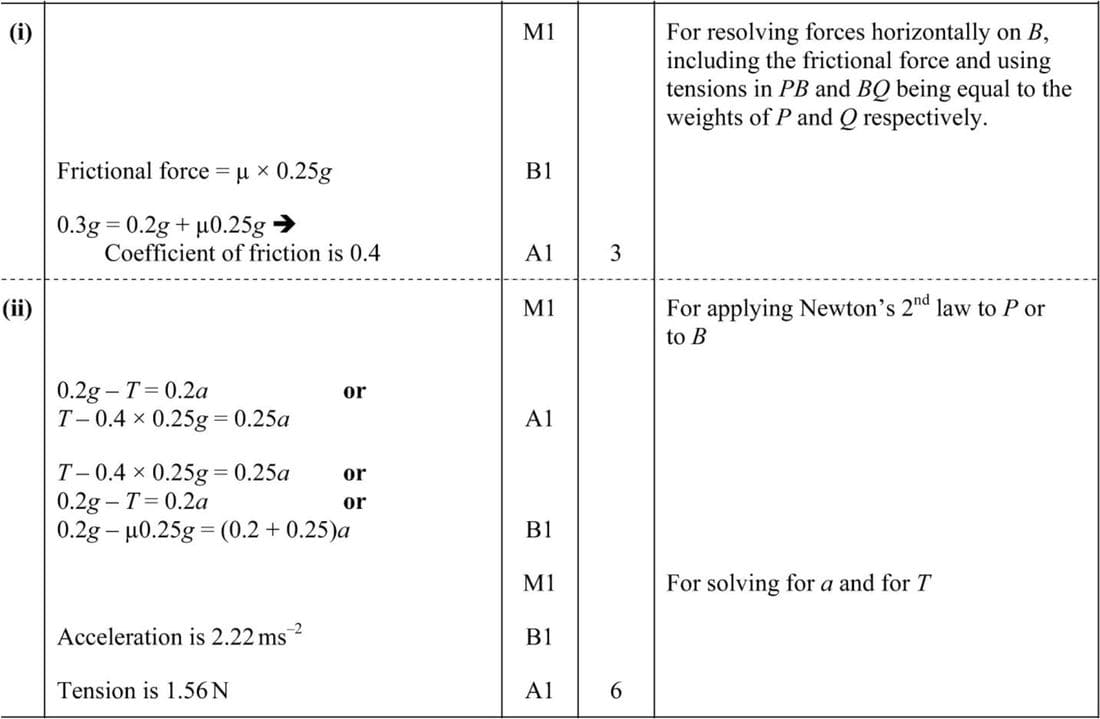
(i) Find the coefficient of friction between B and the table. [3]
Q is now removed so that P and B begin to move.
(ii) Find the acceleration of P and the tension in the part PB of the string. [6]