Exam-Style Problems
⬅ Back to SubchapterNov 2013 p41 q4
Particles P and Q are moving in a straight line on a rough horizontal plane. The frictional forces are the only horizontal forces acting on the particles.
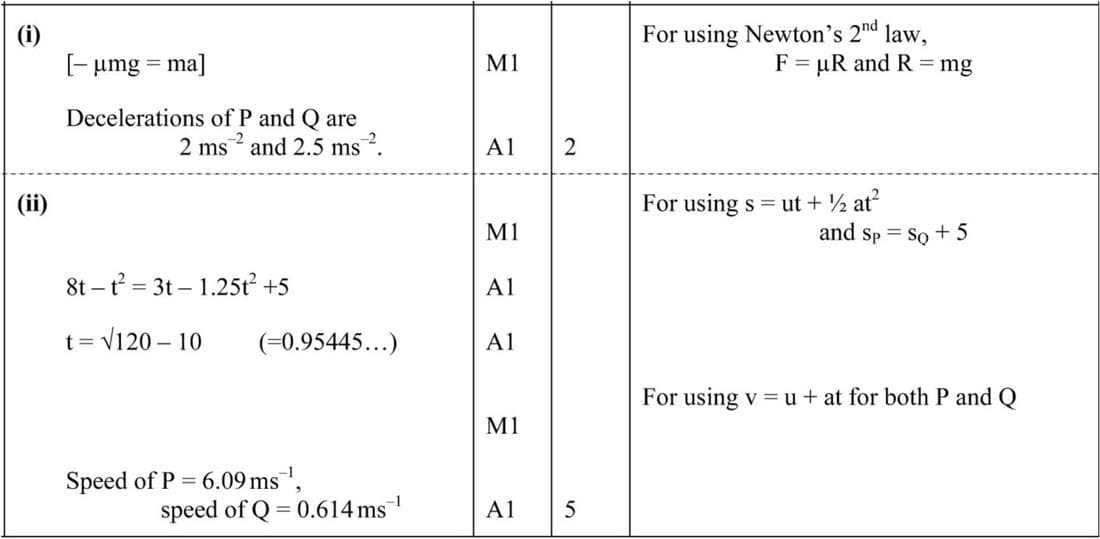
- Find the deceleration of each of the particles given that the coefficient of friction between P and the plane is 0.2, and between Q and the plane is 0.25.
At a certain instant, P passes through the point A and Q passes through the point B. The distance AB is 5 m. The velocities of P and Q at A and B are 8 m s-1 and 3 m s-1, respectively, both in the direction of AB.
- Find the speeds of P and Q immediately before they collide.
June 2013 p43 q6
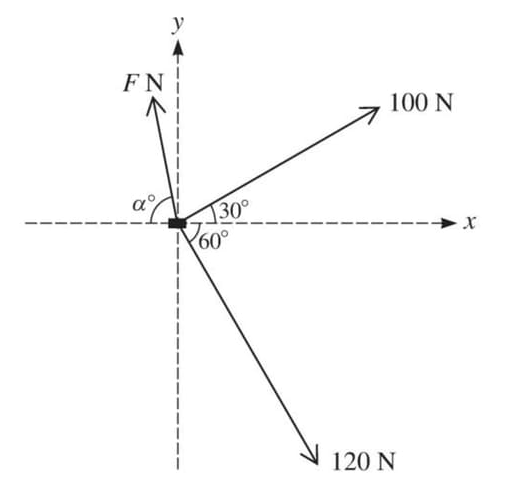
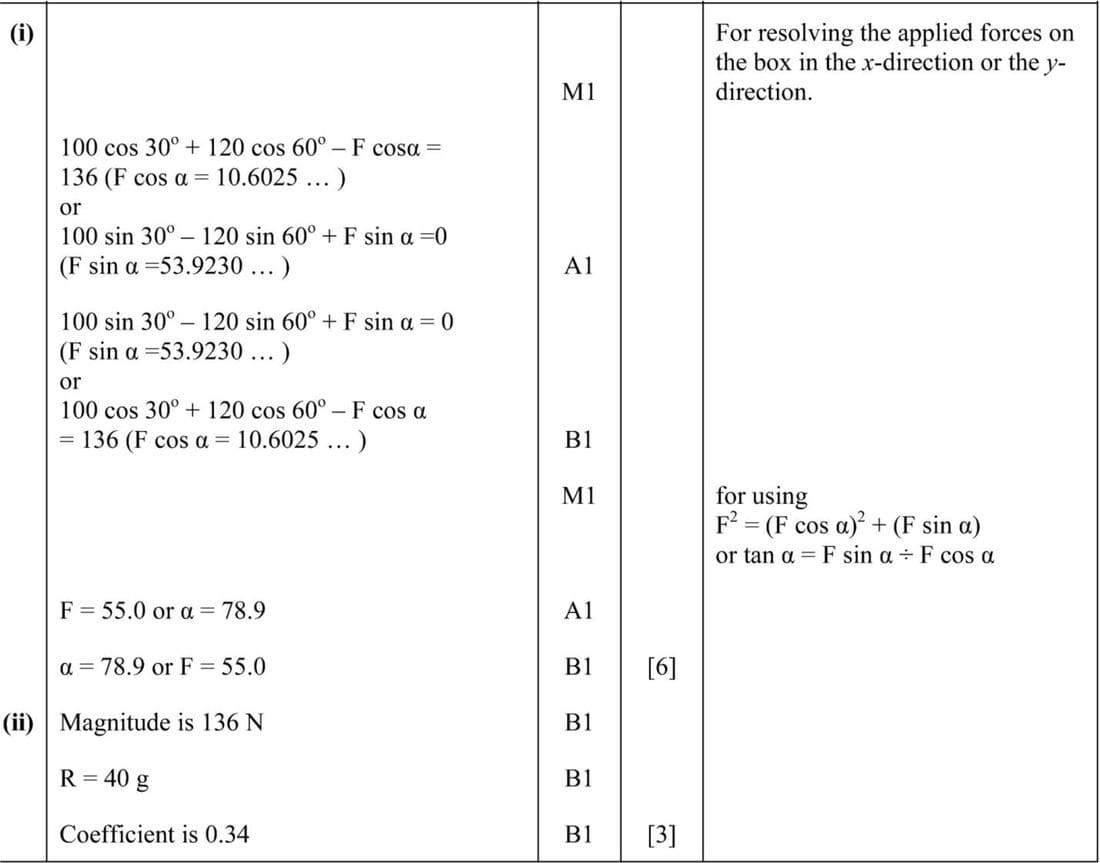
A small box of mass 40 kg is moved along a rough horizontal floor by three men. Two of the men apply horizontal forces of magnitudes 100 N and 120 N, making angles of 30° and 60° respectively with the positive x-direction. The third man applies a horizontal force of magnitude F N making an angle of α° with the negative x-direction (see diagram). The resultant of the three horizontal forces acting on the box is in the positive x-direction and has magnitude 136 N.
(i) Find the values of F and α.
(ii) Given that the box is moving with constant speed, state the magnitude of the frictional force acting on the box and hence find the coefficient of friction between the box and the floor.
June 2013 p42 q1
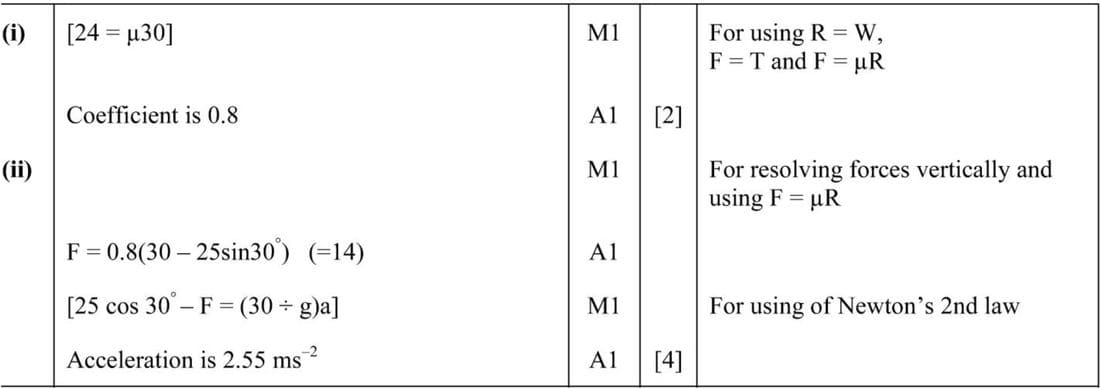
A string is attached to a block of weight 30 N, which is in contact with a rough horizontal plane. When the string is horizontal and the tension in it is 24 N, the block is in limiting equilibrium.
(i) Find the coefficient of friction between the block and the plane.
The block is now in motion and the string is at an angle of 30° upwards from the plane. The tension in the string is 25 N.
(ii) Find the acceleration of the block.
June 2013 p41 q1
A block is at rest on a rough horizontal plane. The coefficient of friction between the block and the plane is 1.25.
(i) State, giving a reason for your answer, whether the minimum vertical force required to move the block is greater or less than the minimum horizontal force required to move the block.
A horizontal force of continuously increasing magnitude \(P\) N and fixed direction is applied to the block.
(ii) Given that the weight of the block is 60 N, find the value of \(P\) when the acceleration of the block is 4 m s\(^{-2}\).

June 2011 p43 q5
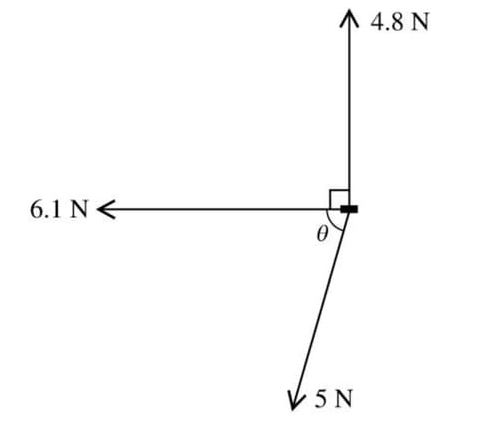
A small block of mass 1.25 kg is on a horizontal surface. Three horizontal forces, with magnitudes and directions as shown in the diagram, are applied to the block. The angle \(\theta\) is such that \(\cos \theta = 0.28\) and \(\sin \theta = 0.96\). A horizontal frictional force also acts on the block, and the block is in equilibrium.
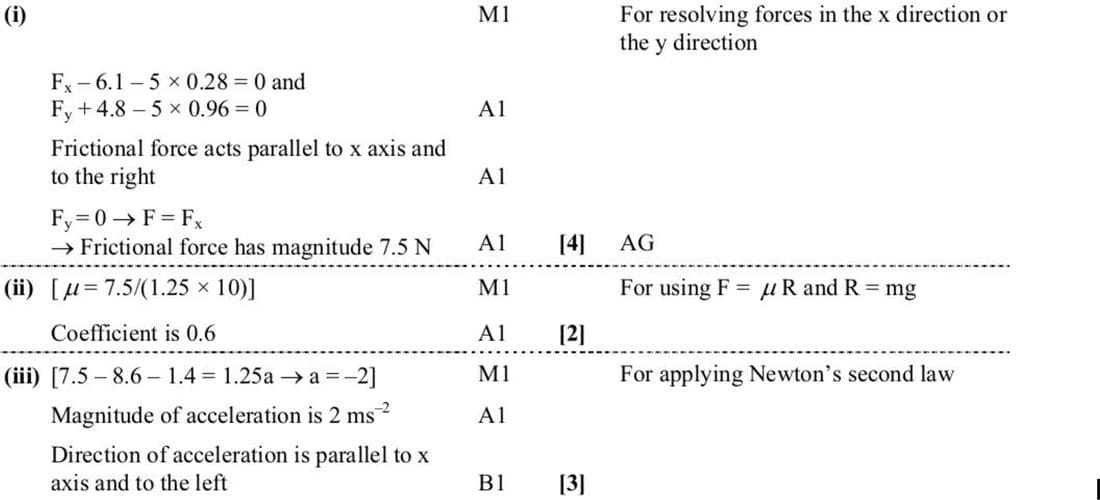
- Show that the magnitude of the frictional force is 7.5 N and state the direction of this force.
- Given that the block is in limiting equilibrium, find the coefficient of friction between the block and the surface.
- The force of magnitude 6.1 N is now replaced by a force of magnitude 8.6 N acting in the same direction, and the block begins to move. Find the magnitude and direction of the acceleration of the block.