Exam-Style Problems
⬅ Back to SubchapterNov 2014 p42 q2
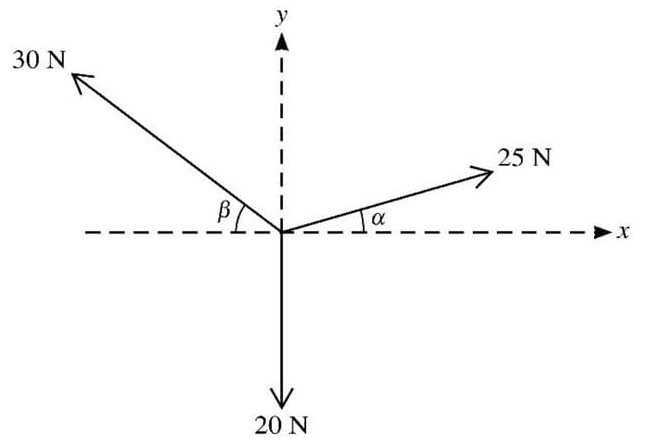
Three coplanar forces act at a point. The magnitudes of the forces are 20 N, 25 N, and 30 N, and the directions in which the forces act are as shown in the diagram, where \(\sin \alpha = 0.28\) and \(\cos \alpha = 0.96\), and \(\sin \beta = 0.6\) and \(\cos \beta = 0.8\).
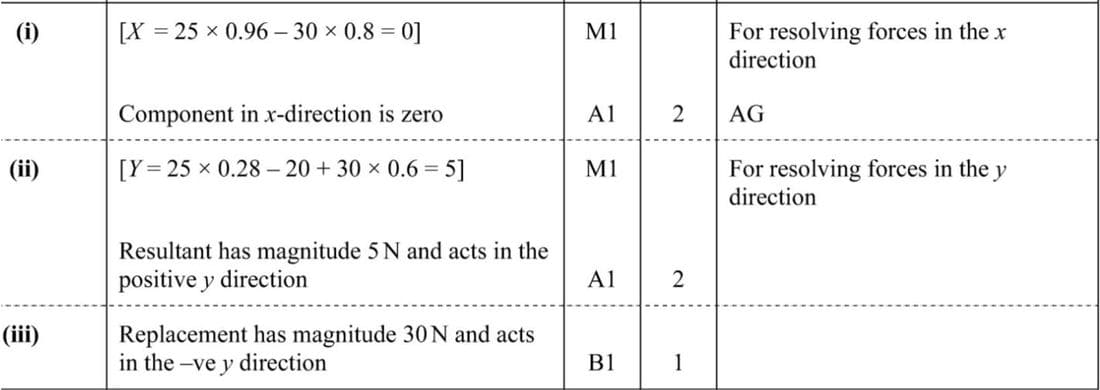
(i) Show that the resultant of the three forces has a zero component in the \(x\)-direction.
(ii) Find the magnitude and direction of the resultant of the three forces.
(iii) The force of magnitude 20 N is replaced by another force. The effect is that the resultant force is unchanged in magnitude but reversed in direction. State the magnitude and direction of the replacement force.
June 2022 p42 q2
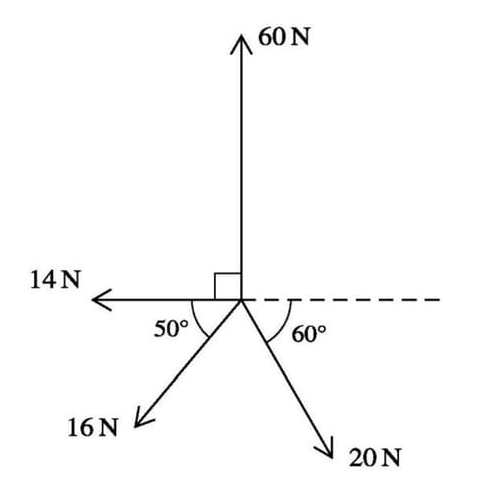
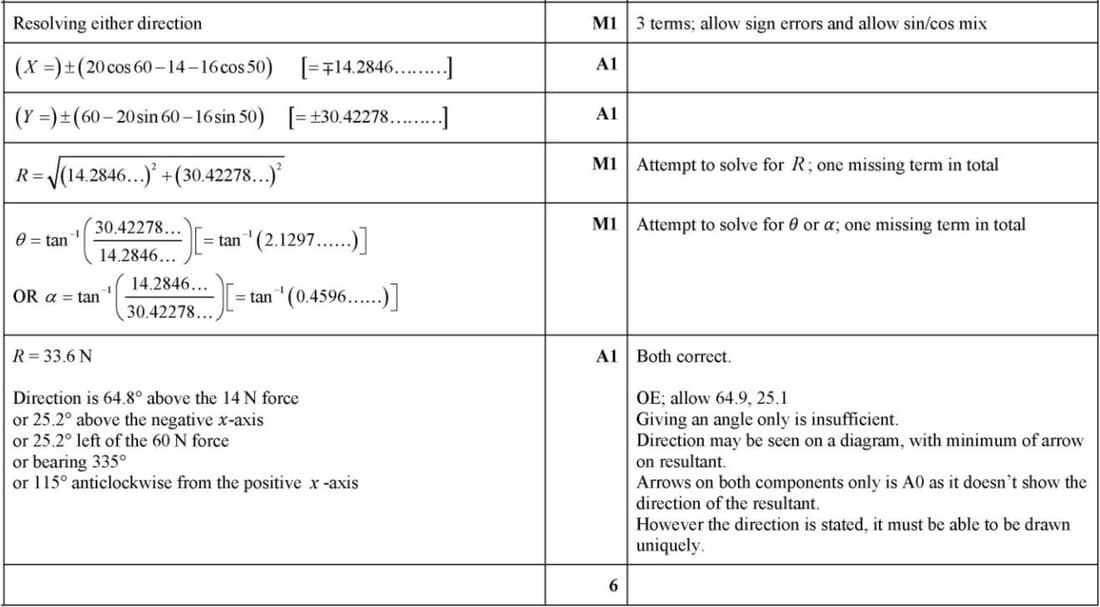
Coplanar forces of magnitudes 60 N, 20 N, 16 N, and 14 N act at a point in the directions shown in the diagram. Find the magnitude and direction of the resultant force.
Nov 2012 p42 q4
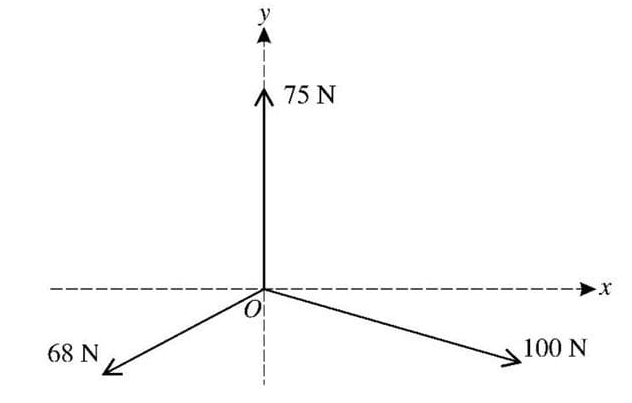
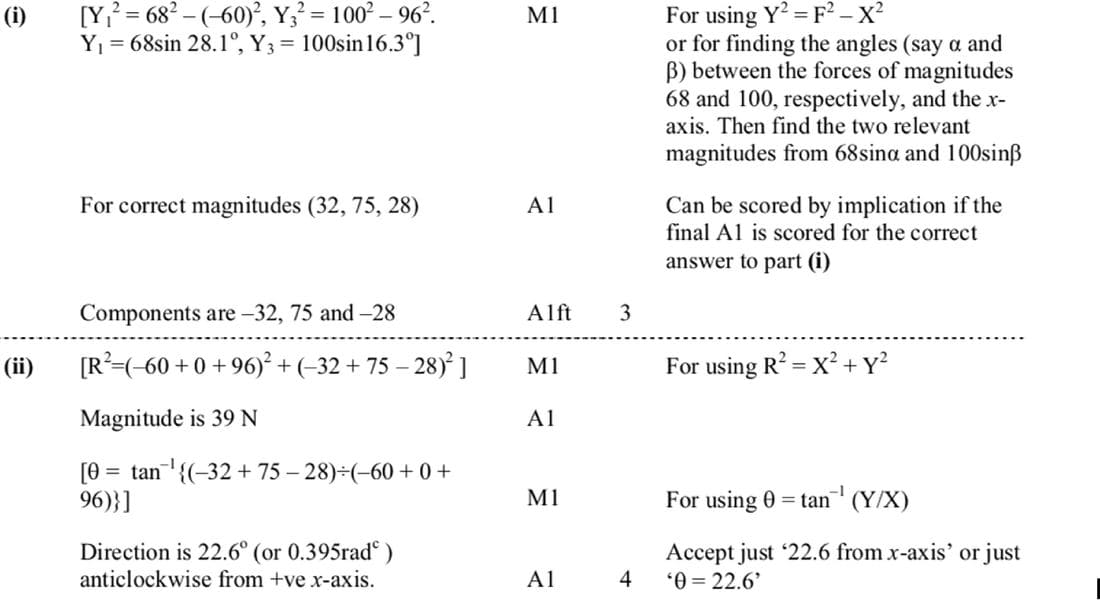
Three coplanar forces of magnitudes 68 N, 75 N, and 100 N act at an origin O, as shown in the diagram. The components of the three forces in the positive x-direction are -60 N, 0 N, and 96 N, respectively. Find
- the components of the three forces in the positive y-direction,
- the magnitude and direction of the resultant of the three forces.
Nov 2012 p41 q4
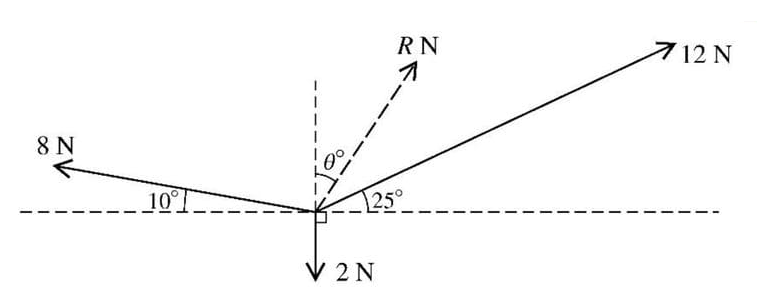
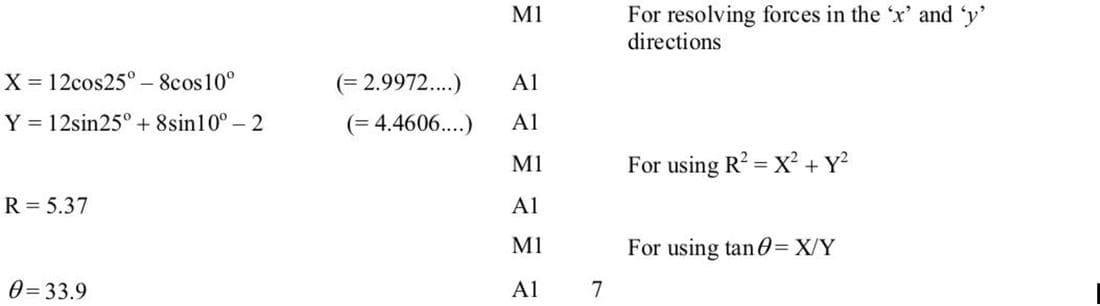
Three coplanar forces of magnitudes 8 N, 12 N, and 2 N act at a point. The resultant of the forces has magnitude \(R\) N. The directions of the three forces and the resultant are shown in the diagram. Find \(R\) and \(\theta\).
June 2012 p41 q2
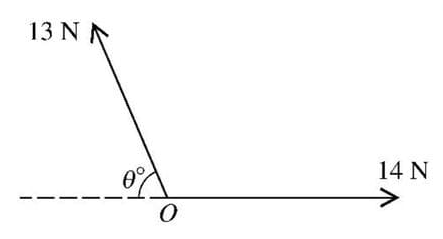
Forces of magnitudes 13 N and 14 N act at a point O in the directions shown in the diagram. The resultant of these forces has magnitude 15 N. Find
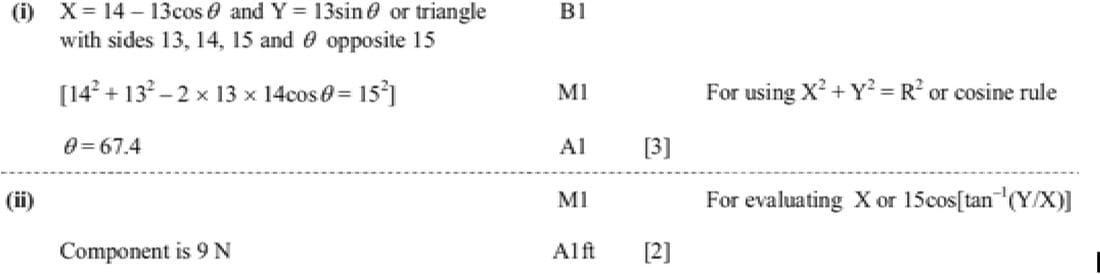
- the value of \(\theta\),
- the component of the resultant in the direction of the force of magnitude 14 N.