Exam-Style Problems
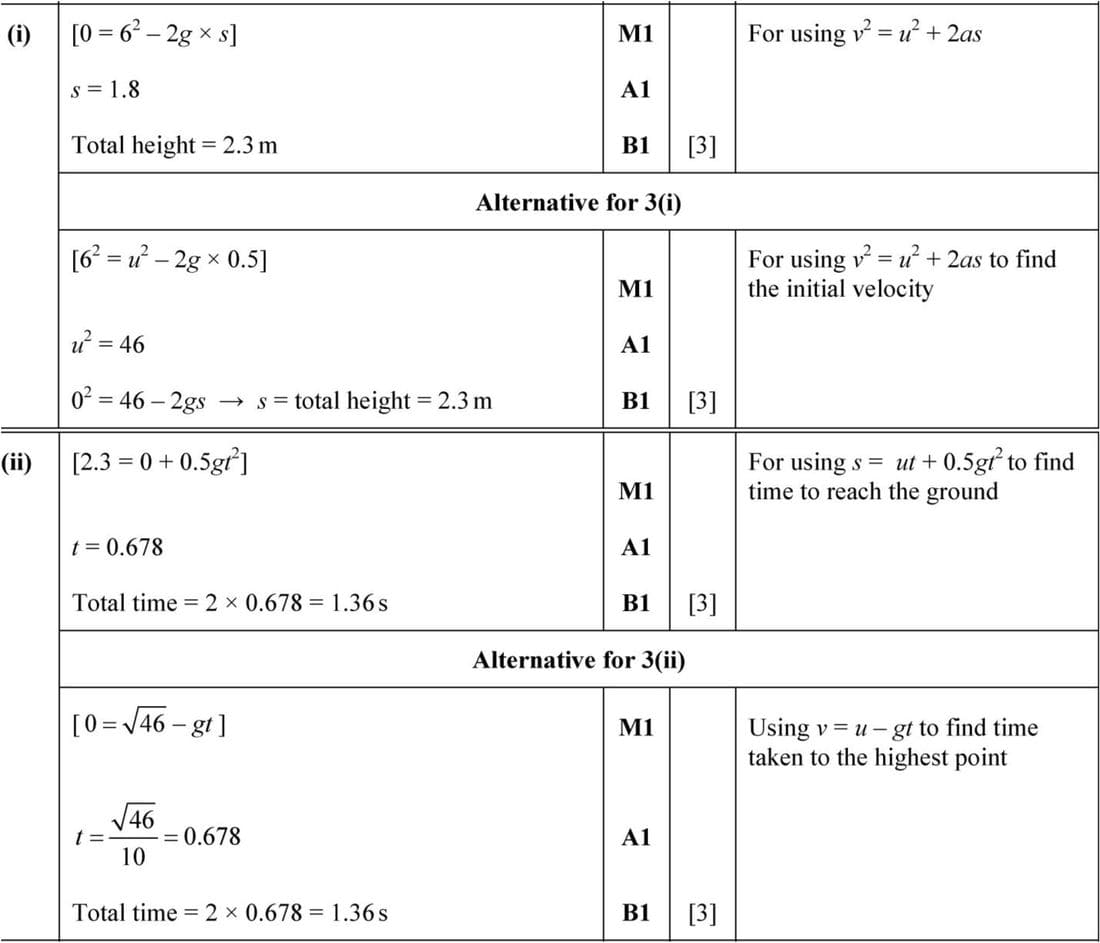
⬅ Back to SubchapterNov 2016 p41 q3
A particle P is projected vertically upwards from a point O. When the particle is at a height of 0.5 m, its speed is 6 m s-1. Find
- the greatest height reached by the particle above O,
- the time after projection at which the particle returns to O.
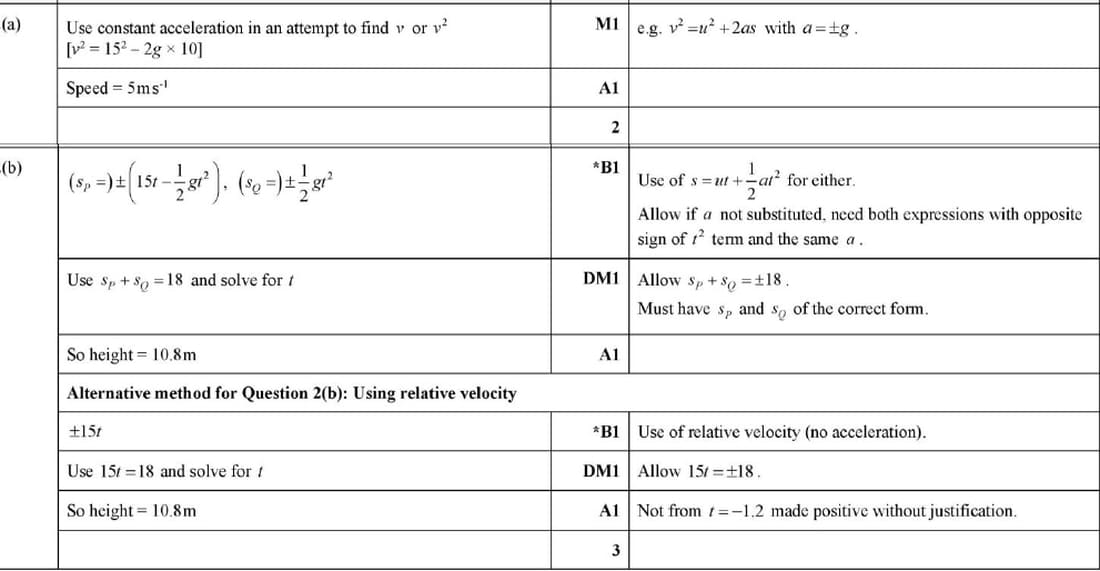
Feb/Mar 2023 p42 q2
A particle P is projected vertically upwards from horizontal ground with speed 15 m s-1.
(a) Find the speed of P when it is 10 m above the ground.
At the same instant that P is projected, a second particle Q is dropped from a height of 18 m above the ground in the same vertical line as P.
(b) Find the height above the ground at which the two particles collide.
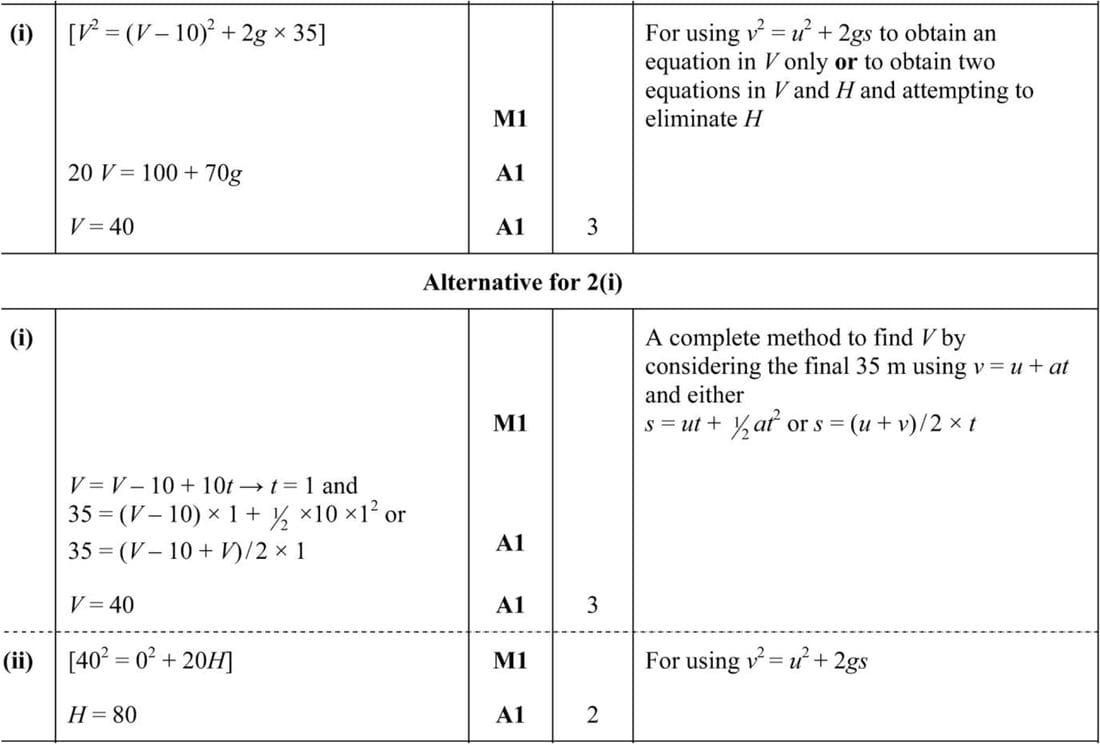
Nov 2015 p42 q2
A particle is released from rest at a point H m above horizontal ground and falls vertically. The particle passes through a point 35 m above the ground with a speed of (V - 10) \text{ m s}^{-1} and reaches the ground with a speed of V \text{ m s}^{-1}. Find
- the value of V,
- the value of H.
Nov 2014 p42 q1
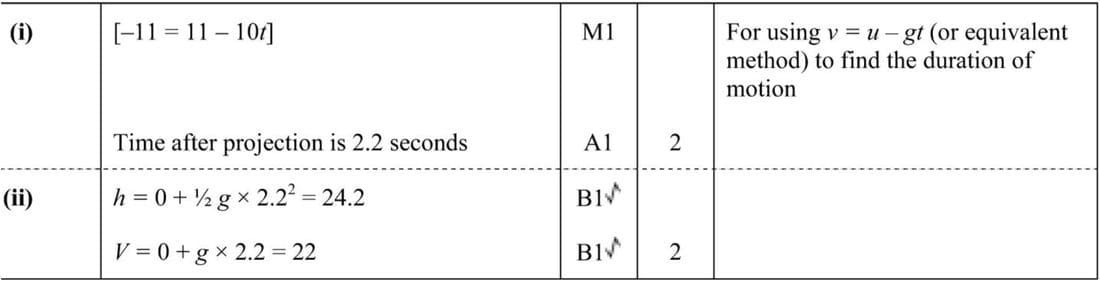
A particle P is projected vertically upwards with speed 11 m s-1 from a point on horizontal ground. At the same instant a particle Q is released from rest at a point h m above the ground. P and Q hit the ground at the same instant, when Q has speed V m s-1.
- Find the time after projection at which P hits the ground.
- Hence find the values of h and V.
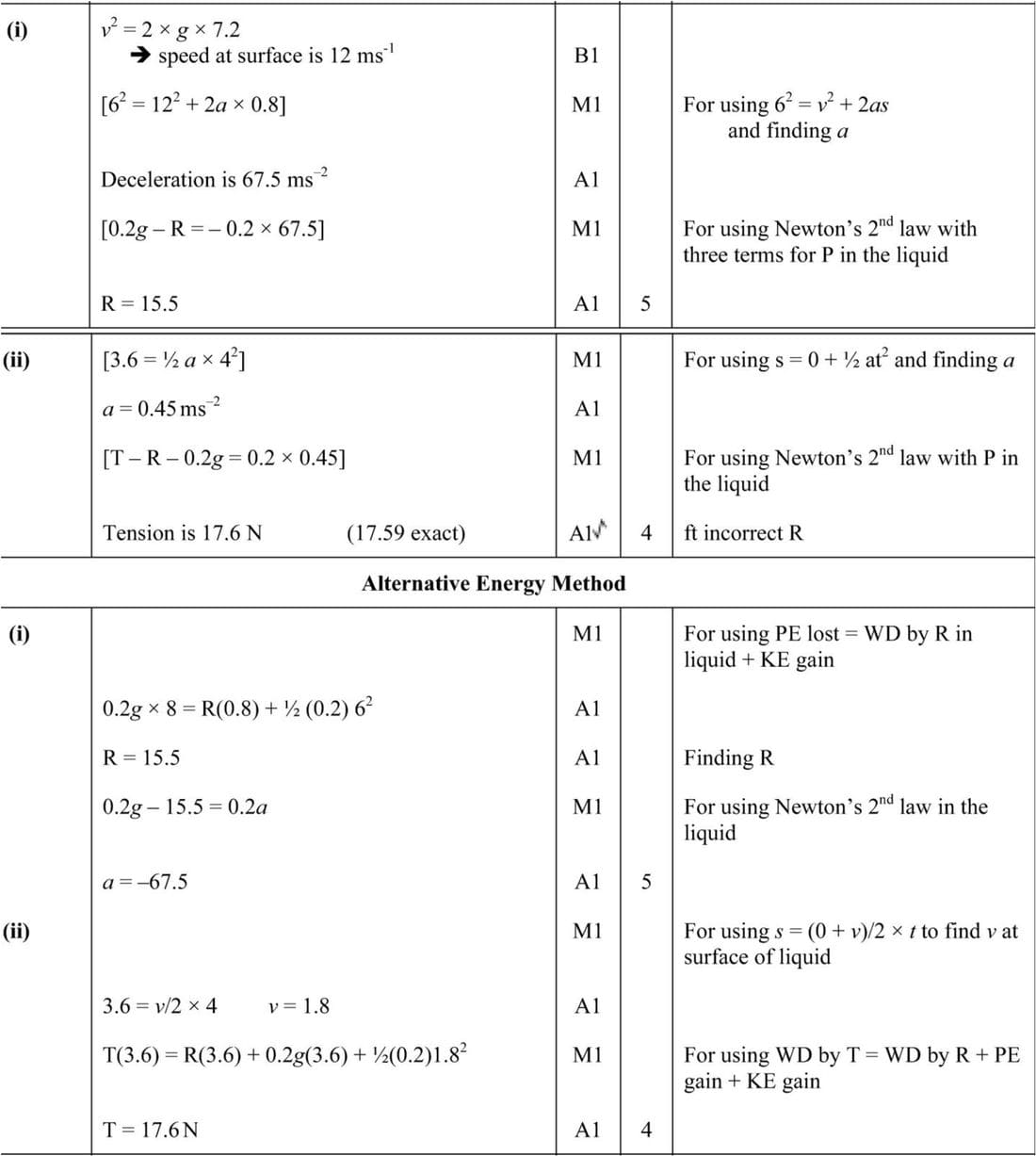
June 2014 p42 q6
A particle P of mass 0.2 kg is released from rest at a point 7.2 m above the surface of the liquid in a container. P falls through the air and into the liquid. There is no air resistance and there is no instantaneous change of speed as P enters the liquid. When P is at a distance of 0.8 m below the surface of the liquid, P's speed is 6 m s-1. The only force on P due to the liquid is a constant resistance to motion of magnitude RN.
- Find the deceleration of P while it is falling through the liquid, and hence find the value of R.
The depth of the liquid in the container is 3.6 m. P is taken from the container and attached to one end of a light inextensible string. P is placed at the bottom of the container and then pulled vertically upwards with constant acceleration. The resistance to motion of RN continues to act. The particle reaches the surface 4 s after leaving the bottom of the container.
- Find the tension in the string.