Exam-Style Problems
⬅ Back to SubchapterJune 2020 p53 q5
A pair of fair coins is thrown repeatedly until a pair of tails is obtained. The random variable X denotes the number of throws required to obtain a pair of tails.
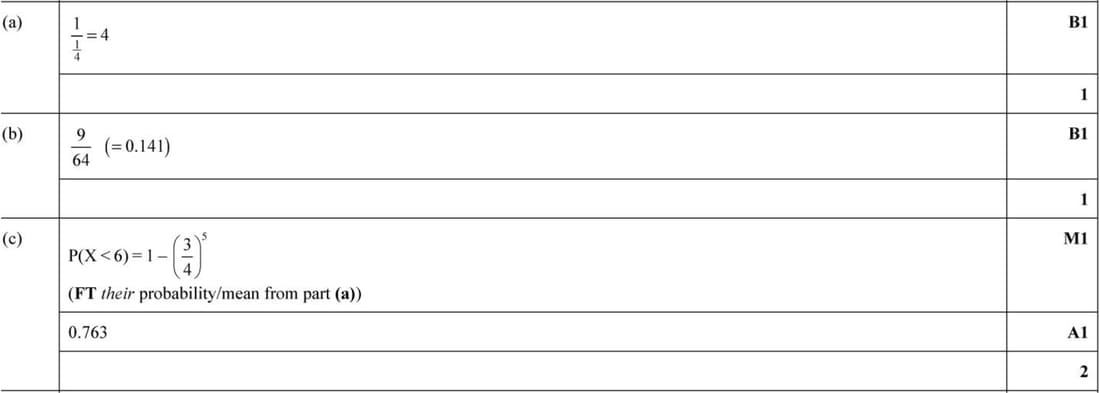
(a) Find the expected value of X. [1]
(b) Find the probability that exactly 3 throws are required to obtain a pair of tails. [1]
(c) Find the probability that fewer than 6 throws are required to obtain a pair of tails. [2]
Nov 2023 p52 q2
George has a fair 5-sided spinner with sides labelled 1, 2, 3, 4, 5. He spins the spinner and notes the number on the side on which the spinner lands.
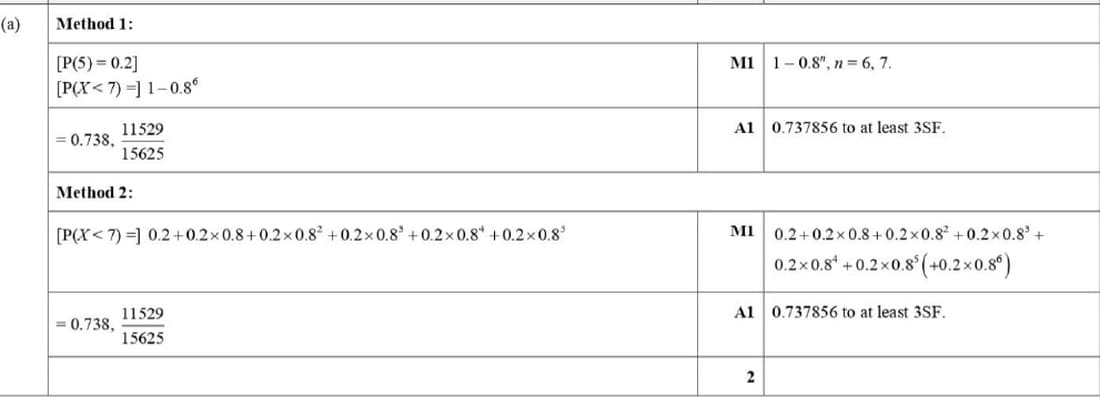
Find the probability that it takes fewer than 7 spins for George to obtain a 5.
June 2020 p51 q1
The score when two fair six-sided dice are thrown is the sum of the two numbers on the upper faces.
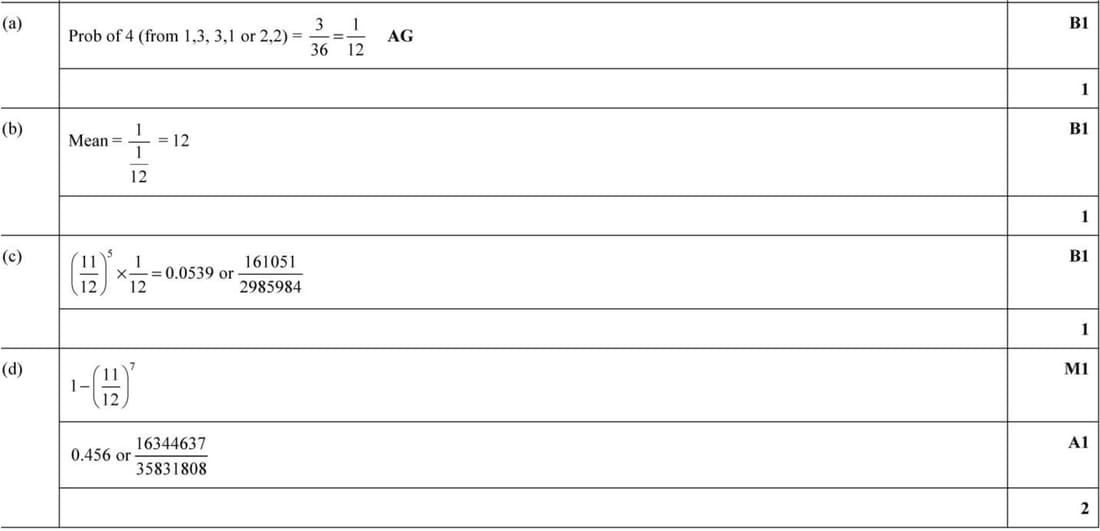
(a) Show that the probability that the score is 4 is \(\frac{1}{12}\).
(b) The two dice are thrown repeatedly until a score of 4 is obtained. The number of throws taken is denoted by the random variable \(X\). Find the mean of \(X\).
(c) Find the probability that a score of 4 is first obtained on the 6th throw.
(d) Find \(P(X < 8)\).
Feb/Mar 2020 p52 q2
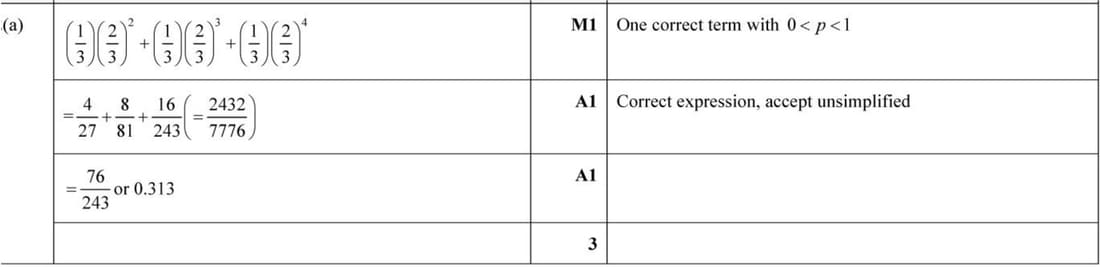
An ordinary fair die is thrown repeatedly until a 1 or a 6 is obtained.
Find the probability that it takes at least 3 throws but no more than 5 throws to obtain a 1 or a 6.
Nov 2023 p51 q5
A red spinner has four sides labelled 1, 2, 3, 4. When the spinner is spun, the score is the number on the side on which it lands. The random variable X denotes this score. The probability distribution table for X is given below.
| x | 1 | 2 | 3 | 4 |
|---|---|---|---|---|
| P(X = x) | 0.28 | p | 2p | 3p |
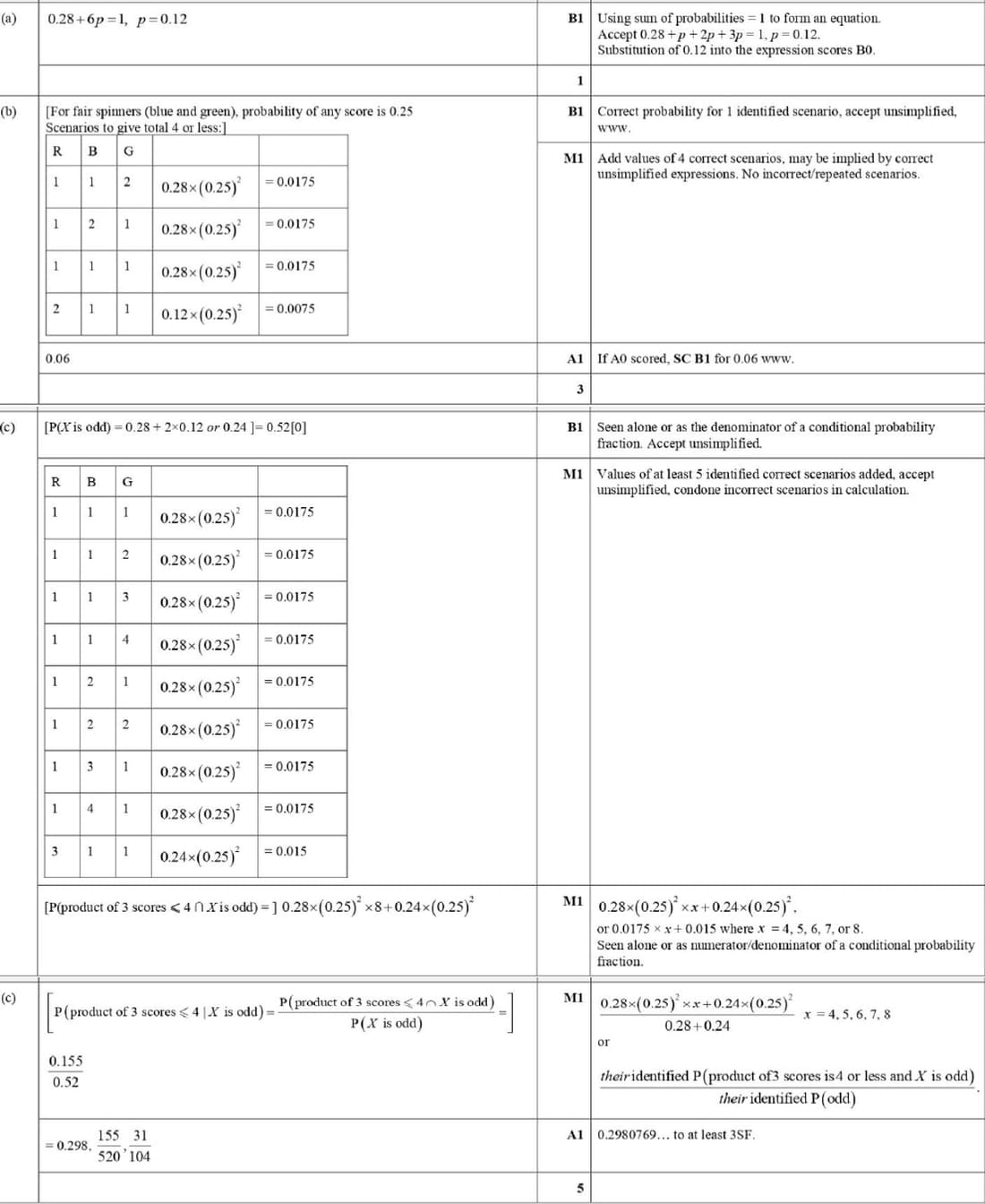
(a) Show that \(p = 0.12\).
A fair blue spinner and a fair green spinner each have four sides labelled 1, 2, 3, 4. All three spinners (red, blue and green) are spun at the same time.
(b) Find the probability that the sum of the three scores is 4 or less.
(c) Find the probability that the product of the three scores is 4 or less given that X is odd.