Exam-Style Problems
⬅ Back to Subchapter
Browsing as Guest. Progress, bookmarks and attempts are disabled.
Log in to track your work.
Nov 2007 p6 q2
2973
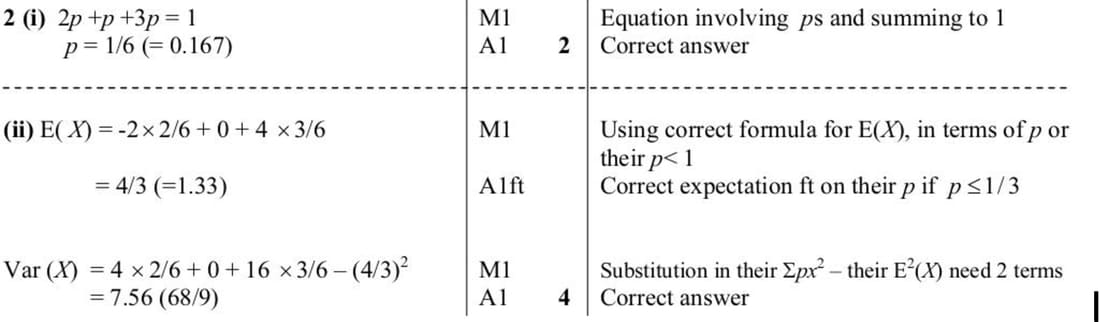
The random variable X takes the values -2, 0 and 4 only. It is given that \(P(X = -2) = 2p\), \(P(X = 0) = p\) and \(P(X = 4) = 3p\).
- Find \(p\).
- Find \(\overline{E}(X)\) and \(\text{Var}(X)\).
Log in to record attempts.
June 2023 p51 q6
2974
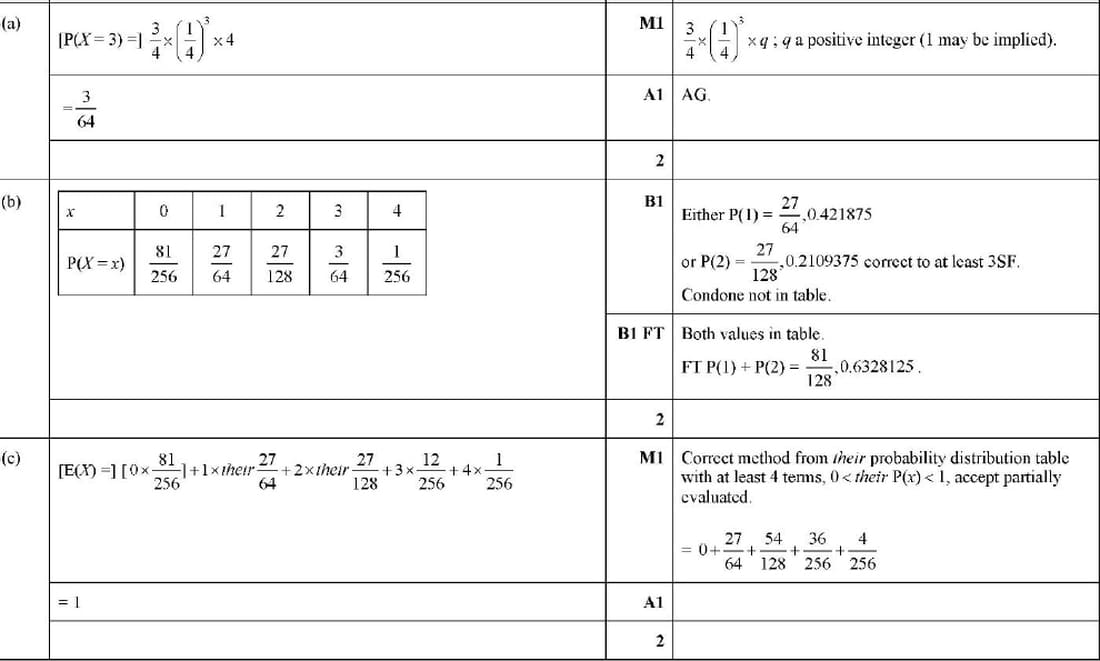
Eli has four fair 4-sided dice with sides labelled 1, 2, 3, 4. He throws all four dice at the same time. The random variable X denotes the number of 2s obtained.
(a) Show that \(P(X = 3) = \frac{3}{64}\).
(b) Complete the following probability distribution table for \(X\).
| x | 0 | 1 | 2 | 3 | 4 |
|---|---|---|---|---|---|
| P(X = x) | \(\frac{81}{256}\) | \(\frac{3}{64}\) | \(\frac{1}{256}\) |
(c) Find \(E(X)\).
Log in to record attempts.
Nov 2006 p6 q2
2975
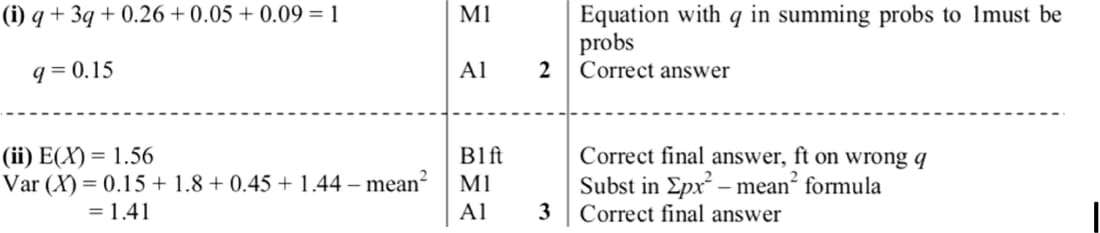
The discrete random variable X has the following probability distribution.
| x | 0 | 1 | 2 | 3 | 4 |
|---|---|---|---|---|---|
| P(X = x) | 0.26 | q | 3q | 0.05 | 0.09 |
- Find the value of q.
- Find E(X) and Var(X).
Log in to record attempts.
Nov 2003 p6 q8
2976
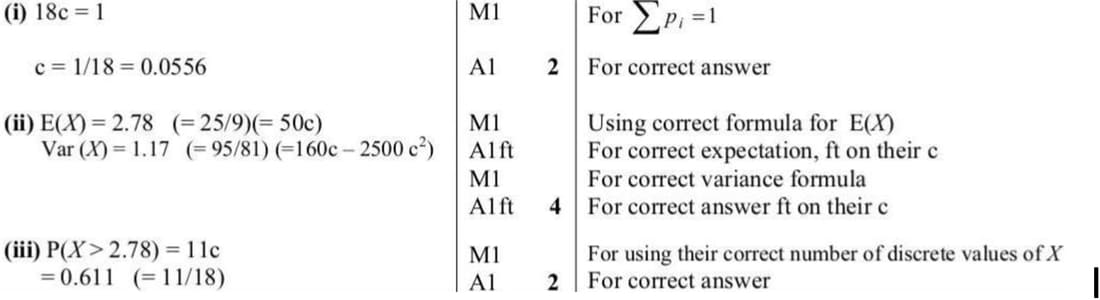
A discrete random variable X has the following probability distribution.
| x | 1 | 2 | 3 | 4 |
|---|---|---|---|---|
| P(X = x) | 3c | 4c | 5c | 6c |
- Find the value of the constant c.
- Find E(X) and Var(X).
- Find P(X > E(X)).
Log in to record attempts.
Nov 2002 p6 q1
2977
The discrete random variable X has the following probability distribution.
| x | 1 | 3 | 5 | 7 |
|---|---|---|---|---|
| P(X = x) | 0.3 | a | b | 0.25 |
- Write down an equation satisfied by a and b.
- Given that \(E(X) = 4\), find a and b.

Log in to record attempts.